Crash Tested Pet Bags: Car Safety Sourcing and Compliance
Crash tested pet bags are evaluated on a dynamic sled test rather than by inspection: the bag is secured to a vehicle seat with a representative test mass inside and subjected to a defined deceleration pulse, typically a 30 mph (48 km/h) frontal change of velocity, with pass criteria covering restraint retention, excursion limits and structural integrity. There is currently no government regulation that mandates crash testing for pet carriers in most markets, which means the buyer - not the regulator - defines the requirement. A defensible programme states the pulse, the mass, the pass criteria and the lab in writing.
Crash testing is the only pet bag claim where a buyer can be exposed for something they did not verify, because the phrase implies a validated result that most products have never been near. The practical position for a wholesale buyer is to treat it as a documented test programme with three decisions: which pulse and speed, which pass criteria, and which laboratory. Our production team supports crash-tested programmes by preparing the restraint geometry, documenting the test setup and supplying the production-lot sample that the lab actually pulls, because a test performed on a hand-built prototype does not describe the shipped product. Qualification sampling runs 6-10 working days before the sample goes to the sled, and the laboratory phase adds its own schedule that must be booked in advance. Bulk production is 35-50 days from approved sample, inspected to AQL 2.5 with restraint anchorage and webbing specification verified on every unit. Standard terms are MOQ 500 pieces per colourway, T/T 30/70 and FOB Xiamen.
Pet bag sample cost is normally credited against the first production order, which makes Material & Technology review the expensive step rather than the sampling itself. Pet carrier sample cost rises with hardware changes, so lock the hardware before the second sample round.
What Crash Tested Actually Means for Pet Bags
In passenger-vehicle safety, a dynamic test accelerates or decelerates a sled carrying a seat, a restraint and a test device, and records what happens. For child restraints the governing regulation is well established; for pet containment there is no equivalent mandate in most jurisdictions, so the term crash tested in this category describes a buyer-defined programme run against adapted criteria rather than a legal standard.
That distinction is the first thing a buyer should communicate internally, because it changes the marketing and the liability position. A product can honestly be described as dynamically tested to a stated pulse with stated criteria disclosed; it should not be described as certified, approved or compliant with a standard that does not govern it. The difference is not pedantry - it is the wording that a claim will be argued over.
The test itself is straightforward to describe. A vehicle seat or a representative seat fixture is mounted on a sled. The bag is installed the way the instructions say it should be installed, using the vehicle belt or a tether as designed. A test mass representing the animal is placed inside. The sled is accelerated to the target speed and then decelerated along a defined pulse, and high-speed video plus instrumentation record the result.
Three criteria determine pass or fail in a well-constructed programme: the restraint system retains the bag, the bag stays within a defined excursion envelope, and the structure stays intact with the closure closed. A fourth, softer criterion - no component becomes a hazard - is worth adding, because a broken frame member inside the bag is a risk to the animal even if containment technically held.
Buyers should also decide in advance whether rear and side impacts are in scope. A frontal-only programme is the industry norm because it is the most common and most severe event for a restrained load, but a programme marketed broadly for car safety is stronger if it documents why frontal was chosen and what the product's behaviour would be in other directions. That sentence belongs in the test request, not in the marketing copy.
Test Pulse, Speed and Pass Criteria Buyers Should Specify
The pulse is the single most important technical decision and the one most buyers leave to the laboratory by default. A frontal impact is typically represented by a change of velocity around 30 mph (48 km/h) with a specified peak acceleration and rise time. Softer pulses with lower peak acceleration are easier to pass and are not comparable to a full-scale frontal crash; a buyer comparing two suppliers' results must confirm both used the same pulse.
The US regulatory baseline for child restraints provides the vocabulary most labs use, and reports frequently reference it even for pet products: the US Consumer Product Safety Commission administers the child restraint and product safety framework, and the automotive performance requirements themselves sit under the Federal Motor Vehicle Safety Standards. The relevant point for a pet bag buyer is that referencing the vocabulary of a standard is not the same as meeting it, and the report should say plainly which criteria were applied.
Test mass matters as much as pulse. A bag marketed for animals up to 10 kg should be tested at or above that mass, with the mass secured inside the way an animal would actually sit. A lighter mass produces better numbers and indefensible marketing.
- State the pulse: target change of velocity, peak acceleration and rise time.
- State the mass: at the top of the marketed weight range.
- State the installation: belt path, tether, and the exact instructions the customer will receive.
- State the criteria: retention, excursion, structural integrity, closure integrity.
Restraint Geometry: How the Bag Is Actually Attached
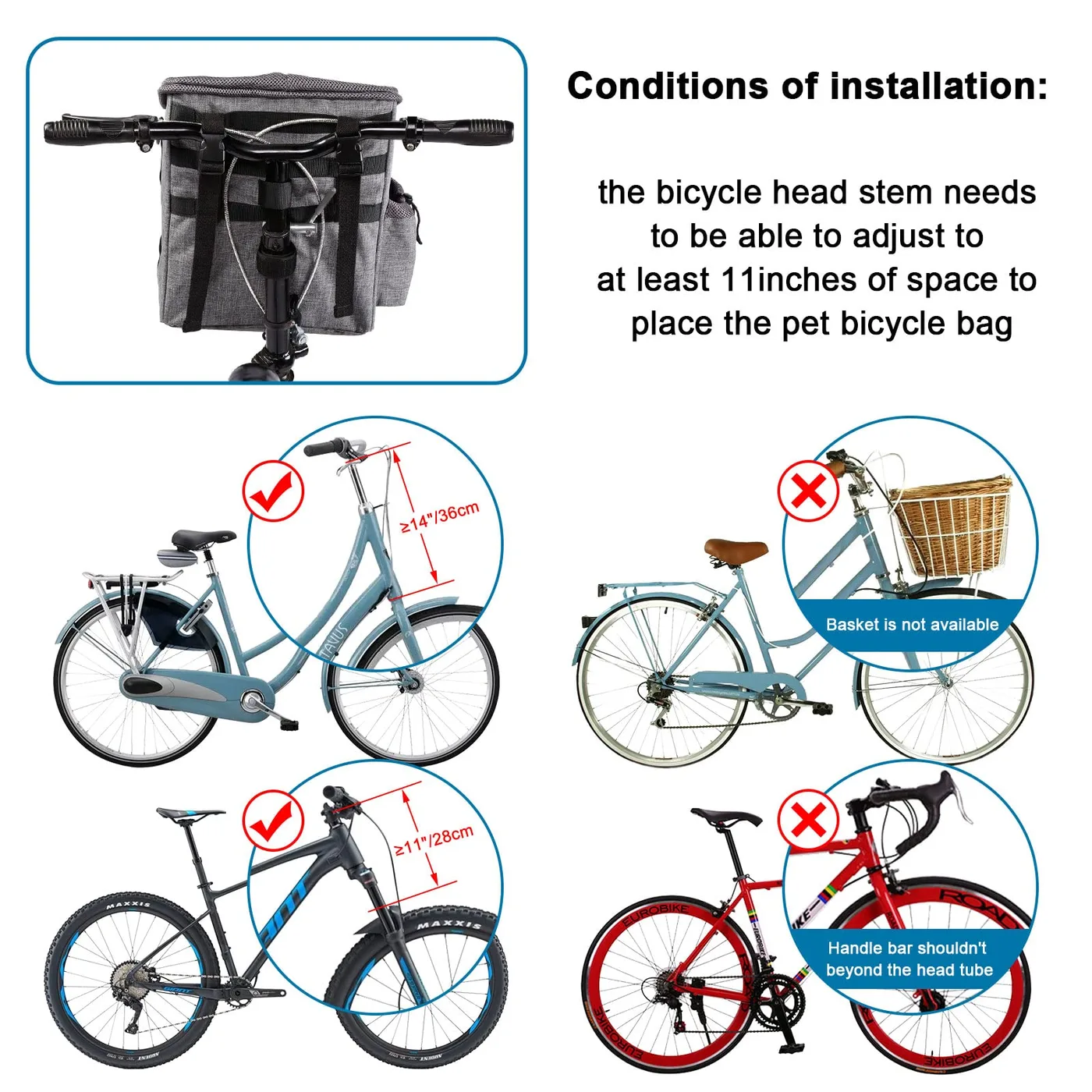
Most crash-test failures are geometry failures, not material failures. A bag with excellent fabric and strong webbing can still fail if the belt path lets the bag rotate, if the tether attaches to a single point, or if the anchor location allows the bag to climb over the seat back. Attachment design is where the engineering value sits.
Three attachment approaches are common. A belt-path design routes the vehicle's lap-and-shoulder belt through sleeves or channels on the bag so the belt itself does the restraining. A tether design uses a short strap from the bag to a vehicle anchor point such as a seat-belt buckle stalk or a cargo anchor. A hybrid uses both, with the belt controlling lateral movement and the tether controlling forward excursion.
Each has a failure signature. Belt-path designs fail when the path is ambiguous, because a customer will route the belt differently from the way it was tested; the fix is a clearly marked, single-route path with a diagram on the product. Tether designs fail when the anchor point is weak or when the tether is too long to limit excursion. Hybrid designs are the most robust and the most expensive, and they are the right answer at the premium end.
Instruction clarity is part of the restraint system. The tested configuration must be the only configuration a customer can reasonably produce, which usually means a labelled belt path, a fixed tether length and a photograph or diagram sewn into or shipped with the product.
Seat compatibility is the constraint that complicates everything else. Seat-belt geometry, buckle stalk position, seat back angle and the presence of side airbags all change how a restraint behaves, and a configuration tested on one seat fixture does not guarantee the same result in every vehicle. The honest approach is to state the fixture used, test on more than one representative seat where the budget allows, and write instructions that tell the customer to install the product in a way that is achievable across common vehicles.
Bench Work Before Booking Sled Time
Sensible programmes do the cheap iteration first. A bench rig with a load cell lets a team compare belt-path routings, tether lengths and anchor positions in a day and narrow the field to two candidates, which turns the sled from an exploration into a confirmation. Our production team treats sled time as the expensive confirmation step rather than the design tool, and buyers who adopt that sequencing typically need fewer runs and reach a defensible result sooner.
Choosing a Laboratory and Reading the Report
Laboratory choice determines whether the report is worth anything. A credible dynamic test facility operates a sled or an equivalent deceleration device, instruments the test with calibrated accelerometers and high-speed video, and issues a report that states the setup, the instrumentation, the pulse achieved and the criteria applied. A facility that cannot state the pulse it achieved is not producing comparable data.
The report should contain seven items: the date and facility, the seat or fixture description, the installation method with photographs, the test mass and its placement, the target and achieved pulse, the pass criteria as written before the test, and the results with video references. A report missing the achieved pulse or the pre-written criteria cannot be defended later.
Sample provenance is the item buyers most often get wrong. The tested unit must come from the production process, not from a hand-built prototype, and the report should identify it as such. Our production team supplies sled samples from the same tooling and the same material lots as bulk, and recommends testing more than one unit so a single favourable result cannot be mistaken for typical performance.
Independent testing organisations publish their own protocols for pet containment, and buyers should be aware of them before writing their own: the Center for Pet Safety publishes its own test protocol and certification programme, which is the most widely recognised third-party benchmark in this category and a sensible reference point even for buyers running their own sled programme. Buyers should decide early whether to pursue a published third-party programme or to run their own documented sled test, because the two produce different marketing rights and different costs, and switching between them mid-programme wastes both.
How Many Units Should Be Tested
One unit is the minimum that produces a report and three is the number that produces a defensible claim, because a single favourable result says nothing about consistency. A sensible structure is one unit for development, then two or three production-representative units for the reportable test, all from different production positions rather than consecutive pieces. Video matters as much as the numbers here: reviewers understand the result far faster from footage than from a table of accelerations.
Documentation, Claims and Liability Exposure
The commercial risk in this category is not a failed test; it is a claim written before a test existed. Marketing copy, packaging and marketplace listings are where exposure is created, and the wording should be set by someone who has read the test report. Four words cause most of the trouble: certified, approved, compliant and crash proof. Each implies an external authority that, for pet containment in most markets, does not exist.
The defensible wording pattern is specific: dynamically tested at a stated facility, to a stated change of velocity, with a stated test mass, against stated criteria, with the report available on request. That sentence is longer than a marketing team would like and it is the version that survives review.
Documentation should be assembled as a folder, not scattered across emails: the report, the video references, the sample provenance statement, the installation instructions as shipped, and the internal claim-approval record showing who signed off on the wording. When a question arrives, the folder answers it in an afternoon.
| Claim wording | Defensible? | What is required to support it |
|---|---|---|
| Crash tested | Yes, if qualified | Report with pulse, mass, criteria and lab named |
| Crash certified | No | Implies a certifying authority that does not exist for pet carriers |
| Meets FMVSS 213 | No, for pet products | That standard governs child restraints, not pet containment |
| Dynamically tested at 48 km/h | Yes | Report showing achieved pulse and pass criteria |
| Crash proof | No | Absolute claim with no supporting method |
Retailers and marketplaces increasingly ask for this folder at line review, and having it shortens onboarding. Not having it usually means the claim is removed from the listing at the last minute, which is the worst commercial outcome available.
Cost Structure: What a Crash-Tested Programme Actually Costs
The cost of a crash-tested programme has three components and buyers usually budget for only the first. The direct test cost is the sled time and the report, which is meaningful but finite and should be amortised across the programme's expected volume. The engineering cost is the design iteration needed to pass, because a first attempt frequently fails on geometry rather than on material, and each iteration costs another sled run. The product cost is the reinforcement, webbing and hardware needed to survive the pulse.
Design iteration is the component that surprises buyers. A programme that budgets one sled run and needs three will either overspend or ship an untested revision. The practical mitigation is to do the geometry work first: belt-path routing, anchor points and tether length can be evaluated and revised on the bench before any sled time is booked.
Product cost is usually the smallest of the three in absolute terms, but it is the one that recurs on every unit. Reinforced anchorages, higher-specification webbing and rated hardware typically add a modest amount per unit, and they are also the components most worth verifying at inspection, because an unrated buckle substituted late is invisible on the finished product.
Volume determines whether the programme makes sense at all. Amortised over a small trial quantity, sled testing dominates the unit cost; amortised across a realistic annual programme it becomes a small line. This is why crash-tested programmes are quoted against stable annual volumes rather than against one-off orders, and why the MOQ 500 pieces per colourway structure matters here more than in most categories. A tested programme also carries a recurrence cost: re-testing after a component change, and periodic re-testing to demonstrate that the shipped product still matches the one that was tested. Both should appear in the annual budget rather than as surprises, and both are cheaper than the alternative, which is discovering a drift after a claim has already been made and the file no longer matches the product on the shelf.
Related Regimes: Airlines, Road Safety and Product Safety
Car safety is one of several regimes that touch pet containment, and buyers often need documentation for more than one. Air carriage is governed by airline-specific rules shaped by the Live Animals Regulations maintained by IATA, with public-facing guidance from the FAA for travellers flying with pets. Those rules address ventilation, containment and kennel construction rather than crash performance, so a crash-tested bag is not automatically an airline-compliant one.
General product safety regimes apply to the product as an article placed on the market, including components, finishes and mechanical hazards. In the US that framework is administered by the Consumer Product Safety Commission; in the EU, chemical documentation sits under REACH as administered by ECHA. A crash programme does not replace either.
Veterinary guidance frames the welfare side of road travel and is worth citing in instructions: the American Veterinary Medical Association publishes animal transport guidance that supports restraint during vehicle travel as a welfare measure. Including a welfare rationale in the instruction card improves compliance by customers, which in turn reduces the gap between tested configuration and real-world use. Because a restraint only performs as installed, instructions are a safety document and should be version-controlled alongside the technical file, with any revision triggering a check that the tested configuration is still the one being described.
Inspection and Production Control for Restraint Components
Crash performance is a property of the assembled product, so production control matters more here than in most categories. The components that carry the load - webbing, buckles, anchor stitching, belt-path channels and tether attachment - must be identical to the tested configuration on every unit, and that requires verification rather than trust.
- Component identity: record webbing specification, hardware part numbers and supplier for the tested configuration, and verify against bulk.
- Stitch specification: anchor stitching pattern, thread and stitch count must match the tested sample.
- Pull testing: a defined sample from each production batch pull-tested to a stated force at the anchorages.
- Instruction set: the shipped instructions must match the tested installation, verified at inspection rather than assumed.
- Change control: any component substitution triggers a documented review and, where load-bearing, a re-test.
At goods-in, restraint-related defects are critical. Wrong webbing, unrated hardware, missing reinforcement at an anchor or incomplete belt-path channels each remove the tested property entirely. Our production team inspects to AQL 2.5 with these classified as critical and with anchorage pull testing performed per batch rather than per shipment.
Building the Programme: A Practical Sequence
The sequence that works starts with the claim and works backwards. Decide what the product will be marketed as, derive the test criteria from that claim, design the restraint geometry to meet those criteria on the bench, book the sled, test production-representative units, then write the marketing to match the report. Programmes that start with the product and add the claim at the end are the ones that end up with indefensible wording.
Common Mistakes That Invalidate a Test Programme
Four mistakes account for most invalid programmes. Testing a prototype and selling a revised product; changing webbing or hardware after the test without review; writing marketing before the report exists; and letting the instructions drift away from the tested installation. Each is avoidable with a simple rule - the tested configuration is the sold configuration, and anything that changes it is documented before it ships.
Timing
Qualification sampling runs 6-10 working days before the sled, and laboratory scheduling is a separate critical path item that should be booked when the brief is finalised rather than when the sample is ready. Bulk production is 35-50 days from approved sample, with the approved sample being the tested configuration rather than a later revision.
Commercial Terms
Standard terms are MOQ 500 pieces per colourway, T/T 30/70 and FOB Xiamen. Because crash programmes depend on stable component sourcing, buyers should confirm that webbing and hardware part numbers are locked for the programme year, and that any substitution triggers review before it reaches the line.
What to Ask a Supplier Before Committing
Ask whether the tested unit came from production tooling, whether the achieved pulse is stated, whether the pass criteria were written before the test, and whether load-bearing components are locked by part number. Four clean answers indicate a supplier who has supported a tested programme before; four vague ones indicate a supplier who will learn on your budget. Ask one further question - what happens if a load-bearing component is discontinued - because the answer reveals whether change control exists at all. A supplier who treats a discontinued buckle as a routine substitution will eventually ship an untested product without noticing.
Production capability
- SGS-verified production space of 4,950 m², 149 machines, 7 assembly lines
- Pet bag output since 2014 from a 137-person team
- 200,000 units shipped monthly under BSCI and ISO 9001 systems
People Also Ask
Are pet bags required to be crash tested by law?
In most markets, no. There is no government regulation mandating dynamic crash testing for pet containment, so the requirement is buyer-defined. That makes the written criteria, the pulse and the laboratory choice the buyer's responsibility rather than the regulator's.
What speed is a pet carrier crash test run at?
A frontal test is typically represented by a change of velocity around 30 mph or 48 km/h with a defined peak acceleration and rise time. Because softer pulses are easier to pass, two results are only comparable if both state the achieved pulse.
Can a pet bag be called crash certified?
No. Certification implies a certifying authority, and none governs pet containment in most markets. The defensible wording is dynamically tested at a named facility, to a stated change of velocity, with a stated test mass and stated criteria.
Does a crash-tested bag meet FMVSS 213?
No. FMVSS 213 governs child restraint systems and does not apply to pet containment. A pet programme may borrow the vocabulary and the general test approach, but the report should say plainly which criteria were used.
What makes a pet bag fail a dynamic test?
Mostly geometry rather than material: an ambiguous belt path that lets the bag rotate, a single-point tether, or an anchor location that allows the bag to climb. Bench work on the attachment design is cheaper than repeated sled runs.
Should the tested unit come from production?
Yes. A hand-built prototype does not describe the shipped product. Test more than one unit from the same tooling and material lots as bulk, and have the report identify them as production-representative.
How much does crash testing add to a programme?
Three components: sled time and reporting, design iteration because first attempts often fail on geometry, and the recurring product cost of reinforced anchorages and rated hardware. Amortised across a realistic annual volume the test cost becomes a small line per unit.
Frequently Asked Questions
What is a sled test?
A sled carries a vehicle seat or fixture with the bag installed and a test mass inside, then decelerates along a defined pulse while instrumentation and high-speed video record the result. It is the standard way to evaluate restraint performance without destroying a vehicle.
What pass criteria should I write?
Retention of the bag by the restraint system, excursion within a defined envelope, structural integrity including the closure staying closed, and no component becoming a hazard. Writing these before the test is what makes the result meaningful.
How should the test mass be chosen?
At or above the top of the marketed animal weight range, positioned the way an animal would actually sit. A lighter mass produces better numbers and indefensible marketing.
What is the most common cause of failure?
Geometry. Ambiguous belt paths, single-point tethers and poorly placed anchors cause most failures, and all three can be identified and corrected on the bench before any sled time is booked.
Do I need both a belt path and a tether?
A hybrid is the most robust approach: the belt controls lateral movement and the tether controls forward excursion. It costs more and is the right answer at the premium end of a programme.
How should the installation instructions be handled?
The tested configuration must be the only configuration a customer can reasonably produce, and the instruction sheet should state the tested installation in one sentence before any diagram, so a customer who reads nothing else reads that. Use a single clearly marked belt route, a fixed tether length and a diagram shipped with the product. Instructions should be verified at inspection.
What should the test report contain?
Date and facility, seat or fixture description, installation method with photographs, test mass and placement, target and achieved pulse, the pass criteria as written before the test, and results with video references.
Is airline approval the same as crash testing?
No. Air carriage rules address ventilation, containment and kennel construction under the Live Animals Regulations, while crash testing addresses restraint performance in a vehicle deceleration. A crash-tested bag is not automatically airline compliant.
Which components need to be locked by part number?
Webbing, buckles and hardware, anchor stitching specification, belt-path channel construction and tether attachment. Any substitution of a load-bearing component should trigger documented review and, where relevant, a re-test.
How often should anchorages be pull-tested?
Per production batch rather than per shipment, to a stated force, with the results recorded. Anchor stitching and webbing are the components most likely to drift from the tested configuration without being visible on the finished product.
Can a tested design be changed later?
Not silently. Any change to restraint geometry, webbing, hardware or stitching pattern changes the tested property and should trigger a documented review. Cosmetic changes away from the load path can usually be logged without re-testing.
How long does a crash programme take end to end?
Qualification sampling runs 6-10 working days before the sled, laboratory scheduling is a separate item that should be booked when the brief is finalised, and bulk production takes 35-50 days from approval of the tested configuration.
Talk to QUANZHOU JUNYUAN BAGS about a wholesale pet bag order: MOQ 500 pieces per colourway, samples in 6-10 working days, bulk production in 35-50 days under AQL 2.5 inspection.
Get a free quote Request a sample