Pet Bag Hang Tag: Product Tag Specs, Cost and Lead Time
A pet bag hang tag is a printed card attached at the point of sale that carries the brand mark, the size and colour reference, the retail barcode, the country of origin, the material content, the care instructions and any required safety statement. Budget USD 0.06 to 0.55 per tag at 500 to 5,000 pieces depending on stock weight, finish and colour count, and freeze the artwork before bulk cutting begins.
A hang tag is the smallest line item on a pet bag program and one of the most expensive to correct, because it is the last component to be approved and the first thing a retailer's receiving team checks. Our production team runs wholesale pet bag programs at MOQ 500 pieces per colourway, with samples in 6-10 working days and bulk production in 35-50 days after approval, inspected to AQL 2.5 before release. Tag artwork is normally confirmed inside the sampling window so that the print run can start while the bag shells are being cut. Four decisions drive the whole line item: the stock and finish, which set unit cost; the attachment method, which sets packing labour; the mandatory content, which sets compliance risk; and the barcode, which sets whether the carton passes receiving. Buyers who treat the tag as artwork get a nice card; buyers who treat it as a specification get a card that scans, survives transport and clears the retailer's intake checklist on the first delivery.
Wholesale nylon pet carrier and wholesale polyester pet carrier lines differ mainly in abrasion behaviour, which Market & Business Strategy should record as a cycle count instead of a fabric name. Wholesale eco friendly pet carrier programmes add a certificate cost that is small per unit but fixed per colourway.
What a Hang Tag Has to Do on a Wholesale Pet Bag
A hang tag on a consumer product is marketing. A hang tag on a wholesale pet bag is a data carrier, and every element on it has a downstream user who will read it mechanically. The retailer's receiving team reads the barcode, the merchandising system reads the style and colour code, the customs file reads the origin, and the customer reads the care line. Losing any one of those creates a cost somewhere else in the chain.
The first job is identification. A pet bag range with three sizes and four colourways produces twelve sellable units, and each one needs a unique retail identifier. Without it, the retailer's system cannot distinguish a medium charcoal from a medium sand, and the consequence is a receiving exception rather than a sale.
The second job is compliance. Country of origin, material content and the applicable safety statement are required markings in most markets, and the tag is where they live because the bag itself offers no flat printable panel of adequate size. A tag missing an origin marking is a customs problem, not a cosmetic one.
The third job is instruction. How to install the liner, how to wash the shell, how to secure the bag in a vehicle, and the weight range the product is intended for are all questions a customer has after purchase. Putting them on the tag removes them from the returns queue.
The fourth job is brand. This is the one every buyer remembers and the one that should be settled last, because a beautiful tag that fails receiving blocks the shipment regardless of how it looks.
The practical consequence for a procurement team is sequencing. Decide the data first, lay the compliance block second, and fit the brand expression into whatever space remains. Reversing that order is the single most common cause of a tag reprint.
A reprint is not cheap in context. Tag artwork, plates and print run typically cost USD 180 to 900 for a mid-size order, but the delay lands against a container booking, and a missed booking costs far more than the tag. Treat the tag as a critical path item with its own deadline.
The final point is who owns the content. Assigning the data block, the compliance block and the brand block to three named owners, with one consolidation date, prevents the late discovery that two of them were written to different size scales.
Stock, Weight and Finish: Choosing the Cost Tier
Hang tag stock is specified by grammage and by finish, and the two together determine both the hand feel and the unit cost. Coated art paper in the 250 to 350 gsm range is the default for a mid-market pet bag, and it prints cleanly at a modest price. Below 250 gsm the tag curls and looks cheap; above 400 gsm the cost rises without a visible benefit on a hanging product.
Uncoated kraft and recycled board are the sustainability-led choices. They cost a similar amount to coated art paper, they accept soy and water-based inks well, and they signal a material position to a retail buyer without changing the bag itself. The trade-off is colour fidelity: a photographic image on uncoated board loses saturation and detail.
Plastic and synthetic stocks suit a specific use case. A pet bag sold into a wet or outdoor channel benefits from a tag that does not disintegrate on a damp shelf, and a tear-resistant synthetic stock solves that at roughly two to three times the paper cost. It is a narrow but real category.
Finish is where unit cost moves most. A matt or gloss lamination adds a small amount and improves scuff resistance in transit. Spot UV, foil stamping and embossing each add a setup charge plus a per-unit increment, and they are the finishes that push a tag from cents into the upper part of the range.
The decision rule is simple and worth stating plainly: spend on finish only where the retail channel rewards it. A specialty pet chain with shelf lighting and a premium planogram pays back a foil-stamped tag; a marketplace fulfilment programme never sees the tag in a retail context and should not fund it.
Testing standards exist for the print side of this decision. Colour fastness and rub resistance on printed board are covered by test methods published by bodies such as ASTM International, and a buyer specifying a dark solid ink area on a laminated tag should ask for a rub test rather than assuming the lamination solves it.
Environmental substance requirements apply to the tag as well as to the bag. Paper and board sold into the European market commonly carry restrictions under the framework administered by ECHA, and an FSC or recycled-content claim on the tag must be supported by chain-of-custody documentation held by the printer.
The practical specification is therefore a short written line: stock type, grammage, finish, ink type and any certification claim, with the documentation owner named. That single line prevents most tag disputes.
Structural Specification: Size, Hole, String and Attachment
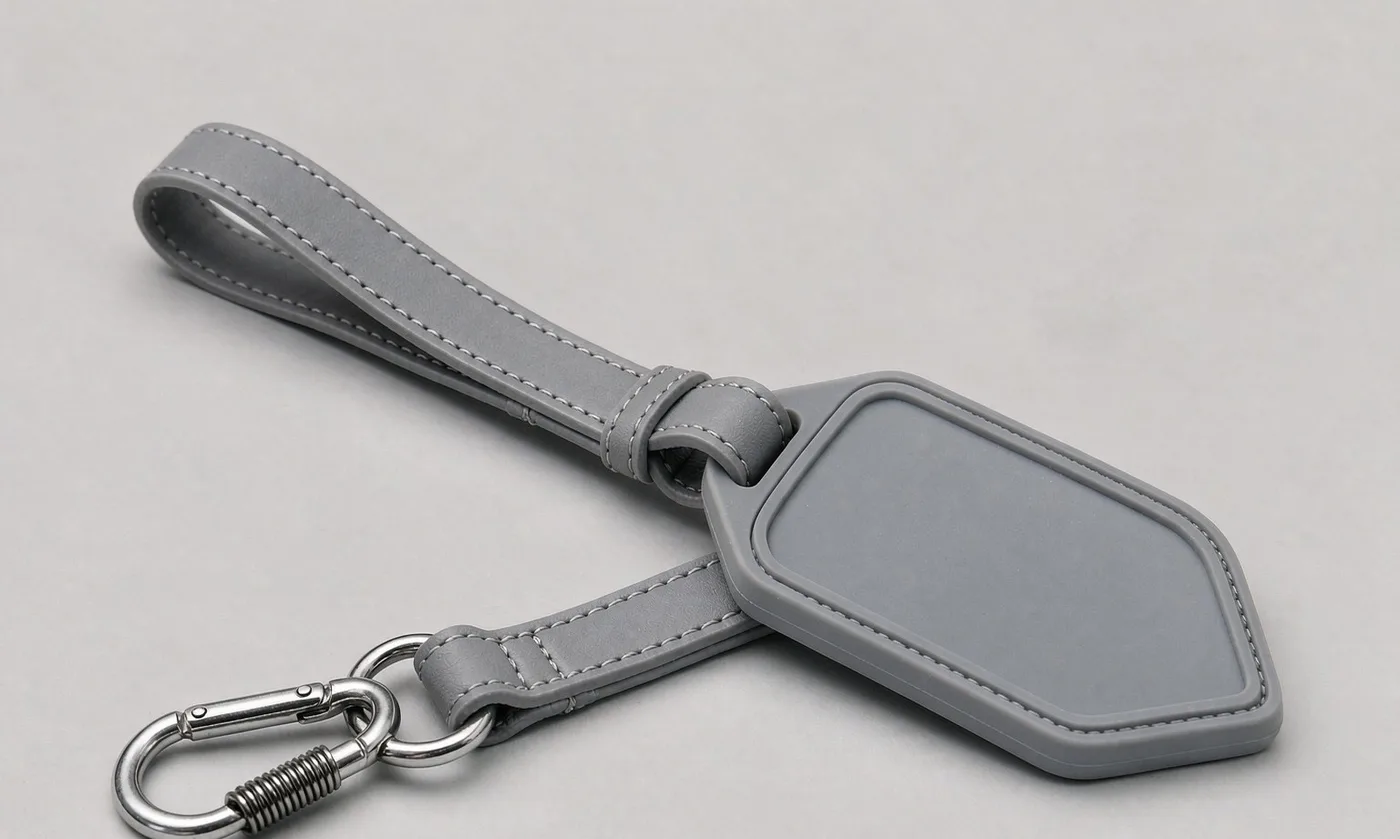
Size is constrained by two things: the legal text that must fit and the shelf presence the channel expects. A tag carrying a two-language care block, a material declaration and a barcode rarely works below 90 by 50 mm, and a single-language tag can go smaller. Going below the practical minimum forces a type size that fails legibility.
The hole and the eyelet are the most frequently under-specified elements. A plain die-cut hole tears out under the weight of a heavy bag on a rail, while a reinforced metal eyelet survives it. The eyelet adds cents per unit and is worth specifying for any bag over roughly 1.5 kg.
String, cord or plastic fastener is the attachment decision. A cotton or polyester cord suits a premium presentation and costs more to apply; a plastic barb fastener is fast, cheap and secure, and is the default for high-volume programmes. The choice is driven as much by packing labour as by material cost.
Attachment point matters for damage in transit. A tag threaded through a webbing loop or a zip pull survives handling; a tag pinned through mesh does not, because the mesh tears under the leverage of the tag. Specifying the attachment point on the tech pack, rather than leaving it to the packing line, prevents a recurring damage finding at inspection.
Tag placement also affects the retail scan. A tag folded over the barcode, or a cord crossing the symbol, is a common cause of a scan failure at the till. The quiet zone around the barcode must stay clear of both the cord and the eyelet.
Packing labour is the hidden cost line. Applying a tag with a barb fastener takes seconds; tying a cord and threading an eyelet takes longer and is more variable between operators. At 5,000 pieces the difference is measurable and should be quoted as a packing operation rather than absorbed silently.
For a bag that ships flat-packed, the tag needs a defined resting position so it does not crease inside the carton. A creased tag is a presentation defect that a retailer will reject on intake even though the bag is perfect.
The specification should therefore include a placement photograph or a marked drawing, not just a dimension. Photographic placement evidence is the cheapest way to stop interpretation drift between the sampling run and the bulk run.
Print Method, Colour Count and Artwork Control
Print method for hang tags is driven by quantity and by colour count. Offset lithography is the standard for runs above roughly 2,000 pieces: plate cost is amortised, colour fidelity is high and Pantone matching is reliable. Digital printing suits short runs and multi-version artwork, with no plate cost and a slightly narrower colour gamut.
Colour count is the direct cost lever in offset. Each additional spot colour is a plate and a pass, and moving from a two-colour tag to a four-colour photographic tag typically raises unit cost by a meaningful margin at 1,000 pieces and by less at 10,000. Buyers should decide colour count against the actual run size.
Pantone versus CMYK is the decision that causes the most rework. A brand mark in a defined Pantone should be printed as a spot colour and proofed against a physical swatch; converting it to CMYK is where the argument about shade starts. Insist on a printed proof on the actual stock, not a PDF on screen.
Variable data is the structural fork in the specification. If every tag in a range shares artwork except for the style and colour code, the code can be overprinted digitally or applied as a label. If each unit needs a unique serial, the tag moves to digital or gains a label step, and the cost model changes.
| Variable | Typical range for pet bag tags | Cost effect | Buyer note |
|---|---|---|---|
| Stock weight | 250-400 gsm | Low | Below 250 gsm curls on the rail |
| Standard size | 90 x 50 mm to 120 x 70 mm | Low | Driven by legal text volume |
| Print method | Offset above 2,000; digital below | Plate amortisation | Multi-version art favours digital |
| Colour count | 2 spot colours to full CMYK | Medium to high | Pantone spot beats CMYK conversion |
| Finish | Matt lamination to foil and emboss | Medium to high | Spend only where the channel rewards it |
| Eyelet | Plain hole to metal eyelet | Low per unit | Specify for bags over about 1.5 kg |
| Attachment | Barb fastener to tied cord | Labour-driven | Quote packing time separately |
| Variable data | None to full serialisation | High if serialised | Serialisation needs a database |
Proofing discipline is where programmes are won. A physical proof on the final stock, checked against the Pantone swatch and against the barcode verification report, costs little and prevents the reprint that costs the booking. Approve the proof, then freeze the file.
Version naming closes the loop. A tag file should carry a version number and a date in the artwork itself, outside the trim, so that a printed tag found in a warehouse six months later can be traced to its approval. That single habit resolves most disputes about which artwork was actually shipped.
Our production team issues tag artwork as part of the sample package, so the proof travels with the physical sample rather than arriving separately. That alignment is deliberate: the tag is approved against the bag it will hang on, not against a screen.

Mandatory Content: Origin, Material, Care and Warnings
The compliance block on a pet bag tag is short but unforgiving. Country of origin must be stated in a form the destination market accepts, and it must match the origin stated on the carton and on the commercial documents. A mismatch between tag and invoice is a customs finding rather than a printing error.
Material content should be stated by component rather than as a single claim. A pet bag is an assembly: a shell, a lining, a foam or padding element, webbing, mesh and hardware. A declaration that names each material and its proportion, at least approximately, answers both a retailer questionnaire and a customs enquiry.
Care instructions belong on the tag because they are read after purchase. For a pet bag the practical content is cleaning method, drying method, and any instruction not to machine wash a structured or padded component. Care symbols are compact and work across languages, which is why they are preferred where the tag serves several markets.
Safety content depends on the product and the market. A bag intended for in-vehicle use carries a securing instruction; a bag intended for air travel carries a statement about the applicable airline rules, and buyers should reference the published guidance from the FAA rather than writing their own summary. A bag with a removable battery-powered accessory carries electrical marking content.
Chemical substance declarations are increasingly requested. Where a buyer sells into California, the warning framework administered by OEHHA may apply to the tag content as well as to the bag. Where the destination is the European market, substance restrictions sit under the REACH framework already noted, and the printer must be able to evidence ink compliance.
Textile claims carry their own evidence burden. A claim of recycled content, organic fibre or a certified dye process should be supported by a certificate from the printer's supply chain, and the most widely used framework for textile substance testing is administered by OEKO-TEX. A claim on a tag without a certificate behind it is a liability, not a benefit.
Language count is a layout decision with a cost consequence. Two languages fit a standard tag; four require a folded or double-sided format. Deciding the language set at the point of artwork, rather than adding a market later, avoids the reprint that follows.
The discipline here is a content matrix: one row per market, one column per required element, with the source document named for each. It is a spreadsheet, not a project, and it prevents the majority of tag compliance findings.
Barcode, QR and Serialisation on the Tag
The retail barcode is the element that determines whether the shipment passes receiving, and it is the element most often damaged by design decisions made for other reasons. A linear barcode on a tag needs a defined symbol, a defined magnification, a quiet zone, and a location that nothing crosses. Any one of those being wrong turns a saleable carton into an exception.
Symbol choice depends on the retail system. UPC-A is the North American retail standard; EAN-13 is the European equivalent and is the safer default for a multi-market programme because it is readable by UPC systems with appropriate configuration. Buyers should confirm the symbol with the retailer rather than assume.
Number allocation is the buyer's responsibility. A GTIN must be obtained through the relevant numbering organisation and registered against the specific style, size and colour combination. A supplier can print the number but should not invent it, and a reused or duplicated number is a serious commercial problem.
Print quality verification is a measurable step. Barcode verification to a defined grade, carried out on the printed tag under defined lighting, is a standard service from inspection bodies such as SGS and costs very little against the cost of a rejected delivery. Ask for the grade report, not just a visual check.
A QR code can sit alongside the barcode but must not compete with it. The barcode is the scanning key and stays at retail scale; the QR carries customer-facing content and should be placed away from the linear symbol so that neither quiet zone is invaded. Both symbols on one small tag is a layout exercise that needs proofing on the real stock.
Serialisation is a separate decision with real infrastructure attached. A unique code per unit supports authentication and channel control, and it requires variable data printing plus a database. For most wholesale pet bag programmes the cost is not justified unless diversion is an observed problem.
Placement relative to the eyelet is the practical failure point. A barcode printed too close to the hole is partially destroyed by the punch, and the error is invisible on the artwork file. Specify a minimum distance from hole to symbol and verify on the printed proof.
The closing rule is that the tag is approved only with a verified barcode. A tag with unverified symbol is an open risk sitting in a closed carton.
Retailer and Marketplace Requirements for the Tag
Specialty pet chains impose tag requirements that go beyond the legal minimum, and they are applied at intake rather than at negotiation. A typical intake checklist covers the barcode scannability, the origin marking, the style and colour code in the retailer's own format, a price field where the channel requires it, and a security or tagging requirement where the chain uses one.
The retailer's style code format is the item most often missed. A chain may require its own article number printed on the tag in addition to the brand's reference, and the number is issued after range confirmation. Leaving space for it in the artwork is a layout decision that must be made early.
Security tagging is a physical requirement, not a print one. Where a chain applies its own electronic article surveillance label, the tag needs a location that does not conflict with it, and the bag needs a surface that accepts it. Confirming this before artwork avoids a rework at the distribution centre at the brand's cost.
Marketplace channels are looser on the tag and stricter on the listing. For a fulfilment programme the tag is not scanned at a till, so barcode verification matters less, but the product identifier must match the listing exactly. A mismatch between the printed GTIN and the listing GTIN causes a listing suspension.
Own-brand programmes add a layer. Where the bag is sold under the retailer's own brand, the retailer typically supplies the tag artwork or a mandatory template, and the brand's role reduces to supplying the data block. Buyers should establish who owns the artwork and who pays for the plate at the outset.
Compliance documentation follows the tag. A retailer's onboarding pack will ask for the origin evidence, the material declaration and the substance test reports referenced on the tag, and those documents should be collated before the first delivery rather than requested after it.
Multi-market programmes should resist the temptation to print one global tag. The origin marking, the language set and the warning content all differ by market, and a single tag that satisfies nobody is worse than two tags that each satisfy their market. Market-specific artwork is cheap; a customs hold is not.
The practical step is to obtain the retailer's packaging and tagging specification during range confirmation. It is a boring document and it prevents most intake failures.
Costing, MOQ, Timing and the Order Checklist
Tag cost has three components: the print run, the finishing, and the application labour. The print run is a function of quantity, colour count and method; the finishing is a function of laminate and special effects; the application is a packing-line operation that should be quoted as such. Quoting all three separately makes the line item negotiable.
Quantity economics are straightforward. Plate and setup charges are fixed, so unit cost falls sharply between 500 and 2,000 pieces and then flattens. A buyer ordering 500 tags pays a disproportionate share of setup, which is one reason a first season should not over-variate the colourway count.
MOQ alignment is the practical constraint. Bag programmes run at MOQ 500 pieces per colourway, and tag printers commonly work to a similar or lower threshold. Where a colourway needs only a small tag quantity, digital printing removes the plate cost and makes the short run economical.
Timing is where programmes fail. Tag artwork approval should close inside the sampling window, so that the print run proceeds in parallel with bulk cutting. Samples are produced in 6-10 working days and bulk runs in 35-50 days after approval, and a tag approved after bulk has started risks landing after the packing date.
Inspection to AQL 2.5 covers the tag as part of the finished article: print quality, attachment security, placement, barcode readability and the absence of creasing. A tag defect is a presentation defect, and presentation defects are disproportionately represented in retailer rejections relative to their cost.
The reorder pattern deserves planning. A second season reuses the plate where the artwork is unchanged, which removes setup cost; a changed origin marking or a changed retailer code forces a new plate. Buyers should hold the tag tooling and artwork on file with a named custodian.
A short order checklist prevents most problems: stock and grammage, size, hole and eyelet, attachment method, print method and colours, finish, the compliance matrix per market, the barcode symbol and verification grade, and the physical proof approval date. Nine items, one page.
Programmes that want a second pair of eyes on the compliance block can route the file through the same inspection partner used for the bag. Our production team coordinates that with the buyer's nominated inspector so the tag and the article are verified together rather than in separate cycles.
Production capability
- SGS-verified production space of 4,950 m², 149 machines, 7 assembly lines
- Pet bag output since 2014 from a 137-person team
- 200,000 units shipped monthly under BSCI and ISO 9001 systems
People Also Ask
What is a hang tag on a pet bag?
A printed card attached at the point of sale carrying the brand mark, style and colour code, retail barcode, origin, material content, care instructions and required safety statements.
Why do retailers reject pet bag shipments over tags?
Mostly unreadable barcodes, missing origin marking, missing retailer article number, or a creased and poorly attached tag at intake.
How do I stop a hang tag from tearing off?
Specify a reinforced eyelet for heavier bags, choose an attachment point on webbing rather than mesh, and avoid threading through a zip pull that levers.
What stock weight is best for a hang tag?
Coated art paper at 250 to 350 gsm is the mid-market default. Below 250 gsm the tag curls; above 400 gsm the added cost is not visible on a hanging product.
Do hang tags need sustainability certification?
Only if a claim is made. A recycled or certified-fibre claim needs chain-of-custody documentation from the printer to be defensible.
Should the tag be barcoded per colourway?
Yes. Each sellable combination of style, size and colour needs its own GTIN, otherwise the retailer cannot receive or replenish the item accurately.
How long does hang tag production take?
Printing itself is days once artwork is approved. The risk is approval timing, which should close within the 6-10 working day sampling window.
Frequently Asked Questions
What size should a pet bag hang tag be?
Plan for 90 by 50 mm minimum where the tag carries a two-language care block and a barcode. Single-language tags can go smaller, but legibility and quiet zone set the floor.
How much does a pet bag hang tag cost per unit?
Typically USD 0.06 to 0.55 at 500 to 5,000 pieces, driven by stock, colour count and finish. Setup amortisation makes the 500-piece run disproportionately expensive per unit.
Should I use a metal eyelet on the tag hole?
Yes for any bag over roughly 1.5 kg. A plain die-cut hole tears out under the weight of a heavy bag hanging on a retail rail.
Offset or digital printing for hang tags?
Offset above roughly 2,000 pieces where plates amortise and Pantone matching matters. Digital below that, or where the range needs many artwork versions.
Can a Pantone brand colour be printed as CMYK?
It can, and it is where shade arguments start. Print a defined brand colour as a spot colour and proof it on the actual stock against a physical swatch.
Who owns the GTIN printed on the tag?
The brand or the retailer whose article it is. A supplier can print the number but must not allocate one, and each style, size and colour needs its own.
Does the tag need a country of origin marking?
In most markets yes, and it must match the origin on the carton and on the commercial invoice. A mismatch is a customs finding.
Can one tag serve several export markets?
It can, but it usually should not. Origin, language and warning content differ by market, and market-specific artwork is cheaper than a customs hold.
Where should the barcode sit on the tag?
Away from the eyelet, away from the cord path and with a clear quiet zone. A symbol printed too close to the punch is partially destroyed.
Is a QR code on the tag worth adding?
Yes where there is content to carry, such as fit guidance or care detail. It must not compete with the linear barcode for space or quiet zone.
What finish should I choose for a premium channel?
Matt lamination for scuff resistance as a baseline, then foil or emboss only where the planogram rewards it. Marketplace fulfilment never shows the tag in a retail context.
When must tag artwork be approved?
Inside the sampling window, before bulk cutting finishes. A tag approved late lands after the packing date and risks the container booking.
Can the hang tag artwork be reused next season?
Yes where nothing changes. Reusing the plate removes setup cost, while a changed origin marking or retailer code forces a new plate.
Talk to QUANZHOU JUNYUAN BAGS about a wholesale pet bag order: MOQ 500 pieces per colourway, samples in 6-10 working days, bulk production in 35-50 days under AQL 2.5 inspection.
Get a free quote Request a sample