Pet Shoulder Bag: Comfortable Carry
Short answer: comfortable shoulder carry comes from four specification decisions — strap width of at least 38 mm with a defined foam density, a bar-tacked strap root with an internal reinforcement patch, a load path that transfers weight into the panel rather than the seam, and a fit range that suits real body types. Standard terms: MOQ 500 pieces per colour, 6-10 working days for sampling, 35-50 days for bulk, AQL 2.5 final inspection.
This guide treats comfort as a manufacturing specification rather than a review outcome, which is the only way to control it at scale. Shoulder-carry pet bags put the animal's full weight onto one strap and one shoulder, so the load path is shorter and more concentrated than in a backpack, and every weakness shows up quickly in field use. Our production team specifies shoulder-carry programs on MOQ 500 pieces per colour, 6-10 working days for development samples, 35-50 days for bulk after sample approval and deposit, AQL 2.5 final random inspection, T/T 30/70 payment and FOB Xiamen, from an SGS-verified production base of 4,950 square metres running 7 lines, 149 machines and 137 staff at roughly 200,000 pieces of monthly output under BSCI and ISO 9001. The sections below cover the strap system, the load path, weight distribution, materials, hardware fit, testing protocol, cost allocation and launch sequence. Buyers who specify comfort numerically at design stage spend slightly more per unit and recover it several times over in reduced returns.
Wholesale hiking pet carrier programmes and wholesale airline approved pet carrier programmes pull in opposite directions - one needs ventilation area, the other needs a rigid footprint - and Pet Bag Types & Styles has to pick which constraint wins. Wholesale pet carrier for small dogs and wholesale pet carrier for large dogs can share a brand but rarely share a pattern.
Comfort Is an Engineering Specification, Not a Review Outcome
Most buyers treat comfort as something discovered after launch, when reviews arrive. That is the most expensive possible way to learn it. Comfort in a shoulder-carry pet bag is the predictable result of four measurable decisions — strap cross-section, attachment geometry, load distribution and fit range — and each can be specified before a sample is cut. Specifying them costs a small amount per unit; discovering their absence costs a return rate.
The reason comfort is measurable is that the failure modes are mechanical. A strap that is too narrow concentrates load over a small area of the shoulder and produces pressure discomfort within minutes. A strap with insufficient foam density compresses flat under load and stops cushioning. A strap root without reinforcement transfers the entire load into stitch holes in the shell fabric, which tear progressively. A bag whose interior geometry lets the animal settle to one side creates a pendulum effect that the carrier compensates for with posture. Every one of these is describable in millimetres, densities and stitch patterns.
The commercial case for specifying comfort is straightforward. In shoulder-carry categories, negative reviews cluster overwhelmingly on comfort and strap failure rather than on appearance, and a return costs more than the entire incremental cost of a well-specified strap. Buyers who model this quickly conclude that the comfort specification is the highest-return line in the bill of materials.
There is also a compliance dimension. Load-bearing components on pet products attract scrutiny, and several retailers now request evidence that strap assemblies have been tested, not merely inspected. Independent testing frameworks and consumer safety guidance — including the work published by the Center for Pet Safety — increasingly shape what retail buyers expect to see in a product file.
Finally, defining comfort numerically makes it repeatable. A specification that says "comfortable strap" produces a different bag in every production run, because each operator interprets it differently. A specification that says 38 mm webbing, 6 mm foam at 25 kg per cubic metre, bar-tack pattern X at the root produces the same bag in March and in November, which is the actual definition of a program.
Strap Systems: Width, Padding and Attachment Geometry
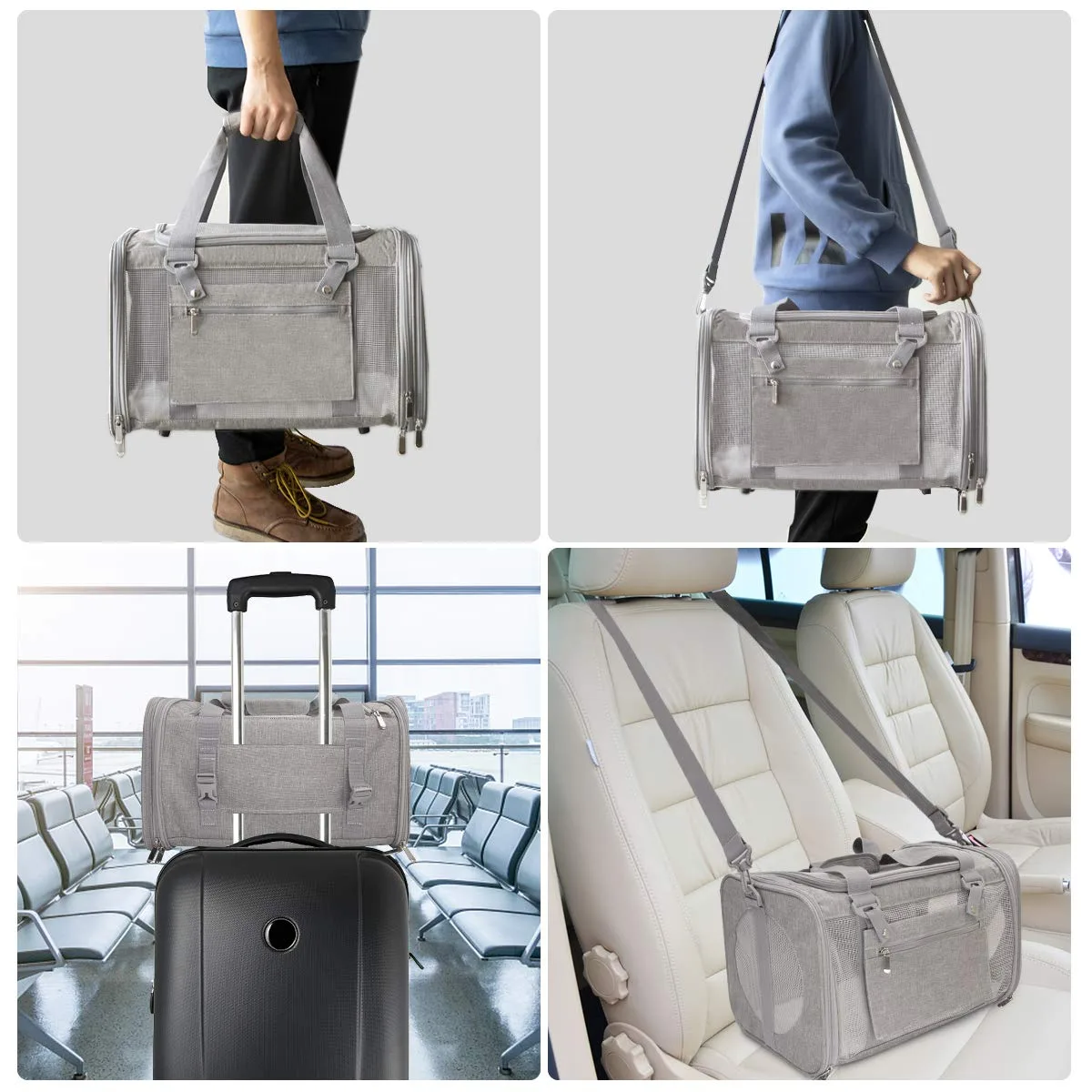
The strap is the component that determines whether a shoulder bag works, and it should be specified in four layers: core webbing, padding, covering fabric and attachment geometry.
Core webbing carries the load. Polyester webbing of 38 mm is a sensible minimum for pets up to 8 kg, and 50 mm for anything above that. Webbing should be specified by width, material and minimum tensile rating, with the rating set comfortably above the maximum working load. Width matters more than thickness: doubling the width halves the pressure per unit area on the shoulder, which is why a wide, thin strap is more comfortable than a narrow, thick one.
Padding determines whether the strap stays comfortable during a long carry. Closed-cell foam of around 6 mm at roughly 25 kg per cubic metre is a reasonable mid-market specification; lower densities compress flat and stop working. Specify the foam by thickness and density rather than by "soft" or "thick", and require that the foam be bonded or sleeved so that it cannot migrate inside the strap cover over time.
The covering fabric is what the customer feels and what wears. A smooth, tightly woven cover slides on clothing and resists pilling; a soft brushed cover feels pleasant initially and pills quickly. For shoulder-carry formats, the smooth cover is usually right, and it should be specified with an abrasion rating so that the choice is verifiable rather than aesthetic.
Attachment geometry is where straps actually fail. The strap root — the point where the strap meets the bag — concentrates the entire load into a small area. The correct construction is a bar-tack or box-stitch pattern over an internal reinforcement patch, with the webbing carried past the join rather than terminated at it. Specify the stitch pattern, the patch material and the length of webbing carried past the join, and photograph it on the approval sample.
Finally, specify whether the strap is fixed, adjustable or detachable. Adjustable straps need a triglide with a rated load and a webbing end treatment that will not slip; detachable straps add a hardware failure point and should use a rated clip rather than a decorative one. Each option changes cost, and each should be chosen deliberately rather than by default.
Load Path and Stress Points in Shoulder-Carry Designs
The load path describes how weight travels from the animal, through the bag structure, to the carrier's body. In a shoulder bag the path is short: base panel, side panel, strap root, strap, shoulder. Every field failure occurs at one of the four joins along that path, and each join should be specified as a discrete engineering decision rather than left to standard construction.
| Stress point | Failure mode | Specification that prevents it |
|---|---|---|
| Base panel attachment | Tear-out and progressive sag | Stiffened panel sleeved into shell, bound seam, reinforced corners |
| Side panel to strap root | Seam creep under sustained load | Internal reinforcement patch, webbing carried past the join |
| Strap root stitch group | Stitch hole tearing | Bar-tack or box-stitch pattern, stated stitch density |
| Triglide and adjustment hardware | Slippage and deformation | Rated hardware in metal or engineering plastic, pull-tested |
| Closure under load | Zipper burst at the base curve | #5 minimum gauge, reinforced tape ends, bound zipper panel |
The most commonly under-specified of these is the base panel attachment. A base panel that is simply sewn into the shell will progressively tear out under an 8 kg load, and the failure is slow enough that it escapes inspection and fast enough to appear in month three. Sleeving the panel into the shell with a bound seam and reinforced corners costs a few cents and removes the most common structural complaint in the category.
The second under-specified point is the zipper at the base curve. When a bag is loaded, the zipper line at the base radius is under tension, and a lightweight chain with unbound tape ends will burst. Specifying a minimum #5 gauge, reinforced tape ends and a bound zipper panel prevents a failure that no final inspection will reliably catch, because the failure occurs under load rather than at rest.
Designers can reduce stress rather than merely reinforce against it. Carrying the webbing continuously under the bag — a full sling of webbing rather than two separate strap ends — transfers load into the webbing itself and removes the strap root entirely as a failure point. This adds a small amount of webbing and removes the most common warranty claim in shoulder-carry formats, which is why it is worth requesting at design stage.
Finally, treat the reinforcement patch as a specified component. Its material, dimensions and position should appear on the specification sheet, because this is the item most quietly deleted when a factory is asked to sharpen the price.
Weight Distribution and Body Position in Everyday Carry
Weight distribution determines perceived comfort as much as strap design does, and it is largely decided by interior geometry. Two bags of identical weight feel very different depending on where the animal settles relative to the carrier's body.
The governing principle is proximity. A bag that holds the animal close to the torso feels dramatically lighter than one that lets it swing away, because the carrier's core muscles take the load instead of the shoulder alone. Interior volume should therefore be shaped to hold the animal against the body panel rather than to maximise open space — a specification that often means a shallower gusset and a firmer back panel.
The second principle is vertical position. A bag that rides high, close to the armpit, is more comfortable than one that hangs at hip level, and it also reduces the pendulum effect that causes the bag to swing while walking. This is an adjustment-range question as much as a design question: the strap adjustment range should allow a high carry on a small-framed person and a comfortable carry on a large-framed one.
The third principle is lateral stability. If the interior allows the animal to slide to one side, the carrier compensates continuously with postural muscles, and the bag is described as uncomfortable even when the strap is well designed. A lightly structured base and a gentle interior contour prevent the slide at minimal cost.
Buyers should specify a recommended weight ceiling for each size and validate it with a loaded carry test rather than deriving it from dimensions. A bag that measures large enough for a 10 kg animal may carry badly at that weight because the load path was designed around 6 kg. Stating the ceiling honestly, and testing to it, is the difference between a product that earns repeat purchases and one that earns returns.
Where a program spans several sizes, document the weight ceiling and the strap specification for each, because a single strap specification applied across a size range is the most common cause of comfort failure in the larger sizes.
Materials That Make Carry Comfortable
Material selection for shoulder-carry formats should be made against three criteria: abrasion resistance at contact points, breathability against the body, and compression behaviour in the strap and back panel.
Shell fabric carries the abrasion duty. 600D polyester with a PU backing is the standard mid-market choice and handles the contact wear of everyday carry well; 900D suits heavier weight bands and premium positioning; nylon offers a softer hand and better abrasion-to-weight ratio at higher cost and with more shade-variation risk. For the body-facing panel, a smooth or lightly textured fabric reduces friction against clothing, and a breathable spacer mesh improves comfort during long carries.
Padding materials determine how long comfort lasts. Closed-cell foam retains its thickness under repeated compression and is the right choice for load-bearing padding; open-cell foam is softer initially and compresses permanently. Specify by density and by compression set rather than by feel, and require a compression test on the strap foam during sampling — a cheap test that predicts the most common comfort complaint.
The body-facing panel deserves particular attention because it is where heat builds up during a long carry. A three-dimensional spacer mesh of 3 to 5 mm allows air to move behind the bag, and it costs less than most buyers expect. Specifying it is one of the few comfort improvements that is visible to the customer, cheap to implement and easy to describe in a listing.
Linings should be chosen for cleanability as well as comfort. A TPU-laminated lining wipes clean and resists odour, which matters in a bag carried close to the body for long periods. The trade-off is slightly reduced breathability, which is normally acceptable because the ventilation duty is handled by the mesh panels rather than by the lining.
Colourfastness and abrasion should be verified against published methods rather than by inspection, particularly where a dark strap cover rubs against light clothing. Standard textile test methods from AATCC and general test frameworks from ASTM International provide the vocabulary for specifying these checks in a purchase order.
Hardware Adjustment and Fit Range Across Body Types
Fit range is the comfort variable most often ignored at specification stage and most often mentioned in returns. A shoulder bag that fits a narrow range of body types generates a steady stream of "strap too short" and "strap digs in" reviews that have nothing to do with strap quality.
Specify the adjustment range in centimetres and validate it against real users. A useful approach is to define the intended fit range from the smallest to the largest adult frame in the target market, then require that the strap adjust across that whole range with the bag loaded. Testing the range loaded matters, because a strap that adjusts easily when empty may not hold adjustment under load — which is precisely when the customer notices.
Hardware selection follows from the range. Triglides should be rated for the working load and matched to the webbing width exactly; a triglide sized loosely for its webbing will slip under load. Slipping is the single most common hardware complaint in adjustable straps, and it is prevented by correct sizing rather than by more expensive hardware.
End treatments matter for both safety and perception. A webbing end that is heat-cut and folded back cleanly reads as quality; a raw cut end frays within weeks. Specify the end treatment — fold-back and bar-tack, or heat-cut and bind — and check it on the approval sample, because it is one of the details customers photograph in negative reviews.
Swivel hardware is worth considering on shoulder formats. A strap that can twist creates pressure points and is described as uncomfortable even when well padded; a swivel clip at one end lets the strap settle flat. The component costs more and removes a whole category of complaint, which is usually a good trade in this format.
Finally, decide whether to offer strap variants. Programs serving a wide market sometimes specify a standard strap plus an extended strap option, which costs one extra component and one extra SKU and removes the fit complaints at both ends of the range. Where volume justifies it, this is a low-cost, high-perceived-value move.
Testing Comfort: Pull, Cycle and Wear Protocols
Comfort claims should be backed by three tests, all cheap and all predictive: a static pull test on the strap assembly, a cycle test on the adjustment hardware, and a loaded carry wear test.
| Test | Sensible protocol | Failure it predicts |
|---|---|---|
| Strap assembly pull test | Load to a stated multiple of the rated pet weight, hold for a defined period | Root tear-out, stitch hole tearing, hardware deformation |
| Compression set on strap foam | Compress repeatedly, measure retained thickness | Strap flattening and loss of cushioning |
| Triglide slip test | Load the adjusted strap to working load, measure movement | Strap lengthening during use |
| Zipper cycle test on a loaded bag | Several hundred open and close cycles under load | Zipper burst at the base curve |
| Abrasion and colourfastness rub | Standard textile method on the strap cover | Pilling and colour transfer onto clothing |
These tests should be written into the purchase order with protocols and acceptance criteria, not merely requested verbally. Stating "strap must pass a pull test" is unenforceable; stating the load, the duration, the sample size and the acceptance criterion is enforceable and produces a report that a retail compliance team will accept.
Sampling should include a destructive test on one unit. Buyers frequently hesitate to destroy a sample, but one destructive pull test on a strap assembly reveals more about production quality than five visual inspections, and it is the only way to know whether the reinforcement patch specified on paper is actually in the bag.
Final inspection at AQL 2.5 should be paired with a specific check list for shoulder-carry formats: bar-tack presence at every strap root, webbing end treatment, triglide sizing, stitch density at the root, and padding position. These five items are the ones that fail in the field, and they should be counted as critical or major defects in the defect classification list rather than left to general workmanship.
Where a channel requires independent evidence, arrange third-party testing through a recognised body such as SGS on the same production lot that is inspected. Physical inspection confirms the bag is well made; laboratory testing confirms the load-bearing components perform. Both are needed and neither substitutes for the other.
Cost Bands for Comfort Features and Where to Spend
Comfort features cost money, and the allocation decision should be deliberate rather than uniform. Ranked by return per unit spent, the highest-value comfort items in a shoulder-carry pet bag are, in order: a continuous webbing sling under the bag, a bar-tacked strap root with an internal reinforcement patch, strap width, foam density, and a breathable body-facing panel.
The continuous webbing sling is first because it removes the most common failure point altogether rather than reinforcing against it. It adds perhaps one metre of webbing per bag and eliminates the strap-root warranty claim, which in field terms is worth many times its cost. Most buyers have never asked for it, which is precisely why it is worth asking for.
Bar-tacking and reinforcement patches are next, and they are almost free. The cost is a few seconds of machine time per join, and the benefit is the removal of the most common structural return in the category. These are the items to protect during any value-engineering conversation.
Strap width and foam density cost real money and should be set by the weight band rather than by the price target. A 38 mm strap with 6 mm foam is appropriate up to about 8 kg; beyond that, 50 mm and denser foam are required, and specifying below that to hit a price point produces exactly the comfort complaints that destroy the listing.
The items that can be reduced without much damage are the visible luxuries: premium zipper pulls, decorative binding, embossed patches and printed linings. These contribute to perceived quality and little to comfort, so they are the right place to economise when a price target must be met.
Program-level economics reward platform sharing here as elsewhere. One webbing specification, one foam specification and one hardware family across three shoulder-carry SKUs moves all three into better purchase tiers, which is how a mid-sized buyer affords a properly specified strap. The wider cost logic is set out in our wholesale pet bags bulk buying guide.
Sampling and Launch Sequence for Shoulder-Carry Programs
Shoulder-carry programs need one extra approval gate beyond the standard sequence, because the critical attribute is experienced under load rather than seen at rest. Plan five gates.
Gate one is the development sample, delivered in 6-10 working days, checked for dimensions, panel alignment, strap width and hardware fit. Gate two is the load test: fill the bag to its stated weight ceiling and inspect the strap roots, the base panel attachment and the zipper line. Gate three is the carry test: wear the loaded bag for a defined period on at least two body types and record the adjustment behaviour and pressure points. Gate four is material compliance testing by family. Gate five is the production pilot, inspected at AQL 2.5 before balance payment.
The carry test is the one most often skipped and the one that catches the most. A bag that looks correct and passes a static load test can still be uncomfortable if the strap geometry lets the animal hang away from the body or if the adjustment slips. Two people and twenty minutes per sample is a small investment against a return rate.
Bulk production takes 35-50 days from sample approval and deposit. Shoulder-carry formats trend toward the shorter end when webbing, foam and hardware are stock items in the specified grades, and toward the longer end when a custom webbing colour or a branded hardware finish is required. Locking webbing and hardware at sample approval is what keeps the schedule short.
Launch sequencing should follow the size curve. Ship the two sizes that dominate demand first, hold the extremes for the second drop, and use returns and review data from the first eight weeks to confirm that the strap specification holds at the upper end of the weight band. Programs that launch four sizes at once cannot tell whether a comfort complaint is a size problem or a specification problem.
Finally, hold the strap specification as a frozen document. Any change to webbing width, foam density, hardware supplier or stitch pattern should trigger a re-test, because these are the variables that determine whether the product keeps working in month six. Freezing them in writing is the cheapest form of quality insurance available in this category.
Production capability
- SGS-verified production space of 4,950 m², 149 machines, 7 assembly lines
- Pet bag output since 2014 from a 137-person team
- 200,000 units shipped monthly under BSCI and ISO 9001 systems
People Also Ask
How wide should a pet shoulder bag strap be?
At least 38 mm for pets up to 8 kg and 50 mm above that. Width reduces pressure per unit area more effectively than extra padding, so a wider and slightly thinner strap is usually more comfortable than a narrow thick one.
What is the most common failure in pet shoulder bags?
Strap root tear-out, where the load concentrates into stitch holes in the shell fabric. Carrying the webbing continuously under the bag removes the failure point entirely; otherwise a bar-tack over an internal reinforcement patch is the standard prevention.
How much weight should a pet shoulder bag be rated for?
Validate the rating with a loaded carry test rather than deriving it from dimensions. A bag large enough for a 10 kg animal may carry badly at that weight if the load path was designed around 6 kg.
What tests prove a shoulder bag is comfortable?
A strap assembly pull test, a compression set test on the strap foam, a triglide slip test under load, and a loaded carry test on two body types. Protocols and acceptance criteria should be written into the purchase order.
Where should I spend money on a shoulder bag program?
Spend on the load path — continuous webbing, bar-tacked roots, reinforcement patches, strap width and foam density — and economise on decorative trims, premium pullers and printed linings, which affect perceived quality rather than comfort.
How long does a shoulder bag program take from brief to launch?
Allow 6-10 working days for sampling, about two weeks for approvals, 35-50 days for bulk, and three to five weeks for freight and clearance, then re-baseline every downstream date the moment a milestone slips.
Frequently Asked Questions
What strap width is comfortable for a pet shoulder bag?
A minimum of 38 mm webbing is sensible for pets up to 8 kg, and 50 mm above that. Width matters more than thickness because doubling the width halves the pressure per unit area on the carrier's shoulder.
How should the strap be attached to prevent failure?
The best construction carries the webbing continuously under the bag, removing the root as a failure point. Where that is not possible, use a bar-tack or box-stitch pattern over an internal reinforcement patch, with the webbing carried past the join rather than terminated at it.
What is the standard MOQ and lead time?
MOQ is 500 pieces per colour, development sampling takes 6-10 working days, and bulk production takes 35-50 days from sample approval and deposit. Final inspection is at AQL 2.5 and standard terms are T/T 30/70 with FOB Xiamen.
How do I test comfort before launch?
Run a static pull test on the strap assembly, a compression test on the strap foam, a triglide slip test under load, and a loaded carry test on at least two body types. Write the protocols and acceptance criteria into the purchase order so the results are enforceable.
What causes a shoulder bag to feel heavy even when it is not?
Usually lateral instability or poor vertical position: if the animal can slide to one side or the bag hangs at hip level, the carrier compensates continuously with postural muscles. A lightly structured base and an adjustment range allowing a high carry solve both.
Which comfort features are worth paying for?
Ranked by return on spend: a continuous webbing sling under the bag, bar-tacked strap roots with reinforcement patches, adequate strap width, correct foam density, and a breathable body-facing panel. Reduce decorative trims before reducing any of these.
What foam specification should I use in the strap?
Closed-cell foam of around 6 mm at roughly 25 kg per cubic metre is a reasonable mid-market starting point. Specify by thickness, density and compression set rather than by feel, because lower densities flatten permanently under load.
Why does my strap lengthen during use?
Usually a triglide that is loosely sized for its webbing, which slips under load. Correct sizing prevents it more reliably than more expensive hardware, and a slip test under working load confirms the fix.
What does AQL 2.5 cover on a shoulder bag order?
AQL 2.5 is the acceptable quality limit for the final random inspection. For shoulder-carry formats, the defect classification list should treat bar-tack absence, webbing end treatment, triglide sizing and stitch density at the root as critical or major rather than general workmanship.
Should I run a destructive test on a sample?
Yes, one destructive pull test on a strap assembly reveals more about production quality than several visual inspections, and it is the only way to confirm that the reinforcement patch specified on paper is actually present in the bag.
How do I keep fit complaints down across body types?
Specify the adjustment range in centimetres, validate it with the bag loaded on the smallest and largest frames in your market, and consider offering an extended strap variant. Straps that adjust when empty may not hold adjustment under load.
Can I share strap components across several SKUs?
Yes, and it is the most reliable way to afford a properly specified strap. One webbing specification, one foam specification and one hardware family across three SKUs moves all three into better purchase tiers.
Talk to QUANZHOU JUNYUAN BAGS about a wholesale pet bag order: MOQ 500 pieces per colourway, samples in 6-10 working days, bulk production in 35-50 days under AQL 2.5 inspection.
Get a free quote Request a sample