AS Standards: Australian Standards for Pet Bag Imports
Australian standards are method references plus consumer law duties, not a single approval. Pet bag importers normally specify the AS 2001 series for textile testing, AS/NZS 1957 for care labelling, AS/NZS 4399 when a sun protection claim is made, and AS/NZS ISO 8124 where retail treats the item as toy-adjacent. A practical pack runs 6 to 10 items at roughly AUD 320 to 680 per colourway, with 6 to 11 working days in an accredited laboratory.
Executive Summary
Australia is a standards-light but enforcement-serious market. There is no approval scheme that a textile pet bag must pass before import, yet the Australian Consumer Law imposes a guarantee that goods are fit for purpose and of acceptable quality, and the regulator acts on unsafe products through recalls and public notices. The commercial result is that importers carry the burden of proof, and the evidence they need is a documented test pack plus correct labelling.
Our production team builds Australian programs on AS 2001 textile methods with the labelling set prepared for the Australian and New Zealand market, and qualifies each fabric base once rather than per style. Terms remain constant: MOQ 500 units per colourway, samples in 6-10 working days, bulk 35-50 days after approval, T/T 30/70, FOB Xiamen. Finished goods are inspected to AQL 2.5 with critical defects at zero, and the inspection worksheet covers the labelling items that Australian retail goods-in teams check first.
Wholesale heavy duty pet carrier builds start at the base panel, and Material & Technology documentation should state the board thickness before the fabric is chosen. Wholesale scratch resistant pet carrier and wholesale tear resistant pet carrier claims only hold when the test method is named, otherwise the coating alone is doing the work.
How the Australian Standards System Works for an Importer
Standards Australia develops AS standards and, through joint committees with New Zealand, AS/NZS standards. Most textile methods are published as AS 2001 series or as adoptions of ISO methods carrying an AS/NZS ISO prefix. Crucially, a standard is not law in itself: it becomes binding when a regulator cites it in a mandatory standard, when a contract cites it, or when a court uses it as the benchmark for acceptable quality. For a pet bag importer, that means the specification is the mechanism that makes a standard enforceable.
The mandatory layer sits in the Australian Consumer Law, which is applied by the competition and consumer regulator and by state fair trading agencies. It requires goods to be safe, durable, free from defects and fit for any purpose the buyer made known. If an importer tells a supplier the bags will carry a 10 kg animal and a strap fails at 6 kg, the legal exposure belongs to the importer, which is why the load rating must be specified and tested rather than assumed.
Mandatory standards exist for specific product categories such as children's toys, certain textiles with fire performance requirements and electrical products, and a pet bag can fall into one of those categories by positioning rather than by construction. A pet bag marketed with a plush toy attachment, sold in a children's aisle or advertised with a fire-retardant claim can attract requirements that a plain pet bag would not. The action for a sourcing team is to read the listing copy and the packaging claims before fixing the test pack.
The final structural point is market size. Australia is a concentrated retail market with a small number of large chains and a strong pet specialty channel, so a compliance failure can close several doors at once. Buyers therefore tend to over-document rather than under-document, and a supplier that can deliver a complete file becomes materially easier to onboard.
AS 2001 Textile Methods: The Numbers to Put in a Specification
The AS 2001 series is the working reference for textile testing in Australia and New Zealand. It is organised into parts covering conditioning, physical properties, colour fastness and chemical properties, and individual methods carry numbers such as AS 2001.2.3 for colour fastness to rubbing and AS 2001.2.4 for dimensional change. Because the series is large, the correct sourcing action is to cite the specific part numbers in the purchase order rather than to reference the series generally.
Buyers should also decide early whether to cite ISO adoptions or national parts. Many Australian methods are adoptions of ISO texts, and a laboratory holding accreditation for the ISO method can usually report under the national reference as well. Confirming this before commissioning avoids the awkward situation where a report is technically valid but does not carry the reference the buyer's compliance team expects, which then requires a re-issue and a second fee.
Colour fastness is the group most often tested. Rubbing fastness is measured with a crockmeter, washing fastness under a defined laundering procedure, perspiration fastness under acidic and alkaline conditions, and light fastness by xenon arc exposure, which matters more in Australia than in most markets because of UV load. A sensible commercial threshold for a pet bag is grade 4 dry rubbing, grade 3-4 wet rubbing, grade 4 washing and grade 5 light for outdoor lines, with the specific method numbers named alongside each.
Ventilation and mesh specification deserve their own line. Australian summers mean a pet bag is used in heat, and the functional claim is airflow rather than style. Specify mesh by hole count, yarn denier and open area percentage, then require the same fastness tests on the mesh as on the body fabric. Adding a dimensional stability check after laundering prevents the common failure where a mesh panel shrinks or distorts and the airflow claim quietly stops being true.
Physical properties follow. Tensile strength and elongation, tear resistance, abrasion resistance and seam slippage are all available within the series, and the useful practice is to set thresholds by product tier rather than to ask for pass or fail. A 600D polyester pet travel bag specified at a stated abrasion cycle count and a stated seam strength can be compared across two suppliers on equal terms, and any dispute at inspection is resolved by measurement.
One nuance worth planning for is conditioning. Australian and New Zealand methods specify conditioning atmospheres, and a laboratory working to a different conditioning regime can produce results that differ enough to cause an argument. Naming the standard in the order resolves this, because the laboratory will apply the conditioning required by the method rather than its house default.
Sun Protection, Water Behaviour and Outdoor Claims
Australia treats sun protection as a regulated claim. AS/NZS 4399 is the standard for sun protective clothing and it defines how ultraviolet protection factor is measured and how a UPF rating may be labelled and classified. A pet bag marketed as sun protective, or a bag with a shade panel marketed with a protection claim, should be tested under that standard before the claim appears on packaging or a listing, and the rating classification determines the wording that may be used.
Water behaviour claims follow the same logic. Water repellency is commonly assessed by spray rating and water penetration by hydrostatic head, both available as AS 2001 methods or as ISO adoptions. The commercial trap is durability: a finish that performs well when new can lose most of its effect after a few washes, and an Australian consumer who buys a "shower proof" bag for a coastal walk will notice. Specifying performance after a stated number of laundering cycles avoids that complaint.
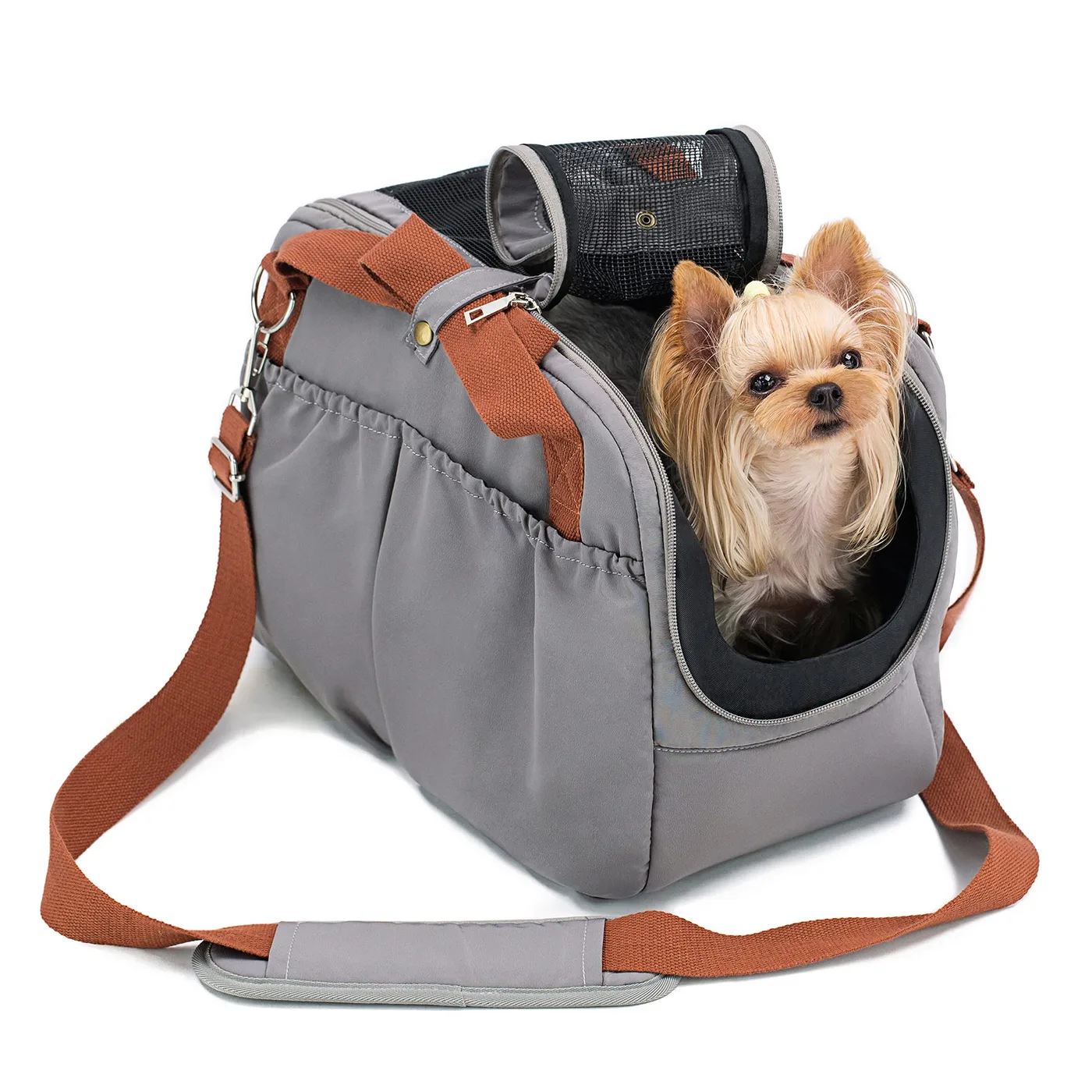
Heat is the other Australian-specific risk. Interior temperatures in a parked car or a sunlit patio are part of the real use environment, and a bag with poor ventilation and a dark shell can become dangerous. Responsible importers therefore specify ventilation area, mesh specification and, for insulated lines, a thermal performance target measured under defined conditions. These are product design parameters rather than legal requirements, but they belong in the same specification document because they determine whether the product is fit for purpose.
Anti-microbial and odour-control claims should be treated with the same caution. Where such a claim is made, it should be supported by a recognised test method and by documentation of the active agent, and the claim wording should match what the test actually demonstrated. Unsupported claims attract regulator attention and, in a concentrated retail market, buyer attention as well.
Care Labelling, Fibre Composition and Country of Origin
Care labelling in Australia and New Zealand is governed by AS/NZS 1957, which sets out how care instructions are expressed using symbols and, where appropriate, words. The symbol set should be selected from the standard rather than invented, and it should be verified against the behaviour the fabric actually showed in laundering tests. A label instructing a warm machine wash on a fabric that failed dimensional stability at that temperature is a compliance defect even if the bag itself is well made.
Fibre composition must be declared accurately, with the recognised fibre names and percentages stated in descending order. Errors here are common when a buyer changes lining supplier late in development and the label artwork is not updated, so the label file should be locked only after the bill of materials is frozen. Retail goods-in teams check the label against the purchase order, and a mismatch delays receipt regardless of test results.
Country of origin marking is a separate obligation under the Australian Consumer Law, and it must not be misleading. A bag made in China from Australian-designed materials is marked as made in China, and claims such as "Australian owned" or "designed in Australia" must be substantiated. Because origin claims interact with consumer law rather than with standards, they are best reviewed once by a compliance adviser and then applied consistently across the range.
Independent verification supports the labelling work. Textile eco-labels and substance screening schemes maintained by bodies such as the OEKO-TEX system are widely recognised by Australian buyers as supporting evidence, even where they are not a legal requirement, and they reduce the volume of questions a compliance team has to ask.
Packaging waste is moving up the agenda too. Australian packaging sustainability commitments and state-level rules increasingly affect how importers specify packaging materials, so a pet bag program should record its packaging material composition at SKU level. Capturing that data during development is far cheaper than reconstructing it for 200 SKUs later.
Electrical and Battery Content in Australian Pet Bag Lines
A pet bag with a heating pad, a fan module, LED lighting or a tracker is an electrical product as well as a textile one. Electrical safety in Australia and New Zealand works through a classification of electrical equipment into levels, with in-scope items requiring approval and marking before sale, and the regulatory mark for the region is the Regulatory Compliance Mark, generally known as the RCM. The relevant safety standard for many low-power consumer products is the AS/NZS 60335 family or the equivalent information technology standard, depending on the device.
The practical consequence is timing. Electrical approval runs on its own clock and requires its own documentation, including a test report from a recognised laboratory and registration by an Australian responsible supplier. Importers who sequence this work after the textile program is finished lose weeks; importers who certify the module first and then freeze its part number keep the whole program on one schedule.
Battery content adds transport requirements. Cells must meet the applicable cell safety standard and be shipped under the dangerous goods rules, with correct documentation, packaging and marking. Where a removable power bank ships with the bag, treating it as a separate line item with its own evidence file is the cleanest structure and simplifies after-sales handling.
Designing the module to be removable is therefore a compliance decision with commercial value. It lets one certified module serve several bag styles, keeps textile testing stable across colourways, and makes replacement straightforward. For a buyer planning a family of products rather than a single item, this is usually the highest-return decision in the whole specification.
What an Australian Test Pack Costs and How It Fits the Schedule
An Australian-facing pack for one colourway typically runs 6 to 10 items: colour fastness to rubbing, washing, perspiration and light, physical items covering tensile, tear and abrasion, plus a chemical screen where the buyer's retailer requires one. In an accredited laboratory the set costs roughly AUD 320 to 680 and takes 6 to 11 working days once samples and declarations are submitted. Reports are normally issued in English and accepted by Australian retail without translation.
Freight and seasonality shape the schedule more than testing does. Sea freight from Xiamen to eastern Australia is typically shorter than the northern Europe run, but Australian retail works to tight seasonal windows tied to summer and to the Christmas period, so a three-week slip can push an order into the wrong window. Running laboratory work in parallel with the 6-10 working day sample window and booking space early are the two decisions that protect the calendar.
| Item | Reference | Typical duration | Indicative cost |
|---|---|---|---|
| Fastness set, 4 items | AS 2001 colour fastness parts | 5-9 working days | AUD 140-280 |
| Physical set, 3 items | AS 2001 physical parts | 5-8 working days | AUD 120-250 |
| UPF rating, if claimed | AS/NZS 4399 | 5-10 working days | AUD 150-300 |
| Care label verification | AS/NZS 1957 | 2-4 working days | AUD 60-120 |
| Sample making and courier | Pre-production sample | 6-10 working days | USD 60-140 |
| Bulk production | Production and packing | 35-50 days | Unit price |
Relative to order value the pack is small: on a 2,000-unit wholesale order it usually sits well under one percent of landed cost. The cost of getting it wrong is a delayed receipt at a distribution centre, a relabelling exercise at the importer's expense, or in the worst case a recall notice published by the regulator.
Re-test cadence should be set at the start. Full re-test once per fabric base per year plus immediate re-test after any change of mill, dye house, coating or hardware vendor is accepted practice and keeps the annual spend predictable across a multi-season program.
Inspection and Documentation for Australian Receiving
Final random inspection to AQL 2.5, with critical defects at zero and minor defects at AQL 4.0, is the standard framework and should be paired with a documentation checklist. The worksheet should verify care symbol correctness, fibre composition text, country of origin marking, batch code legibility, carton marking accuracy and counted quantities. Australian distribution centres are strict about carton counts and documentation accuracy, and a mismatch causes a receipt delay that no test report can cure.
Critical defects in this market include sharp or broken hardware, failed load paths, blocked ventilation and any label that misstates composition or origin. Major defects include shade deviation beyond the signed reference, stitching faults on load-bearing seams, zip malfunction and water performance below the specified rating. Writing these definitions into the inspection plan before the inspection converts the AQL count into a decision rather than a discussion.
Because Australian consumer law places the fitness-for-purpose duty on the supplier in the chain who sold to the consumer, importers should keep their own evidence file rather than relying on the overseas supplier's copy. That file should contain the test reports with method numbers and dates, the mill declarations, the approved sample record with photographs, and the inspection report for each shipment. Maintaining it is a low-effort habit that becomes valuable the first time a claim arrives.
One more operational point: importers should insist on a pre-shipment carton count and a packing photograph set. Australian distribution centres reconcile cartons strictly, and a discrepancy that would be waived elsewhere delays receipt here. A photograph of each pallet and a signed carton count cost nothing and remove the most common administrative cause of a delayed goods-in.
Photographic evidence deserves emphasis. Australian buyers frequently ask for a photo of a specific defect or a specific label months after delivery, and a supplier that attaches photographs to every inspection report can answer in minutes. Our production team attaches a standard photo set covering hardware, stitching, labelling, cartons and packing to every inspection record for this reason.
The Commercial Cost of a Compliance Miss in Australia
The direct cost of a compliance failure is rarely the largest number. A relabelling exercise at a distribution centre, a delayed receipt that pushes a line past its seasonal window, and the administrative time spent answering a regulator enquiry together dwarf the few hundred dollars of testing that would have prevented them. In a market where three or four chains account for a large share of pet category volume, the indirect cost of losing a listing slot for a season can exceed the entire margin of the program.
Recalls have a specific arithmetic. A public recall notice requires the importer to notify, to offer a remedy, to handle returned goods and to report outcomes, and the administrative load falls on the importer rather than on the overseas supplier. Even a small recall consumes weeks of staff time, and the notice remains publicly searchable, which affects future buyer conversations. The expected cost of that event, weighted by a realistic probability, is a strong argument for spending on testing rather than saving on it.
Insurance behaves predictably in this environment. Product liability cover is generally priced and underwritten on the basis that the importer can demonstrate due diligence, and a documented test pack with method references is exactly that demonstration. Importers who cannot produce evidence when a claim arrives often find that cover responds less favourably, which converts a manageable claim into an uninsured loss.
The mitigation is procedural rather than expensive. Keep one evidence file per fabric base, update declarations annually, re-test after any change of mill or vendor, verify labels at inspection, and photograph every inspection. These habits cost a few hours per season and remove most of the downside. Buyers who adopt them tend to treat compliance as routine administration rather than as a risk management exercise.
Picking a Partner Who Understands Australian Requirements
The first question to ask a potential supplier is whether it has shipped to Australia before and can show the file. A previous Australian pack should include method-referenced test reports, a care label approved against the relevant standard, an origin marking decision and an inspection report with photographs. A supplier that produces those within a day is likely to handle the next program smoothly, while a supplier that responds with general certificates will create questions at every stage.
Laboratory evidence should be independent rather than internal. Reports issued by accredited organisations such as third-party testing providers carry the accreditation mark that Australian compliance teams look for, and they are far more persuasive than supplier-issued test sheets when a claim about waterproof or thermal performance is questioned.
The second question is how claims are handled. Australian retail asks for substantiation of any performance claim, so the supplier must be willing to put numbers behind waterproof, sun protective, thermal and load-bearing statements and to have those numbers verified by a laboratory. A partner that treats claims as marketing language rather than specification language is a liability in this market.
Management system evidence rounds out onboarding. ISO 9001 quality management and BSCI or equivalent social compliance are routinely requested by Australian chains, and reports should be current. Working through an SGS-verified production base lets audit evidence and product testing be refreshed in one cycle, which shortens supplier setup by weeks.
Finally, plan the range as a family. Because testing is charged per material rather than per unit, a program built on three fabric bases across many styles is markedly cheaper to qualify than a program where every style introduces a new material. Buyers entering Australia should therefore freeze the material library first and let the silhouettes follow.
A Short Practical Checklist Before the First Australian Order
Before releasing a purchase order for the Australian market, confirm five things in writing: the named standards with part numbers, the numeric acceptance thresholds, the care label symbol set, the country of origin wording, and the inspection defect definitions. Those five items resolve the majority of disputes that arise later, and each takes minutes to agree during development. Buyers who adopt this checklist usually find that their first Australian season runs to schedule and their second season runs faster.
Why brands source here
- Pet bag programmes run since 2014; founding team in sewn goods since 2004
- SGS-verified production floor of 4,950 m² with 137 workers across 7 lines
- Monthly capacity of 200,000 units, audited to BSCI and ISO 9001
People Also Ask
What does AS mean in Australian standards?
AS denotes a standard published by Standards Australia, and AS/NZS denotes a joint standard with New Zealand. Many textile methods are AS 2001 series or AS/NZS ISO adoptions.
Is there a mandatory standard for pet products in Australia?
There is no pet bag specific mandatory standard. General obligations under the Australian Consumer Law apply, covering safety, durability and fitness for purpose.
What is AS/NZS 4399?
It is the sun protective clothing standard that defines how ultraviolet protection factor is measured and how a rating is classified and labelled.
Do I need AS/NZS ISO 8124 testing?
Only where retail treats the item as toy-adjacent, for example with a plush attachment or children's aisle placement. Check the listing and packaging claims before fixing the test pack.
How is waterproof performance tested in Australia?
Spray rating for water repellency and hydrostatic head for penetration resistance are the usual methods, available as AS 2001 parts or ISO adoptions, ideally tested after laundering cycles.
Can I reuse an EU test report for Australia?
Physical results often transfer if the method is an ISO adoption, but Australian reviewers usually want the national method reference on the report. Plan one local pack per fabric base.
Frequently Asked Questions
Are AS standards legally mandatory for pet bags in Australia?
Most are not mandatory in themselves. They become binding when a contract cites them or when a regulator relies on them to judge acceptable quality under the Australian Consumer Law, so a specification is what makes them enforceable.
Which Australian standard covers textile testing?
The AS 2001 series covers textile test methods, including colour fastness, dimensional change and physical properties. Individual part numbers should be cited in the purchase order rather than the series generally.
What standard applies to care labelling in Australia?
AS/NZS 1957 sets out care instruction symbols and wording for Australia and New Zealand. The symbol set should be checked against the laundering behaviour measured in testing.
Do I need UPF testing for a pet bag?
Only if a sun protection claim is made. AS/NZS 4399 defines how UPF is measured and how a rating may be classified and labelled, and the claim wording must match the tested result.
Is country of origin marking required?
Yes, under the Australian Consumer Law the origin marking must not be misleading. Bags manufactured in China are marked accordingly, and design or ownership claims must be substantiated.
Do heated or electronic pet bags need electrical approval?
Yes when the product is in scope, with approval and marking through the regional compliance mark and safety assessed against the relevant AS/NZS product family. Certify the module before the bag program is frozen.
How long does Australian compliance testing take?
Six to eleven working days for a typical six to ten item pack. Run in parallel with the 6-10 working day sample window, it does not extend the 35-50 day bulk schedule.
What does a test pack cost for Australia?
Roughly AUD 320 to 680 per colourway for the fastness, physical and optional chemical items. Cost scales with the number of distinct materials rather than with order quantity.
Can one report cover several Australian styles?
Physical and chemical results cover a fabric base across styles and colours, while fastness results are colour specific. Building a range on shared bases is the cheapest structure.
What is the biggest cause of receipt delays in Australia?
Carton count mismatches and label errors at goods-in. Both are documentation issues and both are prevented by adding a checklist to the pre-shipment inspection.
How often should testing be repeated?
Full re-test once per fabric base per year plus immediate re-test after any mill, dye house, coating or plating vendor change, with periodic verification tied to production volume.
Does AQL 2.5 cover labelling checks?
It should. A well-built worksheet checks physical defects and documentation together, including care symbols, composition, origin marking and carton counts, with photographs retained.
Talk to QUANZHOU JUNYUAN BAGS about a wholesale pet bag order: MOQ 500 pieces per colourway, samples in 6-10 working days, bulk production in 35-50 days under AQL 2.5 inspection.
Get a free quote Request a sample