Pet Camping Bag: Outdoor Gear Guide for Wholesale Buyers
A wholesale pet camping bag should be specced at 35-55 L with a coated ground-contact base, a removable insulated pad for overnight use, compression straps for load control and a pet cavity rated 8-15 kg. Expect USD 18.60-34.20 FOB Xiamen. Orders run at MOQ 500 pcs per colourway, sample in 6-10 working days and ship 35-50 days after approval under AQL 2.5.
Executive Summary
This guide covers the camping-positioned pet bag: the largest and most storage-oriented SKU in a lifestyle pet bag range. It is not a hiking bag with more litres. It is a product designed around a static camp - set down on the ground, left in place, exposed to weather overnight, and expected to organise gear as much as to carry an animal.
Our production team runs these builds at MOQ 500 pcs per colourway, with mixed colourways permitted inside one order. Samples take 6-10 working days from tech pack confirmation and bulk runs 35-50 days after approval. Shipments are offered to AQL 2.5 pre-shipment inspection with third-party inspectors accepted, on T/T 30/70 against FOB Xiamen.
Three decisions determine whether the SKU works at camp: how the base handles ground contact, how the bag organises gear when it is not being carried, and whether the pet cavity is safe overnight. A fourth is carton efficiency. A camping bag of this volume is among the least freight-efficient products in a lifestyle range, and a flat-pack configuration with a removable pad can improve container utilisation by 20-30%.
Pet bag market trends point to two things a buyer can act on: lighter shells and stricter chemical files, both of which land on Pet Bag Types & Styles. Pet carrier market size forecasts are useful for range planning but not for pricing, and pet bag market analysis should be read as a channel question rather than a volume promise.
Camping Versus Hiking: What the Use Case Actually Demands
The two categories are adjacent on a shelf and different in almost every engineering respect. A hiking bag is optimised for motion: load transfer, low weight, close fit. A camping bag is optimised for stasis: it sits on the ground, holds a large volume, and is opened and closed repeatedly at a fixed location. Designing one and marketing it as the other produces a product that is mediocre at both.
The practical differences are specific. A camping bag needs a ground-contact base that resists moisture and abrasion, because it will be set on wet earth and gravel for days. It needs external attachment points, because gear gets strapped to it rather than packed inside. It needs a wide, stable opening that stays accessible when the bag is lying down, because nobody stands a 45 L bag upright to rummage through it. And it needs to be less concerned with harness sophistication, because it is carried from the car to the pitch and not much further.
- Motion profile: carried 50-400 m from vehicle to pitch, then static for days.
- Volume: 35-55 L, because gear volume dominates the requirement.
- Ground contact: sustained, often wet, sometimes abrasive.
- Access: opened repeatedly while lying down or half-unzipped.
- Payload: pet 8-15 kg plus bedding, food, bowls, toys and clothing.
That profile has a commercial implication worth naming: camping bags are bought less frequently and at a higher price than hiking bags, and they are often bought as part of a broader outdoor kit purchase. The buyer is frequently a camping retailer whose pet range is an adjacency rather than a core category, which means the SKU has to earn its place against camping equipment rather than against pet products.
The second commercial implication is the accessory opportunity. A camping programme sells well with a matched set - a bedding pad, a collapsible bowl, a gear pouch - because camping customers buy kits. Accessories carry higher margin than the bag and they make the range look deliberate rather than assembled.
Capacity, Packing and Camp Organisation
Capacity in this category is not simply a bigger number. A 45 L bag that is a single cavity is less useful at camp than a 38 L bag with sensible organisation, because camping gear is small, numerous and needs to be findable in low light. Organisation is the feature that customers mention in reviews when it exists and complain about when it does not.
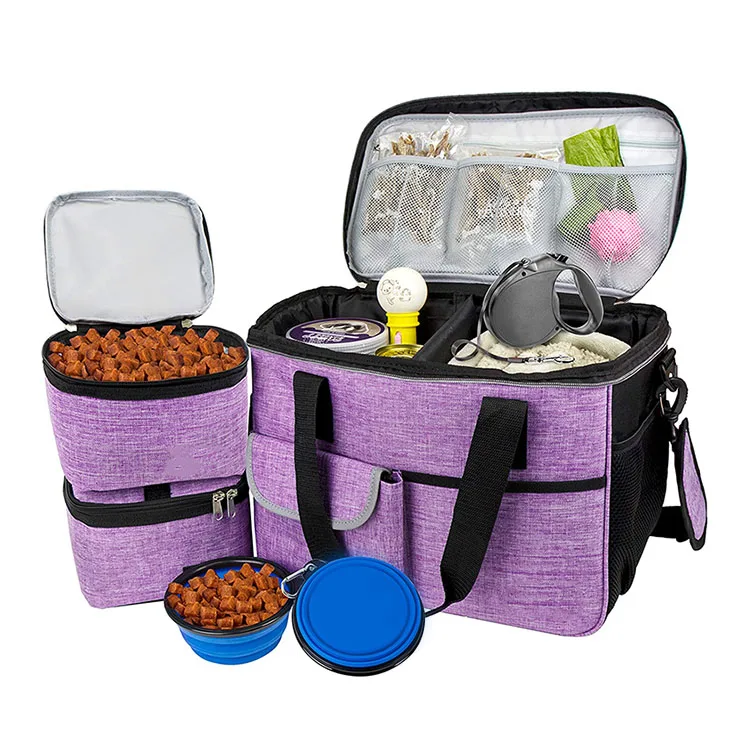
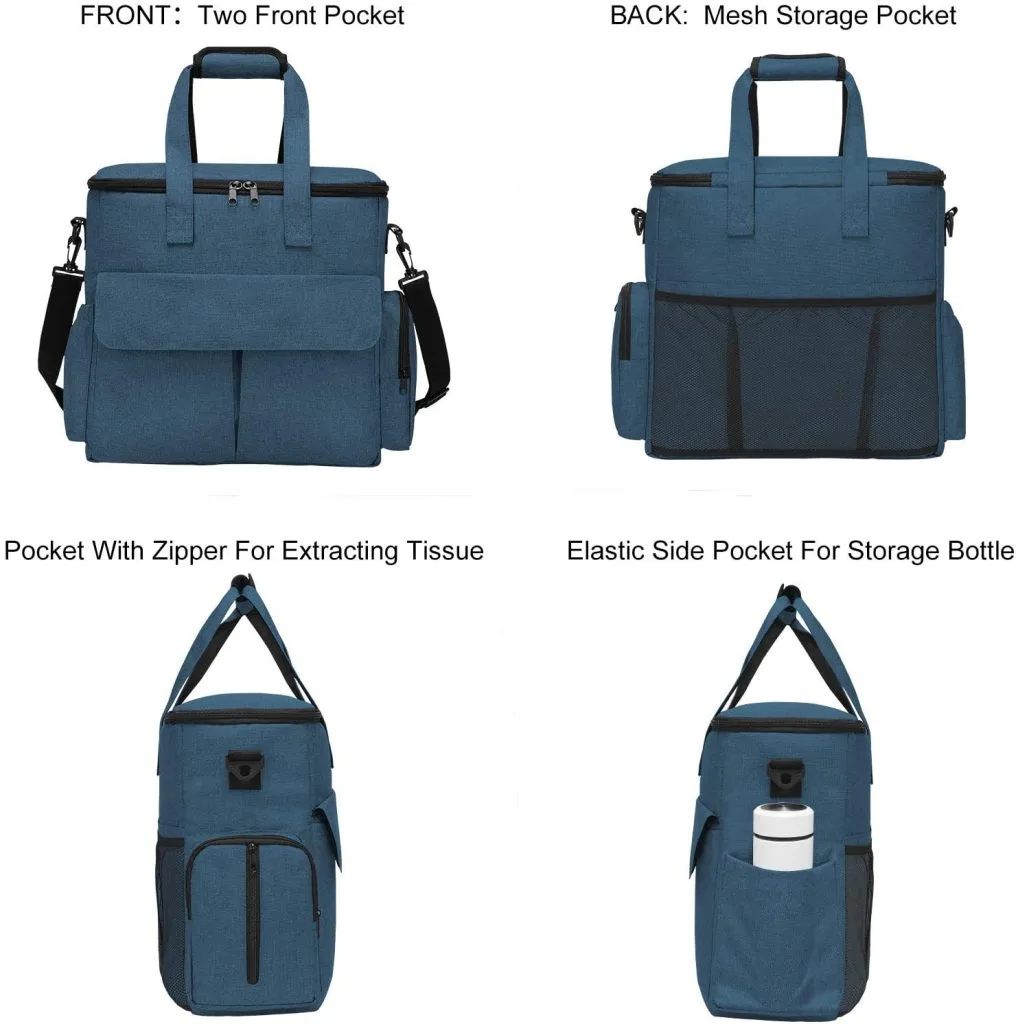
The structure that works is a large main cavity plus a dedicated pet cavity, three to five external or internal organisation pockets, two compression straps and a daisy chain or lash points for external attachment. The pet cavity should be at the base or the back rather than the centre, so the animal's weight stays low and the gear cavity remains accessible without disturbing it.
| Zone | Volume | Contents | Access |
|---|---|---|---|
| Pet cavity | 18-22 L | Animal, bedding pad, tether | Side or top, independent zip |
| Gear main | 14-18 L | Clothing, food, bowls | Full-perimeter top zip |
| Organisation pockets | 3-5 L | Lead, treats, torch, documents | External, glove-friendly |
| External attachment | n/a | Roll mat, water bottle, bowl | Compression straps, lash points |
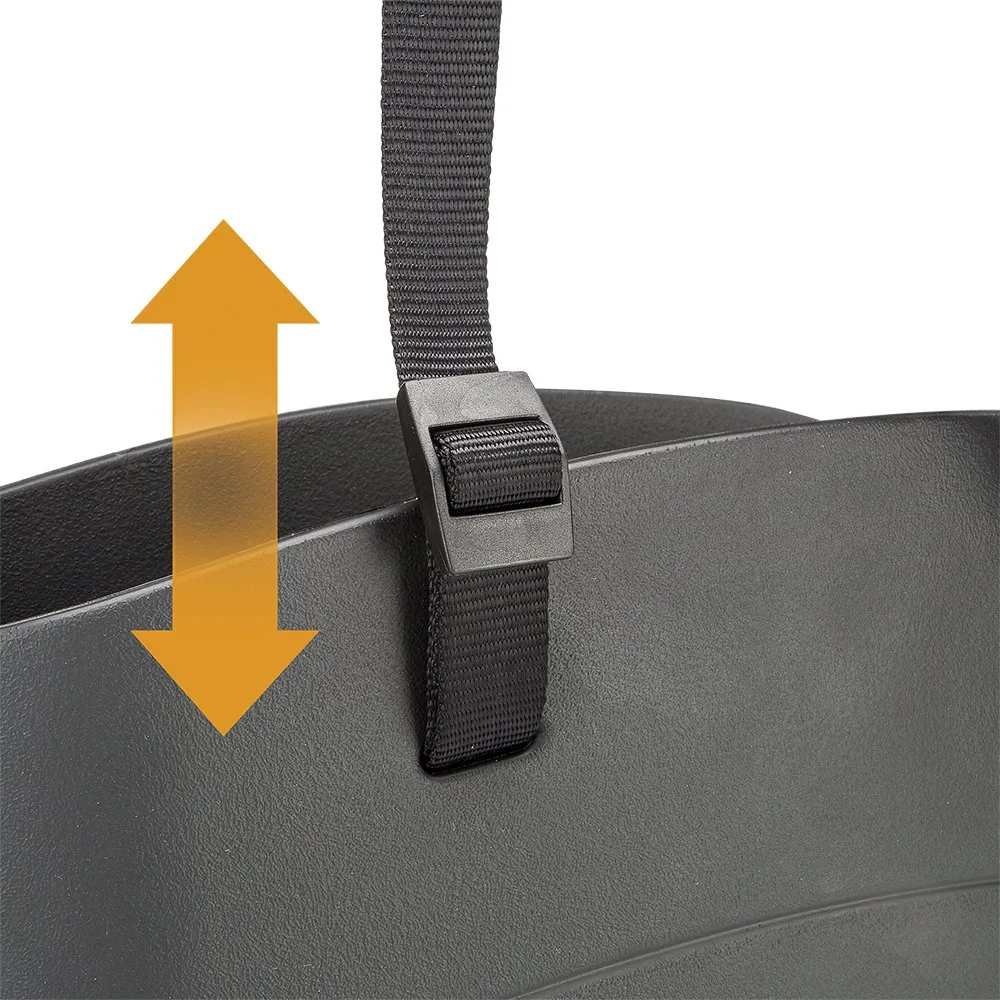
Compression matters more at camp than on a trail. A half-full camping bag with no compression straps becomes a shapeless sack that rolls around a tent; with two straps it stays compact and stable. Compression is cheap - USD 0.40-0.85 - and it is one of the highest-value features per pound in the entire specification.
Access geometry deserves its own decision. Full-perimeter zips that let the bag open like a suitcase are the right answer at this volume; a top-only opening means digging to the bottom for everything. Specify a #10 zip on the main opening with two sliders that can meet anywhere along the perimeter, and a stiffened lip so the mouth holds open while packing.
Colour of the interior lining is a small decision with an outsized effect at camp. A dark interior in a 45 L bag is genuinely hard to search in the evening; a mid-tone or light lining makes the bag usable with a head torch. This is the kind of detail that earns four-and-a-half star reviews rather than four.
Ground Contact, Weather and Overnight Thermal Design
A camping bag lives on the ground, and the ground is wet, cold and abrasive. Every decision about the base, the coatings and the overnight thermal behaviour follows from that. Bags designed as travel products and repositioned for camping fail here first, and they fail visibly.
The base should be a coated 1000D or 1680D panel over a moulded or laminated board, with no exposed stitch line on the ground-contact surface. Stitching on the bottom of a bag that sits on wet earth wicks moisture inward within hours. A welded or coated panel with a turned-up perimeter - a bathtub construction, in outdoor terminology - is the correct answer and it costs USD 1.40-2.80.
Overnight thermal behaviour is the second requirement, and it is easy to get wrong. Night temperatures at a campsite can fall 15-20 degrees below the daytime figure, and an animal in a bag on the ground loses heat to both the air and the ground. The answer is an insulated, removable pad with a closed-cell foam core and a reflective layer, rated rather than described, plus the option to close down the ventilation panels partially when it is cold.
- Base: coated 1000D or 1680D bathtub panel, no ground-contact stitching.
- Pad: removable closed-cell foam, 8-12 mm, with a reflective layer and a washable cover.
- Ventilation: two opposite panels plus a top panel, with closable flaps for cold nights.
- Coatings: hydrolysis-resistant and DWR-treated, with the chemistry declared for compliance.
- Drainage: two grommets at the low corners so condensation and spills escape.
Weather protection should be honest in the specification and in the copy. A camping bag will be left out; either it carries an integrated rain cover with a drain hole, or the listing should say it is shower-resistant rather than waterproof. Outdoor customers are knowledgeable, and an overstated claim in this channel is punished in reviews faster than in any other.
One more consideration specific to camping: rodents and insects. A bag containing pet food left at a campsite will be investigated. A robust #10 zip with a closed garage, and a separate sealed food pouch rather than loose food in the main cavity, are practical answers that cost very little and prevent a genuinely unpleasant customer experience.
Condensation and the morning-after problem
Overnight temperature swings produce condensation inside any enclosed cavity, and a pet bag is no exception. The mitigation is a coated, non-absorbent interior with a drainage path and a removable pad that can be lifted out and dried in the morning sun. Any open-cell foam in the build will hold that moisture and develop odour within two or three trips.
The second mitigation is ventilation management overnight. Panels that are open during the day should be closable at night, because the same airflow that cools an animal in the afternoon chills it at four in the morning. A zip or roll-down flap over each panel costs USD 0.35-0.75 and makes the bag genuinely usable across a full day-night cycle.
The third is the pad. A closed-cell foam core with a reflective layer and a removable coated cover can be lifted out, dried in the morning and refitted in seconds. That single component is what makes the difference between a bag that smells by the third morning and one that does not, and it is worth spending on before almost any other feature in the build. Where the programme can afford one upgrade only, choose the removable coated pad over a rain cover, a frame upgrade or extra pockets: it addresses the complaint that actually ends products in this category.
Buyers should also state the drying routine on the insert rather than leaving it to the customer. Lift the pad, open the panels, prop the bag mouth open and let it air for an hour before packing it away. That instruction costs nothing and it prevents the majority of odour complaints a camping bag will ever receive.
Pitching the SKU to a camping buyer
A camping buyer is not a pet buyer, and the pitch has to be translated. The arguments that work in pet retail - safety, comfort for the animal, ventilation - are necessary but not sufficient. The arguments that win the shelf are capacity per dollar, durability against camping equipment benchmarks, and how the SKU fits the retailer's existing range architecture.
Practically, that means the sell-in sheet should lead with volume, packed dimensions, weight and the abrasion result, and treat the pet features as the differentiating second paragraph rather than the headline. It also means bringing a sample that has been through the ground test, because a camping buyer will put it on the floor and look at the base before anything else.
The second practical point is range fit. Camping ranges are merchandised by activity and by price ladder, and a pet bag has to slot into an existing gap rather than create a new category on the shop floor. Ask where the buyer intends to place it and what it sits next to, then build the sample presentation around that adjacency.
The third point is the price ladder. Camping ranges are built in clear steps, and a pet bag that lands between two steps competes with the step below it on price and loses. Ask the buyer where the gap is and then engineer to that number, rather than designing the product and discovering afterwards that it sits in the wrong place.
Finally, bring the compliance file to the meeting. Camping buyers increasingly ask for chemical declarations and durability evidence at the range review rather than after it, and a supplier who arrives with the folder already assembled shortens the buying process by weeks.
Durability and Repairability for Multi-Day Use
Camping gear is used hard and kept for years, and customers in this channel expect repairability as a matter of principle. A bag that cannot be fixed is a bag that gets returned or, worse, reviewed badly by a customer who expected better from an outdoor product.
Durability starts with stitch construction at load points. Every handle root, strap root, compression strap anchor and lash point should be bar-tacked with a specified stitch count, reinforced with a webbing extension that spreads load into the panel. Specify a bonded polyester or nylon thread at a stated ticket number, because thread degradation is an invisible failure that appears in year two rather than week two.
Repairability is the design choice that follows: standardised, replaceable buckles; a user-replaceable slider on the main zip; and accessible seam allowances that a repair shop can work with. None of these adds cost; all of them require the designer to think about it. It is worth a line in the tech pack and a line in the product copy.
- Bar-tacks: specified count at every load point, with webbing extensions.
- Thread: bonded polyester or nylon, stated ticket number, UV-resistant.
- Buckles: named supplier, standardised across the range, replaceable.
- Zips: #10 main with a replaceable slider; #8 secondary with storm flaps.
- Warranty: consider a stated repair policy - it is a genuine differentiator in this channel.
Abrasion and tear performance should be measured to a named method rather than asserted. Test methods for physical and mechanical properties are published by ASTM International, and textile abrasion and colour-fastness behaviour is normally run to AATCC test methods. A cycle count in the product copy, backed by a report, is defensible and persuasive.
Finally, test the sample the way it will be used: load it to the rated weight, set it on wet gravel for 48 hours, then carry it 300 m. Most faults in this category - base wicking, strap anchor creep, coating softening - appear in that test and nowhere else.
Carton efficiency and the flat-pack question
A 45 L camping bag is one of the least freight-efficient products in a lifestyle pet range, and carton efficiency is therefore a genuine design consideration rather than a logistics afterthought. A bag that ships flat with the pad rolled separately can improve carton density by 20-30% compared with one shipped assembled and stuffed.
The design implication is that the pad should be removable and the base board should be either removable or foldable, and that the carton drawing should specify the packed configuration explicitly. Those two decisions cost nothing in production and they reduce landed cost by a measurable margin on a bulky product.
Buyers should ask for packed carton dimensions and a carton-per-container figure at quoting stage, then compare it across two or three packing options. On a container of seasonal stock the difference frequently exceeds the cost of a material upgrade that would have improved the product.
The second lever is carton quantity. A carton packed to the container's internal dimensions rather than to a round number can add a meaningful number of units per container, and it costs nothing but a conversation with the factory's packing team. Ask for the carton drawing early and check it against the container, not against a habit.
Neither lever is glamorous, and on a bulky seasonal product they are frequently worth more than a price negotiation. Buyers who model landed cost including freight usually find that freight, not FOB, is where the biggest controllable saving sits. The exception is air freight, where carton shape matters more than carton count and a flatter pack often beats a denser one on volumetric weight.
Safety at Camp: Containment, Tether and Wildlife
A campsite is an uncontained environment with distractions, wildlife and other people's dogs. Containment is therefore a functional requirement rather than an optional feature, and it is the area where camping-specific design differs most from urban design.
The tether is the primary control. It should be adjustable, anchored to a structural point rather than to a lining seam, and rated well above the animal's weight - a 15 kg dog lunging at a squirrel generates several times its body weight in force. Specify the anchor as a bar-tacked webbing loop carried into the frame or base board, and test it to a stated pull figure.
Closure security is the second control. A pet that can nose a zip open is a pet that will be out of the bag at a campsite within minutes. The answers are a locking slider, a two-slider arrangement that can be positioned away from the animal, and a secondary hook-and-loop or buckle restraint over the zip garage. Outdoor customers understand and expect this; urban customers do not think about it until it fails.
- Tether: adjustable, structurally anchored, rated to a stated pull figure, clipped to a harness.
- Closure: locking sliders plus a secondary restraint over the zip garage.
- Mesh: claw-resistant coated polyester, with an inner mesh layer where a determined animal could reach the outer panel.
- Visibility: reflective piping or a reflective print for movement around a campsite at night.
- Instruction insert: never leave a pet unattended in the bag; wildlife and heat warnings stated specifically.
The instruction insert deserves real attention in this category because the misuse scenarios are serious. State plainly that the bag is not a kennel and not a restraint device for an unattended animal, give a maximum ambient temperature for use, and give a maximum continuous containment period. That insert is a welfare measure first and a liability measure second.
Reflective elements are worth specifying for a different reason: campsites are dark, and a bag set down outside a tent is a trip hazard. Reflective piping costs cents and prevents an accident that would otherwise end the customer's relationship with the brand.
Cost Structure and Price Banding
Camping programmes sit at or above hiking in unit cost because of volume, base construction and the number of features. The margin is correspondingly better, because camping customers expect to pay for capacity and durability.
| Build level | Base | Features | FOB band | Target retail |
|---|---|---|---|---|
| Entry | Coated 600D, exposed stitching | Basic organisation, no compression | USD 18.60-22.90 | USD 85-115 |
| Mid | Bathtub 1000D, welded panel | Compression, insulated pad, lash points | USD 24.20-29.60 | USD 125-170 |
| Premium | Moulded tray, bathtub 1680D | Removable pad, rain cover, accessory set | USD 30.40-38.90 | USD 185-250 |
For a mid build around USD 26.80, the split is: shell, lining and base fabric 26-32%, hardware 12-16%, foam and pad 9-13%, structure and board 6-9%, labour 22-27%, packaging 4-6%, factory margin 8-12%. The base construction and the pad are the two line items that separate a camping build from a travel build, and together they account for roughly a fifth of the unit cost.
The saving levers, ranked by safety: consolidating volume, reducing colourways, standardising hardware across the outdoor family, simplifying packaging, and then reducing organisation features. Cutting the bathtub base back to a stitched one saves USD 1.40-2.80 and reintroduces the single most complained-about failure in the category - a damp interior by morning.
Freight is the real constraint at this volume. A 45 L bag is bulky and, unlike a soft hiking bag, it does not pack down. Volumetric weight will dominate air freight completely, and sea freight carton efficiency becomes a genuine design consideration: a bag that can be shipped flat with the pad rolled separately can improve carton density by 20-30%.
Accessories, as noted earlier, carry better margin than the bag. A matched pad, bowl and gear pouch set at USD 3.20-6.40 FOB retailing at USD 25-45 is the most profitable part of many camping programmes, and it improves the perceived completeness of the range.
MOQ, Sampling and the Outdoor Season Calendar
The working minimum is MOQ 500 pcs per colourway, and camping programmes frequently run at two colourways because the outdoor channel merchandises on earth tones rather than on seasonal brights. Order structure should follow the accessory plan: if a matched pad and pouch set is part of the programme, those components are made in the same slot and share the inspection.
Sampling is 6-10 working days per round, and this category needs two rounds plus a field test. The first validates capacity, organisation and base construction; the second validates colour, branding and packaging. Between them, run a 48-hour loaded ground test on wet ground - the single test that predicts whether the base specification is adequate.
| Milestone | Target | Note |
|---|---|---|
| Channel and accessory plan fixed | June | Determines base and pad specification |
| Tech pack locked | July | Includes ground-contact construction |
| Structure sample and ground test | August | 48 hours loaded on wet ground |
| Branding and accessory sample | September | Golden sample sealed |
| Bulk production | October to November | 35-50 days |
| Freight and receipt | December to January | 30-45 days |
Camping retail sets planograms for the spring and summer season well in advance, and the range review happens in the autumn. As with hiking, the sample sent to the range review is a separate item from the internal approval sample, and both need time in the calendar.
Pre-shipment inspection at AQL 2.5 should carry a defect list specific to this build: ground-contact stitch presence, base coating integrity, pad thickness, bar-tack count at lash points and zip slider conformity. Those five are where camping builds fail, and none appears on a generic bag checklist.
Compliance, HS Classification and Documentation
A camping pet bag is a consumer textile product with outdoor equipment ambitions, and it carries the documentation load of both. Two areas deserve particular attention: chemical compliance on coatings, and customs classification, because the wrong classification discovered at clearance costs days and money.
For the US, general consumer-product obligations and recall traceability sit with the US Consumer Product Safety Commission, and the buyer-side requirement is a batch code on the product with retained production records. California exposure warnings are administered by OEHHA, and coatings, DWR treatments and hardware finishes are the usual questions.
For the EU, REACH restrictions are administered by the European Chemicals Agency, and durable water-repellent chemistry has attracted specific scrutiny in several member states. Ask which DWR chemistry is being used at quoting stage, because a reformulation after production triggers re-testing.
Classification is the practical trap. Pet bags, travel bags and camping equipment can fall into different tariff headings depending on the market and on how the product is presented, and the description on the commercial invoice drives the decision. Confirm the classification with a licensed broker before the first shipment, keep the ruling on file, and use the same description on every subsequent shipment.
- Batch code on the product; production record retained for 24 months.
- Fibre composition and country of origin in the importing market's format.
- Instruction insert: pet weight rating, heat and wildlife warnings, containment limits, cleaning.
- Test reports: abrasion, tear, coating integrity, hardware load, chemical screens as requested.
- Confirmed customs classification with the broker's ruling on file.
- Carton marking and barcode to the retailer's receiving specification.
On the manufacturing side, an ISO 9001 quality management system keeps a multi-component build consistent across seasons, and independent verification through SGS testing and inspection gives the retail buyer a recognised name on the file. Our production network operates under that system with per-shipment inspection rather than annual verification.
Order and quality terms
- MOQ 500 pieces per colourway; samples in 6-10 working days
- Bulk production 35-50 days after approval; AQL 2.5 inspection standard
- T/T 30/70 terms, FOB Xiamen, full document set per shipment
People Also Ask
What size pet camping bag do I need?
35-55 L for a pet of 8-15 kg plus bedding, food and clothing. Organisation matters more than raw volume at this size - a well-divided 38 L bag beats a single-cavity 45 L one.
Can a dog sleep in a camping bag overnight?
With an insulated removable pad, partial closure of the ventilation panels for warmth and a structurally anchored tether, yes. The bag is a transport and resting product, not a kennel for an unattended animal.
How do you keep a camping bag dry on wet ground?
A coated bathtub base with no ground-contact stitching, drainage grommets at the low corners and, ideally, a rain cover. Set the bag on a mat if the ground is saturated.
Why do camping bags cost more than hiking bags?
Because of the base construction and the pad, which together account for roughly a fifth of unit cost, plus higher fabric volume and more hardware.
Should a camping pet bag have compression straps?
Yes. At USD 0.40-0.85 they are among the highest-value features in the specification: a half-full 45 L bag without them becomes an unstable sack.
How do you stop a dog opening the zip at camp?
Locking sliders, a two-slider arrangement positioned away from the animal, and a secondary buckle or hook-and-loop restraint over the zip garage.
Do camping retailers accept pet products?
Increasingly yes, as an adjacency, provided the SKU meets their onboarding pack and competes on specification with camping equipment rather than with pet accessories.
Frequently Asked Questions
How is a pet camping bag different from a pet hiking bag?
It is optimised for stasis rather than motion: a coated bathtub base for ground contact, 35-55 L of organised capacity, compression straps and lash points, and an insulated removable pad for overnight use.
Why does the base need a bathtub construction?
Because stitching on a ground-contact surface wicks moisture inward within hours. A coated 1000D or 1680D panel with a turned-up perimeter and no ground-contact stitching keeps the interior dry on wet earth.
What pet weight can a camping bag carry?
Realistically 8-15 kg for a 35-55 L build, with the tether anchored structurally and rated to a stated pull figure well above the animal's weight.
Does the bag need an insulated pad?
Yes for overnight use. Night temperatures at a campsite can fall 15-20 degrees below the daytime figure, and an animal loses heat to both air and ground. A removable closed-cell pad with a reflective layer is the correct answer.
What is the MOQ for a pet camping bag?
MOQ is 500 pcs per colourway with mixed colourways permitted in one order. Two earth-tone colourways is the common structure for outdoor channels.
How long do samples and bulk take?
Samples take 6-10 working days per round, with two rounds plus a 48-hour loaded ground test expected. Bulk runs 35-50 days after approval, plus 30-45 days for sea freight and customs.
How much does a wholesale pet camping bag cost?
USD 18.60-22.90 FOB Xiamen for an entry build, USD 24.20-29.60 for a mid build with a bathtub base and insulated pad, and USD 30.40-38.90 for a premium build with a moulded tray and accessory set.
What inspection standard applies?
AQL 2.5 with a camping-specific defect list: ground-contact stitch presence, base coating integrity, pad thickness, bar-tack count at lash points and zip slider conformity.
Should the bag be sold as waterproof?
Only if it is. A coated, shower-resistant bag should be described as such, or supplied with an integrated rain cover. Outdoor customers test claims and punish overstatement in reviews.
How should customs classification be handled?
Confirm the tariff heading with a licensed broker before the first shipment, keep the ruling on file, and use the same product description on every subsequent shipment to avoid delays.
Are accessories worth adding to a camping programme?
Yes. A matched pad, bowl and gear pouch set costs USD 3.20-6.40 FOB, retails at USD 25-45 and makes the range look deliberate rather than assembled.
Can the bag be left outside a tent overnight?
The product should be designed for it, with a coated base and drainage grommets, but the instruction insert should state that the bag is not a kennel and that a pet should not be left unattended in it.
Talk to QUANZHOU JUNYUAN BAGS about a wholesale pet bag order: MOQ 500 pieces per colourway, samples in 6-10 working days, bulk production in 35-50 days under AQL 2.5 inspection.
Get a free quote Request a sample