Pet Deaf Dog Bag: Hearing Impaired
Buying this line wholesale means paying for a replacement mechanism for the owners voice: two sequential release actions, one visible seated indicator and either a vibration cue or high-contrast panel. MOQ 500 per colorway applies, typical pricing runs USD 7.10-13.90 FOB. Exterior trim alone is not a substitute, because it reaches the handler rather than the occupant and cannot confirm anything inside the unit.
Sourcing here is a risk-transfer exercise. Audible recall is gone, so containment, status confirmation and attention-catching all have to be delivered physically and priced honestly. Start by choosing whether the unit carries power at all, since that single decision shapes lead time, warranty allocation and the amount of documentation the channel will demand. Standard commercial terms are MOQ 500 pieces per colorway, prototype units in 6-10 working days, volume production across 35-50 days following written sample approval, and release inspection at AQL 2.5. Payment runs T/T 30/70 on an FOB Xiamen quotation. Our production team coordinates assembly through an SGS-verified production base and partner facilities holding BSCI and ISO 9001 records. Confirm also who owns the cleaning instruction and who approves claim wording for each destination, since those two items cause more post-launch disputes than any physical defect ever will.
Wholesale heavy duty pet carrier builds start at the base panel, and Pet Bag Types & Styles documentation should state the board thickness before the fabric is chosen. Wholesale scratch resistant pet carrier and wholesale tear resistant pet carrier claims only hold when the test method is named, otherwise the coating alone is doing the work.
What a Silent Recall Changes for Whoever Is Paying
Buyers usually arrive at this category through a complaint rather than a plan. Someone loaded a dog at a kerb, the harness clip opened before it was fully engaged, the handler called out and nothing happened. Nobody was negligent; nobody heard anything. What the buyer learns afterwards is that a hearing-impaired occupant removes the cheapest recovery channel available to a retailer, which is the owner voice.
That loss has to be replaced mechanically. In practice it means at least two things must be true before the unit leaves a warehouse: the handler can confirm every closure is seated without looking closely, and something other than sound can draw the occupants attention when needed. Both are engineering attributes with unit-cost consequences, so they belong in the request for quotation rather than in the marketing copy.
Responsibility then splits. Importers handle claim wording and instruction legibility; the house that sews the unit handles delivery of the physical cue. Mixing those responsibilities up is how programs end up with a bag that promises noise-free communication and delivers a piece of reflective piping. Decide early who signs off each element.
Indicative pricing for this configuration runs roughly USD 7.10-13.90 FOB. The lower end carries no electronics at all and relies entirely on high contrast plus closures; the upper end adds a vibration module, a power source and a protected harness channel. Nobody should commit to either without knowing which selling channel absorbs service questions.
Incident economics should be quantified before the first purchase order goes out. Add up the cost of one escape claim handled through your own customer service, then compare it with adding a secondary release action per unit across the whole order. In most programmes the infrastructure costs a few cents and the claim costs tens of dollars, which makes the decision straightforward once it is written down rather than debated.
Buying premise: Remove reliance on audible recall from the whole system, then pay for the replacement mechanism explicitly in the bill of materials rather than absorbing it inside a blended unit price.Comparing Vibration, Visual and Reflective Prompting
There are exactly three practical ways to reach an occupant that cannot hear: something it feels, something it sees, or something the handler sees on its behalf. Each carries different cost, different certification obligations and a different failure pattern, which is why comparing them in one document is more useful than debating features.
Vibration delivered through a small module in the floor panel is the only method that works regardless of ambient light or handler position. Cost sits at the top of the range and introduces a power source, its own component minimum and a warranty conversation about discharge during storage. Reserve it for channels that will defend the feature with staff training.
Visual prompting works through movement or contrast inside the field of view the occupant retains. It is inexpensive, needs no power and adds no chemical file obligations, but it only functions when the animal happens to look in the right direction. Treat it as support rather than the sole mechanism.
Reflective and high-contrast trim serves the handler, not the occupant. It reduces accidental kicks at dusk, improves roadside visibility and photographs well for listings, yet it does nothing for in-bag communication. many buyers overpay here because these elements are the most visible in a sample photograph.
A fourth option deserves mention only to be dismissed: sound-based alerts including ultrasonic modules. If the occupant cannot hear audible commands, louder frequencies are not the answer, and some fall inside ranges that produce their own complaints. Do not allocate budget to this route.
| Prompting method | Reaches | Power required | Added unit cost | Failure signature | Best channel |
|---|---|---|---|---|---|
| Floor vibration module | Occupant | Button cell or rechargeable pack | USD 2.40-4.60 | Flat battery after long storage | Specialist and training-led retail |
| High-contrast internal panel | Occupant | None | USD 0.15-0.40 | Ineffective when occupant looks away | Marketplace entry tier |
| Retroreflective exterior trim | Handler and roadside traffic | None | USD 0.30-0.75 | Abraded edges lose return over time | All evening-walk channels |
| Combined trim plus vibration | Occupant and handler | Rechargeable pack | USD 2.90-5.20 | Charging port wetted during cleaning | Specialty chains |
Selection should follow the selling channel rather than personal enthusiasm. A marketplace shopper comparing photographs cannot perceive vibration at all, so the module adds cost the listing cannot recover. A specialty retailer demonstrating the unit on the shop floor can recover it twice over. Match the mechanism to whoever must justify the price in person.
Method rule: Fund one occupant-facing mechanism first, then add handler visibility; never substitute exterior trim for genuine in-bag communication.
Power Placement, Battery Access and Warranty Allocation
Electronics turn a sewn goods programme into something closer to a small appliance, and the paperwork should reflect that. Begin with access: whoever replaces a cell must be able to do it without unpicking lining, so specify a covered port that opens with a coin rather than a tool and sits away from any surface likely to be wiped.
Moisture is the dominant failure given that these units are cleaned. A charging port positioned low on the body will corrode long before the battery itself degrades, regardless of any printed rating. Place it high, add a bonded flap, and require evidence from a repeated exposure test rather than a datasheet.
Storage discharge deserves explicit treatment. Units may sit in a warehouse for three months and then be shipped to a retailer, arriving flat and generating immediate negative reviews describing a broken product. Agree a transport mode with the supplier, isolate the cell with a pull tab, and print the replacement instruction where the customer will see it first.
Decide before quoting who funds an early failure. A reasonable allocation asks us to cover defects discovered within a stated period after receipt and asks the importer to cover damage from improper cleaning. Writing that sentence into the purchase terms prevents the slow, expensive argument that otherwise follows the first complaint.
Regulatory expectation deserves a line in the file as well. An electronic component inside a textile item usually pushes the importer into battery transport documentation, additional marking and sometimes a separate harmonised code entry. Confirm classification with your broker before shipping rather than discovering the difference at customs.
Power rule: Specify access, moisture position and storage isolation before agreeing a price, and settle the warranty split in writing at quotation stage.Sightlines, Panel Placement and Handler Confirmation
Owners manage a bag they cannot see into. Every engineering decision should therefore be judged by whether it lets a handler verify status quickly: open or closed, contained or released, settled or agitated. Panels are not decoration here; they are instrumentation, and their placement should follow what needs checking rather than what looks symmetrical.
Place the largest observation panel where the handler stands at a kerb rather than on the carry side. A window facing away from a car door is useful to nobody who is holding a lead in one hand. This single change reduces awkward moments more effectively than any feature listed on packaging.
Status confirmation should be redundant. A brightly coloured indicator tab visible only when a slider is fully home gives instantaneous confirmation without opening anything, while a single inconspicuous pull leaves the handler guessing. Ask the developer to specify one visible seated indicator per closure and test it by asking participants to check status at arm length in low light.
Exposure in the compartment matters less than people expect once handlers can see enough to judge breathing and posture. Excessive mesh increasingly drives up in-bag alertness, and nervous animals react badly to a stream of passing traffic. A balanced layout uses one generous observation zone plus two modest cross-ventilation openings rather than full-perimeter intake.
Panel film should also be specified for scratch behaviour. Soft PVC fogs after a few weeks of paw contact, which quietly removes the observation advantage while the unit still looks acceptable in a returns photograph. A slightly stiffer coated mesh costs marginally more and survives the cleaning routine described on the care label.
Observation rule: Locate panels from the position where handlers actually stand, and give each closure a visible seated indicator rather than relying on one glance.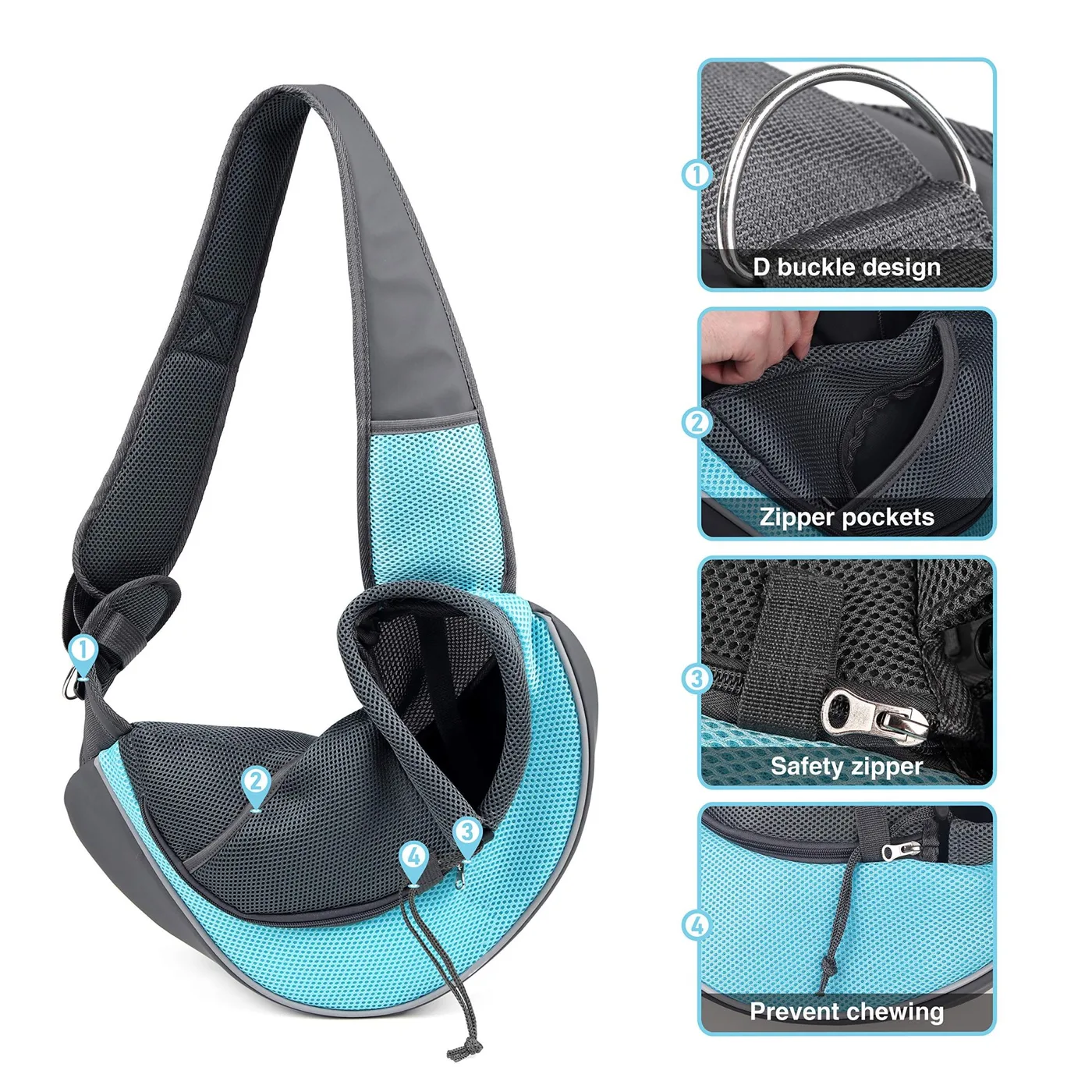
Double-Action Closures for Unsupervised Kerbside Handling
Closure architecture does most of the containment work in this category. Any single-action slider can be pushed from inside by a determined chest, especially when the panel is flexed during lifting. Specify two sequential actions before full release: a slider that must clear a stop, followed by a secondary clip or covered unit that must be disengaged deliberately.
The secondary element needs to be cheap and replaceable. A moulded clip with its own tooling is worse than a standard attachment available from several sources, because a lost or broken one strands inventory. Standard attachments also let us quote for shared components across the whole programme, which lowers the effective MOQ on each individual part.
Instructional clarity decides whether any of this works. Photograph the two-step sequence for the hangtag, keep each step to one hand, and avoid printed paragraphs that assume the reader already understands the mechanism. Trial it with people who have never handled that particular model; their hesitation locates the real problem faster than any internal review.
Finally, test release under a pushing load rather than only in the static state. Place a weighted form inside, press outward from beneath the panel while emulating a dog leaning against the closure, and record whether anything disengages. This test costs minutes and catches the majority of escapes reported after launch.
Abrasion of the indicator deserves a line in the specification too. Contrast tabs lose their coating quickly when they rub against a lead or a car door frame, and once faded they stop signalling anything. Require retained contrast after a defined rubbing cycle and keep a dated photograph beside the reference unit for comparison at final inspection.
Closure rule: Two deliberate actions, standardised hardware, one illustrated step per action, and a push-release test carried out with a weighted form inside every prototype.After-Dark Returns: Trim Evidence Rather Than Trim Claims
Visibility claims are easy to make and hard to defend. Listing copy saying highly visible at night means nothing unless someone measured reflected return from the finished assembly after abrasion, and marketplace compliance teams increasingly ask for exactly that. Ask instead for a stated coefficient of retroreflection and evidence taken after washing.
Trim position beats trim area. A continuous band around the lower body panel is read by approaching headlights far earlier than a decorative logo transfer, and it survives contact better than anything printed. Keep any branding transfer clear of the visible-scope band so nobody has to choose between marketing impact and safety.
Abrasion is the quiet killer of visibility performance. Cheap transfer film delaminates along the edges first, leaving islands of reflective material and a listing that can no longer be sustained. Specifying a minimum retained performance after a defined abrasion cycle is more useful than specifying initial brightness, because nobody argues about day-one appearance.
Appropriate references for the technical file include the U.S. Consumer Product Safety Commission for general consumer-product obligations and the American Veterinary Medical Association for guidance on animal handling behaviour. Both should be cited as current destination requirements inside the specification; neither replaces lot-specific laboratory results.
Colour choice interacts with every visibility decision. Dark shells photograph well in studio lighting and then disappear against a wet road at dusk, so insist that proof photographs are taken outdoors rather than in a light box. Where the palette must stay dark, increase trim coverage rather than relying on the shell itself to provide contrast.
Visibility rule: Ask for retained retroreflective performance after abrasion and washing, not initial brightness, and never let branding artwork sit inside the visibility band.
Prototype Trials Run by People Who Have Never Used It
Internal teams are the worst possible test subjects because they know how the mechanism is meant to work. Recruit five participants unfamiliar with the model, hand them the sample with its retail packaging and no verbal briefing, then ask them to load a weighted form, secure everything and report closure status. Record hesitation, not completion.
Where possible, run the same exercise at dusk or in a dim car park. Most real usage happens in poor light, and a design that is obvious under warehouse fluorescents frequently disappears on a grey evening. This step regularly finds problems that no amount of internal discussion surfaces.
Insist on two rounds whenever electronics enter the bill of materials. The first round confirms sewing and pattern; the second confirms the module, the port placement and instruction legibility together. Combining them into a single round saves perhaps a week and risks discovering an access problem after tooling has begun.
Finally, capture everything in a signed record: photographs of each closure position, measurement setup for any trim test, and the participants noted observations. That file is what lets quality control later decide whether a shipment matches what was approved, rather than relying on memory.
Keep one unopened retail pack in the reference file as well. Later disputes frequently concern what the customer was shown rather than what was delivered, and having the original carton, insert and hangtag together settles those questions quickly when a shipment is already halfway across an ocean.
Trial rule: Validate with unfamiliar handlers, in realistic light, using retail packaging only, and archive photographs from every session alongside the signed reference unit.Pricing, Listing Copy and Claim Discipline
Establish what each price tier buys before comparative shopping. Entry configuration uses high contrast and closure redundancy only, landing near the lower end; mid tier adds panel upgrades and exterior trim; top tier carries a vibration module and protected power access. Costs move most when a power source enters, which is why that decision comes first.
Write copy from the evidence file backwards. Every sentence on the listing should map to a recorded test or a measurable attribute: a closure requiring two deliberate actions, retained retroreflection after X cycles, a replaceable cell accessible without tools. Anything unmatched should be deleted before the page goes live.
Then prepare the claim boundaries with the channel. A bag that helps handlers manage an occupant which cannot hear them is a support product; one that claims to guarantee safety or cure anxiety is a liability waiting for a lawyer. Require written agreement from marketplace compliance staff before launch, not after the first complaint.
Return coding closes the loop. Classify incoming complaints by cause rather than by outcome: escapes, perceived failure to attract attention, misread status, wrong size. Two seasons of that data will tell you far more about where to invest than any amount of internal discussion, and it gives purchasing a defensible basis for the next specification.
Negotiation order matters as much as the target number. Establish the attention mechanism, closure redundancy and both structural elements first, then trade closing candidates elsewhere: pocket count, print colours, hangtag stock, master carton strength. Those concessions are visible to nobody but the accounts team, whereas weakening any protected element shows up on the return desk within weeks.
Listing rule: Every public sentence traces to recorded evidence, and claim boundaries are agreed in writing with the selling channel before the first unit ships.Retail Packout, Inserts and What Store Staff Actually Touch
Packaging for this segment does a job that normal soft goods rarely ask of it: it teaches a two-step mechanism before purchase. A shopper who cannot see how the unit secures will not pay a premium for it, and front-of-box illustration is the cheapest way to communicate that. Keep the diagram on the primary face, above any barcode zone.
Inserts should mirror what the trial validated. If participants needed two frames to reproduce the sequence, the leaflet uses two frames. Do not let a copywriter compress it into prose because prose reads better; comprehension data from the trial outweighs aesthetic preference, and the return desk proves this within one season.
Store staff handle the unit long before the customer does, mostly for shelf replenishment and price changes. A hangtag that obscures the indicator tab or partially covers the observation panel will be repositioned dozens of times a week, and each reposition risks tearing the trim it sits against. Place attachments so they never cross the visible band.
Carton engineering also matters because these units are bulky relative to weight. Ask your forwarder to model both unit-master and pallet configurations, since a small change in fold direction can shift the cube enough to pay for a print upgrade. None of this appears in the unit price, yet all of it reaches the margin.
Finally, agree who holds artwork liability. We supply print files and physical proofs; your compliance team confirms that warnings, recycling symbols and any required marking satisfy the destination. Dividing that responsibility explicitly prevents a late relabelling exercise that could otherwise consume the shipping window. Keep every approved file under a version number so nobody accidentally sends an obsolete diagram to the printer.
One further practical point concerns returns testing at your own warehouse. Open a random carton each month, walk the trial programme again with someone new, and log any hesitation. Product knowledge decays faster than most teams expect, and regular repetition costs one hour while protecting the specification every time.
Packout rule: Let the mechanism drive the illustration, keep attachments clear of the indicator and banding, and name artwork sign-off owners before the print files are released.Order and quality terms
- MOQ 500 pieces per colourway; samples in 6-10 working days
- Bulk production 35-50 days after approval; AQL 2.5 inspection standard
- T/T 30/70 terms, FOB Xiamen, full document set per shipment
People Also Ask
Is this essentially the same unit with different marketing?
No. The closure sequence, observation layout and indicator placement differ from a standard soft carrier, all of which are physical rather than promotional. Sellers who simply add wording without changing the mechanism generate complaints quickly, because nothing in the product actually changes.
Which feature should be protected if the price must fall?
Never the secondary closure. Exterior trim, print complexity and pocket count can all be reduced safely, whereas removing the second release action returns the containment problem the range exists to solve. Reduce decoration first, then reconsider any electronic element.
What is the realistic price spread before freight?
Expect roughly USD 7.10-13.90 FOB. Variation comes almost entirely from whether a power source is included and from how much retroreflective trim is applied. Compare offers only after each is broken into shell, lining, hardware, module, trim, labour, testing and packing lines.
Should every unit carry a vibration module?
Not necessarily. It suits channels with trained staff and higher price points; it complicates cleaning, storage and warranty for everyone else. Many successful assortments offer one electronic SKU alongside one purely mechanical alternative, letting the customer choose.
How visible does the interior really need to be?
Enough for a handler to judge posture and breathing without opening anything. One generous observation zone beats full-perimeter mesh, which raises alertness and lets draughts through. Dusk trials with people unfamiliar with the model show whether the layout actually achieves this.
Can instruction illustrations be simplified to a single image?
A single image rarely works because the secure sequence has two deliberate actions. Use one frame per action with the hands visible and no surrounding text. Any step participants cannot reproduce without asking counts as a design fault rather than a documentation one.
How long do reflective finishes last?
Performance depends on abrasion and film quality rather than on initial appearance. Ask for retained-return figures after a defined abrasion and wash count, and require the same evidence for replacement lots. If the supplier cannot produce it, assume the trim is decorative.
Frequently Asked Questions
Can we source this range without any electronic components?
Yes, and many channels should. A high-contrast interior, redundant closures and retroreflective trim deliver most of the practical benefit at a far lower unit cost, with no power, no port and no resulting warranty obligation. Electronics suit sellers prepared to train staff and answer service questions; they rarely suit price-led marketplaces.
How do we confirm a closure is actually seated before lifting?
Specify one visible indicator per closure, usually a contrast tab that only aligns when the slider clears its stop. Trial participants then need to identify status at arms length in dim conditions. If they cannot, the indicator is decorative and should be redesigned before the order is placed.
What is the realistic production calendar here?
Prototype units take 6-10 working days once the specification, artwork and any reference parts are confirmed. Volume runs 35-50 days after the physical unit is signed. Electronics extend both because the module requires sourcing before cutting starts, so identify that requirement in the first enquiry.
What order size should be budgeted?
Plan around MOQ 500 pieces per colorway for a standard construction. A dedicated electronic module, custom moulded hardware or mill-dyed fabric can carry its own supplier minimum, and those should be identified before any purchase order is issued rather than discovered at the sourcing stage.
Which payment and delivery basis applies?
The standing basis is T/T, thirty percent deposit with seventy percent against documents, quoted FOB Xiamen. If your logistics team prefers a different Incoterm, request a separate landed calculation instead of comparing it directly with ex-works pricing, since freight can alter which option is genuinely cheaper.
Who pays when a vibration unit arrives discharged?
Settle the split before quoting. A common arrangement covers genuine defects appearing within a stated period of receipt, while damage arising from immersion or incorrect cleaning sits with the importer. Agree isolation with a pull tab for long storage so such cases remain rare in the first place.
What does the inspection level cover for this product?
Final release uses AQL 2.5 with defects grouped by consequence. Any closure that releases under push, any missing indicator tab and any non-functioning module count higher than print variance or minor shade difference. Written definitions stop an inspector applying generic soft-goods tolerances.
Who owns the care label and cleaning instruction content?
Standard terms are thirty percent deposit and seventy percent against documents, quoted FOB Xiamen. Requests for other Incoterms are handled as separate landed proposals so they can be compared with the ex-works figure on equal footing rather than mixed into one number.
Can we match an existing shell we already import?
Often yes, provided you supply a physical reference and the original component codes. Matching a panel location or adding an indicator tab is straightforward; matching an existing electronic mount is rarely possible without the original tooling drawing. Send the unit itself rather than photographs.
Do reflective elements need separate documentation?
They help. Ask the laboratory reports to cover retained performance after abrasion and laundering on the finished assembly, and keep the lot reference with the golden sample. Initial brightness figures alone are weak support when a marketplace compliance team asks for evidence.
Will carton artwork be able to carry the two-step instructions?
Packaging can be developed alongside, but approve structure and mechanism first. Illustrations must not sit over fold lines, and any warning panel should stay legible after the hangtag is attached. We supply the print files; your compliance team remains responsible for wording approval per destination.
Can several nearby items share one container?
Mixed loads are practical when ex-factory dates, carton marks and inspection bookings are coordinated. Model space by packed volume rather than unit value, because these units are light for their size and often fill a container well below its weight limit.
How do we handle a repeat of the same model next season?
Quote the original reference number and component codes, then list only intentional changes. Shade lots, coatings and electronic batches drift between runs, and treating them as interchangeable merely because the visible design is unchanged is a frequent source of disappointed customers.
Talk to QUANZHOU JUNYUAN BAGS about a wholesale pet bag order: MOQ 500 pieces per colourway, samples in 6-10 working days, bulk production in 35-50 days under AQL 2.5 inspection.
Get a free quote Request a sample