Pet Booster Seat: Elevated View
Elevated seating pays off when the platform adds 12-26 cm of lift, holds the animal's chest line under the window sill, and still leaves a belt channel that lies flat on the vehicle cushion. Order entry begins at MOQ 500 pieces per colour. Beyond roughly 26 cm the base needs a rear brace and a headrest tether, because the taller stack raises the centre of mass and turns ordinary braking into a tipping event.
Retailers who reorder booster seats are buying a repeatable lift figure, not a cushion with a strap attached. A programme survives on three measurable items: how far the platform rises, how wide the load-bearing footprint is, and how the belt channel is cut underneath. Miss any of those and the unit slides across the vehicle bench no matter what the cover fabric cost. Our commercial frame is MOQ 500 pieces per colour, prototypes in 6-10 working days, volume output in 35-50 days, and release against AQL 2.5. Settlement runs T/T 30/70 with FOB Xiamen as the default basis. Two height tiers normally cover an opening assortment; four tiers fragment the buy and raise unit cost without adding shelf presence. Split the quotation into lift block, base board, harness channel, removable liner and carton packing so any price move can be traced to one component. Our production team coordinates through an SGS-verified production base and partner facilities able to issue BSCI and ISO 9001 files on request. Keep catalogue copy to measured rise, declared working load and belt path geometry, and avoid crash-protection wording unless a complete-system test report exists for the finished assembly.
Pet bag retail buyers and pet bag wholesale business owners look at the same unit cost from opposite ends, and Pet Bag Types & Styles is where those numbers meet. Pet bag procurement teams normally fix quality first and negotiate price second, which is why pet bag supplier selection is really a documentation exercise.
How Much Lift Justifies a Booster Platform
Lift is the single number that separates a booster from a flat cushion, and it is also the number most often guessed instead of measured. The useful reference is not the animal's overall height but the distance from its shoulder blade to the top of the door sill with the door closed. Once that gap is known, the platform rise can be set so the animal's eye line clears the sill without the chest resting on the trim. For small breeds in the 4-9 kg bracket that gap usually falls between 14 cm and 22 cm, which explains why the commercial sweet spot sits in the mid-teens to low twenties.
Specifying lift as a range rather than a fixed value protects the buyer on two fronts. Vehicles differ: a compact hatchback has a lower sill and a shallower rear bench than a mid-size crossover, so a single rigid height will over-lift in one cabin and under-lift in another. Animals differ too, since a long-backed breed sits differently from a compact one even at the same mass. Writing 18 cm plus or minus 2 cm, measured from the compressed top surface under a 5 kg static load, gives the factory a defensible target and gives the inspector a repeatable method.
Lift also carries a cost signature. Each additional centimetre of side wall adds fabric, foam and sewing time, but the jump is not linear: beyond about 24 cm the base usually needs a stiffener board or a moulded insert to stop the walls folding outward, and that insert changes both the bill of materials and the packing cube. A 20 cm seat may ship 12 units per carton while a 28 cm version ships 8, which quietly moves the landed cost by several percent before any fabric is discussed.
Buyers should settle the lift band before choosing colours, because the band fixes the tooling, the pattern and the carton. Changing the band after the pre-production sample is approved means new foam dies, revised patterns and another sample cycle, and that rework consumes weeks of the production window. The cheapest lift decision is the one made during the RFQ.
Reading the Platform Height-to-Weight Ratio
A booster platform behaves like a lever. The higher the load sits above the belt line, the more lateral force reaches the anchor points during cornering, and the more the foam walls have to resist shear rather than simple compression. Practical sourcing therefore pairs each lift band with a maximum declared animal mass and a minimum footprint. A wide, shallow seat for a 6 kg animal is stable; a narrow, tall seat for the same animal is not, even where both use identical fabric and identical foam density.
The grid below is the working matrix we hand to buyers during the RFQ stage. It ties lift band to footprint, belt channel style and an indicative FOB band so that a price conversation can start from geometry instead of from a photograph. Figures assume a 600D polyester outer, 25 kg/m3 slab, a removable liner and a plain carton; decorative quilting, printed panels or branded hardware move the band upward.
| Lift band | Platform rise | Declared animal mass | Minimum footprint | Belt channel style | Indicative FOB |
|---|---|---|---|---|---|
| Compact | 12-15 cm | up to 5 kg | 38 x 30 cm | Single waist pass-through | USD 7.20-9.40 |
| Standard | 16-20 cm | 5-9 kg | 44 x 34 cm | Dual sleeve with grip strip | USD 9.60-12.80 |
| Tall | 21-26 cm | 9-13 kg | 50 x 38 cm | Dual sleeve plus rear brace | USD 12.40-16.20 |
| Extended | 27-30 cm | 13-16 kg | 56 x 42 cm | Braced sleeve with headrest tether | USD 15.80-20.40 |
Footprint is the column buyers most often try to shrink. Reducing width by 4 cm saves perhaps USD 0.35 in fabric and foam, yet it also cuts the contact patch that resists sliding, and the resulting returns cost far more than the saving. The safer economy is to drop one lift band while keeping footprint, because the animal still gains a clear sight line in most cabins while the unit stays stable and ships in a tighter carton.
Declared mass should be printed on the hangtag and repeated in the listing. A seat declared to 9 kg and loaded with a 14 kg animal will deform the slab and eventually split the belt sleeve, and the resulting complaint is a specification failure rather than a manufacturing defect. Publishing a conservative number protects the retailer and the importer together.
Cushion Core Options: Foam, Board and Air Layers
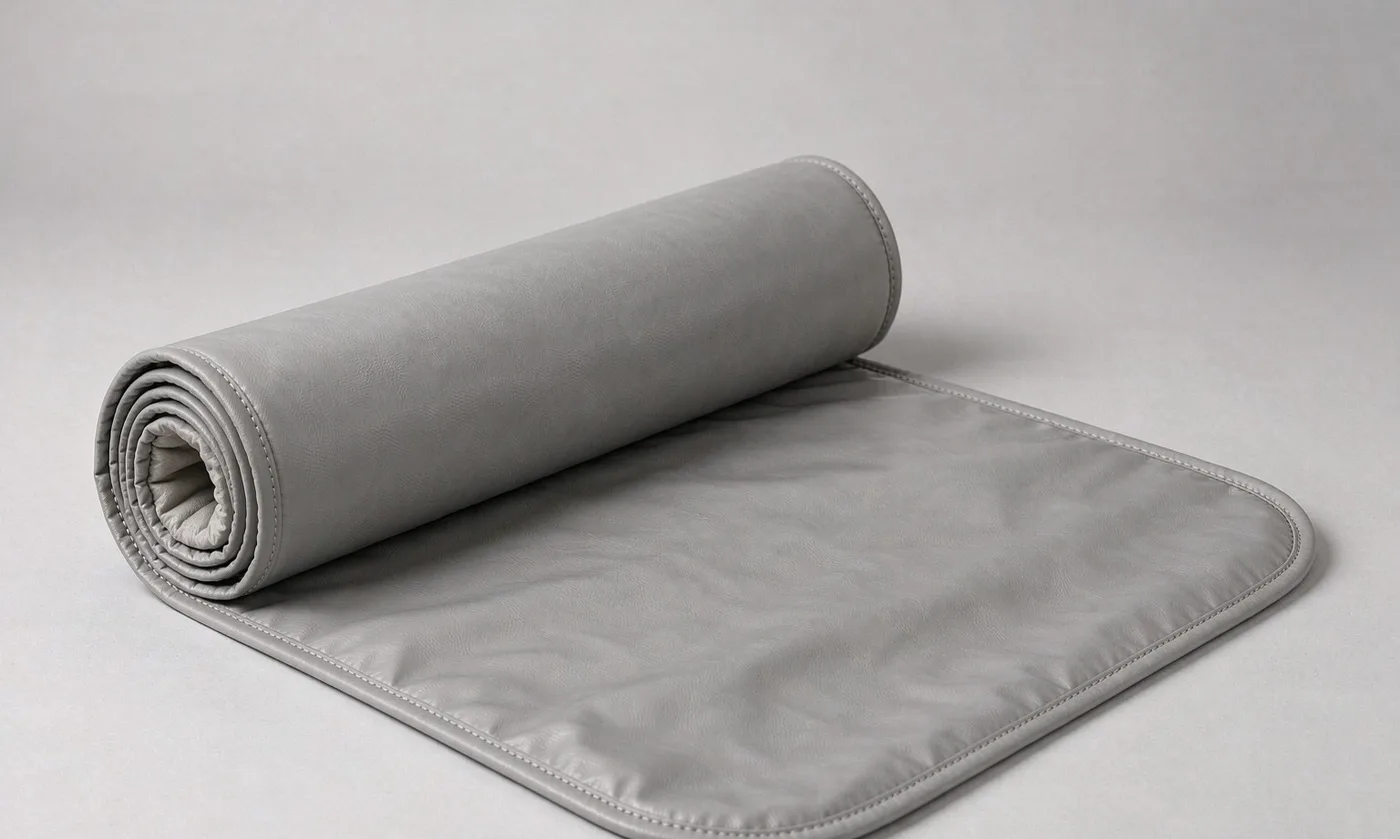
The core decides whether the declared lift survives a season of use. Three constructions dominate the wholesale market, and each carries a distinct cost, weight and recovery profile. Understanding the trade lets a buyer choose the cheapest core that still holds its height, rather than upgrading the cover fabric and hoping for the best.
- Single-density slab foam. The usual opening choice at 20-28 kg/m3. Cheap, light and easy to cut, but it loses 8-12 percent of its height after a few thousand compression cycles, which quietly erodes the lift the customer paid for.
- Laminated foam over a stiffener board. A 3-5 mm board under the slab stops the base dishing and lets the walls stand without extra foam. Adds roughly USD 0.90-1.40 per unit and about 140 g, but holds rise within 3 percent.
- Dual-density build. Firm base layer, softer top layer. Better comfort and good recovery, at a 15-25 percent core cost premium and a slower cutting operation.
- Air or inflatable insert. Attractive for freight because it ships flat, but puncture risk and slow filling make it a poor fit for mass retail where the unit is used daily.
Recovery testing is worth writing into the sample protocol. Compress the platform to 50 percent of its height for 22 hours, release, and measure after 24 hours; a core that has not returned to at least 92 percent of original rise will sag in the field. The method is a simple adaptation of compression-set thinking used across foam supply chains and costs nothing to run at the factory bench.
Core choice also interacts with the removable liner. A soft slab under a loose liner lets the animal sink into a pocket, which reduces effective lift by a centimetre or two and makes the seat feel smaller than specified. Where the declared lift matters for marketing, pair a firmer core with a taut liner so the published number matches what the customer measures at home.
Seat Belt Routing Paths That Actually Hold
A booster is only as secure as the path the vehicle belt takes through it. Four routing styles appear in the market, and their real-world holding power differs far more than their photographs suggest. Buyers should specify the channel explicitly, including its width, its lining and whether the belt is gripped or merely passed through.
- Open pass-through. Two slits in the base; the belt slides under the platform. Fastest to fit and cheapest to make, but it allows lateral drift and is the style most associated with sliding complaints.
- Closed sleeve. A fabric tunnel across the underside. Better lateral control, slightly slower fit, marginal cost increase.
- Sleeve with grip strip. A silicone or rubberised band inside the tunnel. Meaningfully reduces creep during braking; adds about USD 0.30 and needs a bonding step that must be inspected for edge lift.
- Sleeve plus rear brace. The tunnel combined with a strap that ties the seat back to the headrest post. Required above roughly 26 cm of lift, and the only configuration we recommend for the Extended band.
Channel width should be stated as a finished dimension, not a cut dimension. A 50 mm cut that closes to 44 mm after binding will not accept a 48 mm belt tongue without forcing, and forcing is what tears the binding in the field. Ask the sample report to record the finished opening with a gauge, and keep a tolerance of plus 2 mm and minus 0 mm.
Harness attachment is a separate decision from belt routing. A short internal tether clipped to the animal's harness keeps it inside the platform, but the tether webbing, its stitch pattern and the clip rating all need their own specification. Webbing of 20-25 mm with a box-stitched attachment and a declared break strength above 200 kgf is a reasonable wholesale baseline; anything lighter invites a claim the importer cannot defend.
Vehicle Fit Trials Across Three Cabin Types
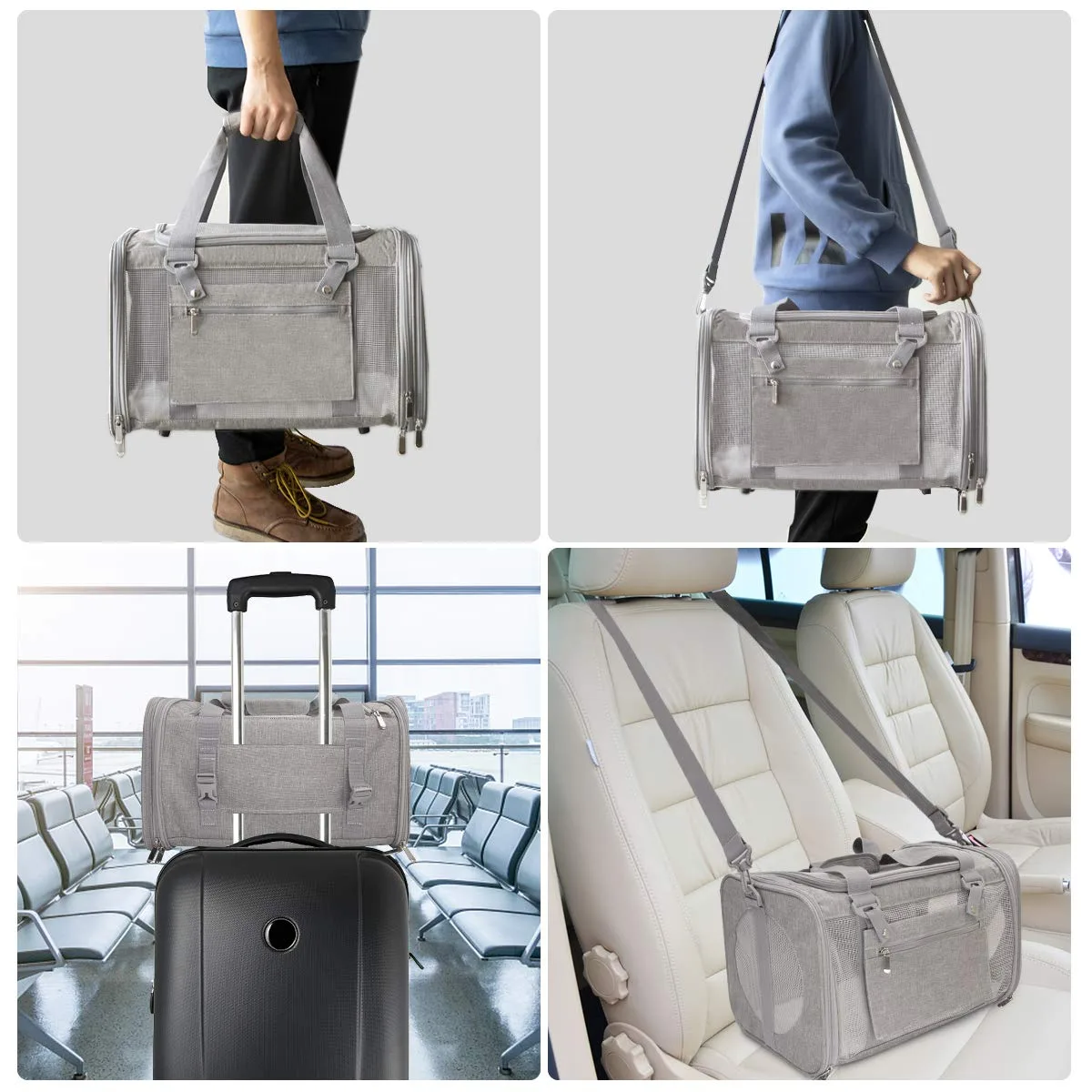
Fit failures are the most expensive category of booster complaint because they surface only after the unit reaches a customer's car. A structured fit trial during sampling removes most of that risk for very little money. The minimum useful exercise covers three cabin archetypes: a compact hatchback with a shallow bench, a mid-size sedan with a contoured bench, and a crossover with a flatter, higher bench.
For each cabin, record four observations. First, whether the belt tongue reaches the buckle without stretching the webbing. Second, whether the platform sits level or tilts more than 5 degrees fore and aft. Third, whether the side walls foul the door trim or the centre armrest. Fourth, whether the animal's chest line lands below the sill when the seat carries the declared mass in a static test. Photograph each position from the same angle so the record can be compared against the next sample round.
Bench contour matters more than bench width. A seat that is 44 cm wide fits a 140 cm bench in every cabin on paper, yet a deeply contoured bench will leave the platform bridging a hollow and rocking under load. Adding a shaped filler wedge under the base, or specifying a slightly softer lower foam layer, resolves most cases for under USD 0.50 per unit.
Buyers selling into markets with a high share of pickups and large SUVs should add a fourth archetype. Rear benches in those vehicles are often wider and flatter but sit higher, which reduces the lift needed for a clear sight line; selling a 26 cm seat into that fleet means selling unnecessary height, unnecessary foam and an unnecessary carton. Matching the band to the fleet is a genuine margin decision, not a detail.
Wording the Visibility Benefit Without Overclaiming
The commercial promise of an elevated seat is a better outward view, and that promise is defensible when it is phrased as geometry. A sentence such as "raises the animal by 18 cm so its eye line clears a typical door sill" is measurable. A sentence such as "reduces travel anxiety" is a physiological claim that no fabric supplier can substantiate and that invites regulatory attention in several markets.
Crash-performance language needs particular care. A booster sold as a comfort and visibility accessory is a different regulatory object from a restraint tested as a safety device. Where a retailer wants safety framing, the honest route is a full-system dynamic test on the finished assembly with the harness included, documented by a recognised laboratory. Without that report, copy should stay with containment and visibility. Independent programme information is available from the Center for Pet Safety, and testing language for restraint assemblies is published by ASTM International.
Listing copy should also state the declared mass and the fit limitation plainly. A sentence such as "sized for animals up to 9 kg; check rear bench width before purchase" reduces returns more effectively than any photograph, because it sets the expectation at the point of sale. Retail marketplaces increasingly treat mismatch returns as a seller-performance signal, so this wording carries direct commercial value.
Finally, keep the word "elevated" tied to a number everywhere it appears. If the hangtag says elevated but the specification sheet says 14 cm and the competitor says 22 cm, the listing loses the comparison on the parameter the customer actually cares about. Numbers win this category.
Unit Cost Drivers in a Booster Build
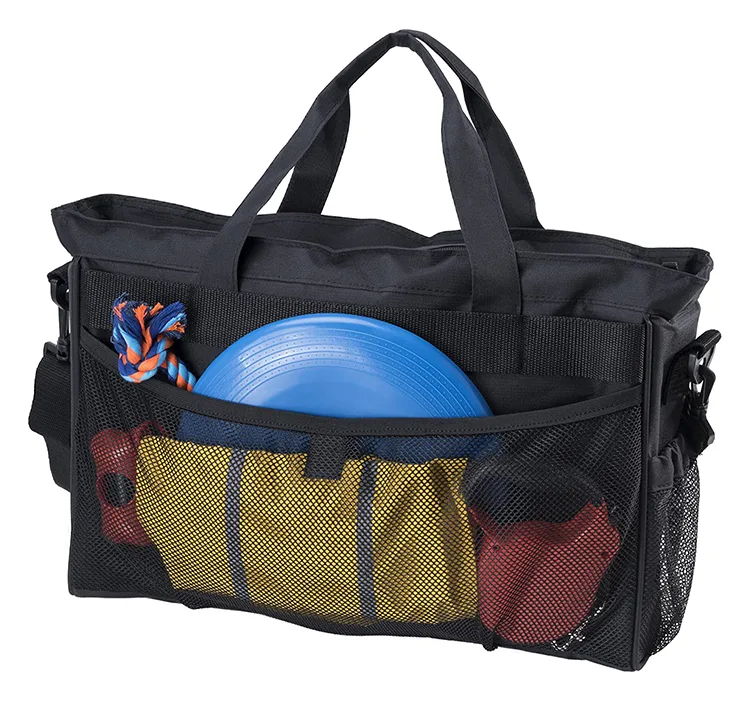
Booster quotations look opaque because the visible parts are cheap and the expensive parts are hidden. Understanding where the money sits lets a buyer negotiate a specific component instead of asking for a blanket discount that usually comes back as a thinner slab or a lighter board.
- Core and stiffener, 26-34 percent. Foam volume scales with lift and footprint, and the board adds both material and a handling step.
- Outer fabric and lining, 22-28 percent. Driven by denier, coating and whether the liner is a second full panel or a partial one.
- Hardware and webbing, 12-18 percent. Clips, adjusters, grip strip and the tether assembly. Metal hardware roughly doubles this line against acetal.
- Labour, 14-20 percent. Wall assembly, sleeve binding and liner fitting dominate; complex quilting can add 4 percent on its own.
- Packing and freight, 8-12 percent. Compression straps and vacuum packing can lift carton count by 30-40 percent and are usually the cheapest available saving at volume.
Volume behaviour is worth planning for. Moving from 500 to 2,000 pieces per colour typically takes 6-9 percent off unit price, mostly through foam nesting and cutting efficiency rather than fabric. Moving from 2,000 to 10,000 adds another 3-5 percent. Colour count works in the opposite direction: three colours at 500 each cost more per unit than one colour at 1,500, because fabric minimums and changeover time are charged per shade.
Where the budget is fixed, the correct sequence of cuts is decorative quilting first, then printed panels, then hardware finish. Never cut foam density or board thickness to hit a price, because those two items are what the lift claim depends on, and a seat that sags invalidates the whole marketing proposition.
Release Criteria Before the First Container
Final random inspection on a booster programme should be built around the three things that generate complaints: lift loss, belt channel failure and liner fit. A general-purpose checklist will pass a container that still produces returns. The acceptance file below is what we recommend attaching to the purchase order so the inspector and the factory work from one document.
| Check | Method | Acceptance | Sample size |
|---|---|---|---|
| Platform rise | Measure corner to corner after 24 h rest | Within plus or minus 5 mm of approved sample | 5 per colour |
| Belt channel width | Gauge the finished opening | Specified width, plus 2 mm, minus 0 mm | 5 per colour |
| Tether attachment | Pull test at declared load | No stitch failure, no clip deformation | 3 per colour |
| Liner removal and refit | Cycle three times | No seam stress, no zipper jam | 3 per colour |
| Carton drop and count | Standard corner drop, recount | No rise loss above 3 mm, count correct | 1 carton per 50 |
Documentation should travel with the goods, not after them. The shipment pack normally includes the inspection report, a foam density certificate, a hardware declaration, the test report behind any claimed water or abrasion performance, and BSCI plus ISO 9001 references from the SGS-verified production base where requested. Mills and assembly partners working to ISO 9001 quality management principles already hold most of this in their own records, so the buyer is asking for a copy rather than commissioning new work.
Book the inspection when the pre-production sample is approved, not when the goods are finished. Inspection slots at partner facilities are reserved days ahead, and a late booking is the most common cause of a missed vessel that has nothing to do with manufacturing. Prototypes take 6-10 working days and volume runs 35-50 days; a two-day inspection delay can swallow the buffer that schedule assumed.
Assortment Planning and Reorder Cadence
A booster range is small enough that assortment mistakes show up immediately in sell-through data, and the usual mistake is too many heights. Each additional lift band adds a pattern, a foam die, a carton size and a shade of inventory risk, while the customer's decision is usually made on one number. Two bands, Standard and Tall, cover the overwhelming majority of small and medium breeds and keep the buy concentrated enough to earn a better price.
Colour behaves differently from height. Two shades per band is a reasonable ceiling for a first season, because shade does not change the pattern and shares the same carton. A third shade dilutes the fabric buy without adding shelf presence, and the resulting mill minimums are charged per colour rather than per programme. Buyers planning a third shade should plan it as a second season extension once the first season's data identifies which band actually sold.
Reorder cadence deserves attention because booster foam and board have lead components within the wider 35-50 day window. A reorder placed after the shelf is empty arrives a full cycle later, which in practice means the peak weeks are served by air freight or not at all. The practical method is to place a rolling reorder at 60 percent of forecast when the first container lands, using the first two weeks of sell-through to set the size.
Seasonality in this category is milder than in outdoor ranges but real, with a lift around holiday travel periods and a second one in spring. Planning the fabric buy for both peaks at once reduces mill lot risk and usually improves shade consistency, since both production rounds can come from adjacent lots. Buyers who treat the two peaks as unrelated orders typically end up with two shades of the same nominal colour on the same shelf.
Finally, keep one approved reference unit per band in the buyer's own office, not only at the factory. When a reorder is disputed twelve months later, that physical reference is what settles whether the bulk matches what was approved, and no photograph or email thread resolves the question as quickly.
Buyers should also agree a written change procedure before the first order lands. Any future revision to the foam, the board or the belt channel should trigger a new pre-production unit and a fresh 6-10 working day cycle rather than a silent adjustment at bulk, because the lift figure on the packaging depends on those three items and cannot be updated casually.
Why brands source here
- Pet bag programmes run since 2014; founding team in sewn goods since 2004
- SGS-verified production floor of 4,950 m² with 137 workers across 7 lines
- Monthly capacity of 200,000 units, audited to BSCI and ISO 9001
People Also Ask
Do elevated seats help pets see out of the window?
Yes, when the rise matches the sill height of the vehicle. Measure shoulder to sill and choose the band that clears it; a fixed height guess will over-lift some cabins and under-lift others.
Is a booster seat the same as a car safety seat?
No. A booster is a comfort and visibility accessory. A restraint making safety claims requires a documented dynamic test on the finished system, harness included.
What size animal fits a standard booster?
Most Standard-band units declare 5-9 kg with a 44 x 34 cm footprint. Extended units reach 13-16 kg but need a brace and headrest tether.
How does carton packing affect booster freight cost?
Lift drives cube directly. A 20 cm seat may ship 12 per carton while a 28 cm version ships 8, moving landed cost several percent before any fabric change.
Why does my booster sample sag after a month?
Slab foam compression set. Specify a stiffener board under the slab, or a higher density layer, and require a 22-hour compression recovery test at 92 percent minimum.
Should I buy metal or acetal hardware for boosters?
Acetal keeps the hardware line near 12 percent of unit cost and resists corrosion. Metal roughly doubles that line and is only justified on premium tiers.
Can one booster fit both a hatchback and an SUV?
Usually yes in the Standard band. Tall and Extended bands tend to over-lift in shallow hatchback benches and should be aimed at crossover and SUV fleets.
Frequently Asked Questions
What lift height should a wholesale booster seat target?
Aim for the gap between the animal's shoulder and the door sill, which for 4-9 kg breeds usually lands at 14-22 cm. Commercial assortments are best served by two bands, Standard at 16-20 cm and Tall at 21-26 cm, rather than by one fixed figure.
Does a taller platform always sell better?
No. Above roughly 26 cm the unit needs a brace and a headrest tether, the carton grows, and the fit fails in shallow compact benches. Height sells only where the target vehicle fleet has a sill tall enough to justify it.
Which foam density holds its rise longest?
A 25-28 kg/m3 slab over a 3-5 mm stiffener board holds rise within about 3 percent across a selling season. Bare slab foam without a board typically loses 8-12 percent of height in the same period.
How is the belt channel specified on the tech pack?
Give the finished opening width with a plus 2 mm and minus 0 mm tolerance, the lining material, and whether a grip strip is bonded inside. Cut dimensions are not acceptable because binding closes the opening.
Should the tether clip to a harness or to a collar?
A harness. A collar attachment concentrates load on the neck during any sudden stop. Specify 20-25 mm webbing, box-stitched, with a declared break strength above 200 kgf.
What is the minimum order for a booster seat programme?
MOQ 500 pieces per colour. Pre-production units take 6-10 working days, volume output runs 35-50 days after approval, and final release is against AQL 2.5.
Can two height tiers share one fabric buy?
Yes, and it is recommended. Using a single 600D outer across both tiers keeps the fabric minimum concentrated and typically saves 3-5 percent against splitting the buy across two shades or two deniers.
How much does lift add to landed cost?
Each band step up adds roughly USD 2.80-4.20 through foam, wall fabric and carton volume. The Extended band also carries a brace and tether, which adds about USD 1.60 more.
Are vacuum-packed boosters safe for foam recovery?
Yes for slab foam up to about 30 days of compression, provided the pack is opened on arrival. Board-laminated cores should not be packed tightly, since the board can take a set.
What documents accompany a booster shipment?
Inspection report, foam density certificate, hardware declaration, any water or abrasion test report, plus BSCI and ISO 9001 references from the SGS-verified production base where the retailer requires them.
How do I stop sliding complaints?
Combine a grip strip inside the belt sleeve with a sufficient footprint. Reducing width to save fabric is the most common cause of sliding and costs more in returns than it saves in material.
Can crash-protection wording be used on the listing?
Only with a full-system dynamic test report on the finished assembly including the harness. Without it, keep copy to measured rise, declared mass and containment.
What fit trial should be run before approval?
Three cabins minimum: compact hatchback, mid-size sedan and a crossover. Record belt reach, platform tilt under 5 degrees, side wall clearance and the occupied chest line against the sill.
Talk to QUANZHOU JUNYUAN BAGS about a wholesale pet bag order: MOQ 500 pieces per colourway, samples in 6-10 working days, bulk production in 35-50 days under AQL 2.5 inspection.
Get a free quote Request a sample