Pet Running Bag: Jogging Gear Wholesale Specs & Cost
A wholesale pet running bag program runs at MOQ 500 pieces per colorway, with samples in 6-10 working days and bulk in 35-50 days. Expect USD 5.40-11.90 FOB Xiamen for hands-free running units, with price driven by suspension design, stretch fabric quality and reflective coverage.
Running pet bags are the most fit-sensitive category in the pet bag range. A walking bag can be loose and still work; a running bag that bounces or chafes is returned within two weeks. For wholesale buyers, that means the specification conversation has to start with suspension and size runs, not with fabric color or logo placement.
Commercial terms follow the standard framework: MOQ 500 pieces per colorway, samples in 6-10 working days, bulk production in 35-50 days after sample approval, pre-shipment inspection at AQL 2.5, T/T 30/70 payment and FOB Xiamen quotation. Production runs through an SGS-verified production base with BSCI and ISO 9001 coverage, 7 lines and 149 sets of equipment, which allows running units to be combined with other lightweight categories in a single container.
The commercial opportunity in this category is size and fit rather than novelty. Buyers who treat a running bag as a sized garment, with graded patterns and a defined fit block, consistently outperform buyers who treat it as a one-size accessory. The sections below set out how to specify the category, what the cost drivers are, and how to plan the first season around a realistic production calendar.
Wholesale pet bags uk and wholesale pet bags australia share most of the same test file, but Pet Bag Types & Styles still has to be matched to the retailer's own checklist. Pet bags wholesale china terms are usually quoted FOB, so pet bags import export cost is a separate line the buyer has to model.
Why Running Pet Bags Are a Fit Problem Before They Are a Bag Problem
A pet bag designed for jogging has to solve a problem that no other soft pet product faces: it moves with a human body that is itself moving at speed, and it carries a live load that shifts independently. The result is a dynamic system where the failure mode is not breakage but discomfort. For a wholesale buyer, discomfort converts directly into returns, negative reviews and a stalled reorder.
Three forces define the category. Vertical bounce comes from the gait cycle and is the most visible complaint. Lateral sway comes from the animal shifting position inside the bag. Rotational pull comes from the bag swinging away from the body during arm movement. A design that addresses only vertical bounce will still generate complaints, which is why the better products in this category use a combination of a compression structure, a stabilising strap, and a load position close to the body's centre of mass.
Because fit is the driver, the specification should be built around a fit block. That means defining the body-contact dimensions, the strap geometry and the adjustable range in writing, and treating them as controlled dimensions in production rather than as approximate targets. Our production team holds tolerances on these measurements because they determine whether a size run fits consistently across a shipment.
Buyers new to the category often ask for the lightest possible unit. That instinct is usually wrong. A running bag that is too light lacks the structure to control bounce and ends up feeling worse than a marginally heavier unit with a proper suspension panel. The target should be the lightest unit that still controls movement, and that is an engineering decision rather than a weight target. Buyers comparing quotes across suppliers should therefore ask for the suspension description in writing: what stiffens the load panel, how compression is delivered, and what the strap angle is. Two quotes at the same price can describe very different products, and the suspension description is the only reliable way to tell them apart before a sample arrives.
Formats in Demand: Waist, Chest, Hydration and Convertible Units
The running category splits into four formats, and each one maps to a different buyer and price band. Choosing the wrong format for a channel is a more expensive mistake than choosing the wrong fabric, because format determines whether the product fits the customer's activity at all.
Waist packs are the entry format and the highest-volume one. They suit short runs, small dogs, and buyers who want a simple product with a low return risk. The commercial limitation is capacity: a waist unit realistically carries up to about 5 kg before it becomes uncomfortable, and above that the design stops working regardless of how well it is built.
Chest and front-carry units are the specialist format. They suit small dogs and cats, keep the animal in the runner's line of sight, and are perceived as safer by buyers with small breeds. They are more complex to pattern, which pushes unit cost up by roughly USD 1.20-2.40 over a comparable waist unit, but they also command a higher retail price and tend to generate strong review content.
Hydration-integrated units are the premium format. They combine a pet compartment with a bottle or bladder sleeve, and they sell into the same channel as running hydration vests. They are the most complex to manufacture because two load systems share one chassis, and they require more testing. They also carry the highest margin, and for buyers with an established outdoor customer they are usually the most defensible SKU in the range.
Convertible units that switch between waist, shoulder and hand carry are the flexible format. They reduce SKU count for a buyer who wants one product to serve several activities, and they are popular with online sellers who need a long feature list. The trade-off is weight and hardware count, both of which add cost and add failure points.
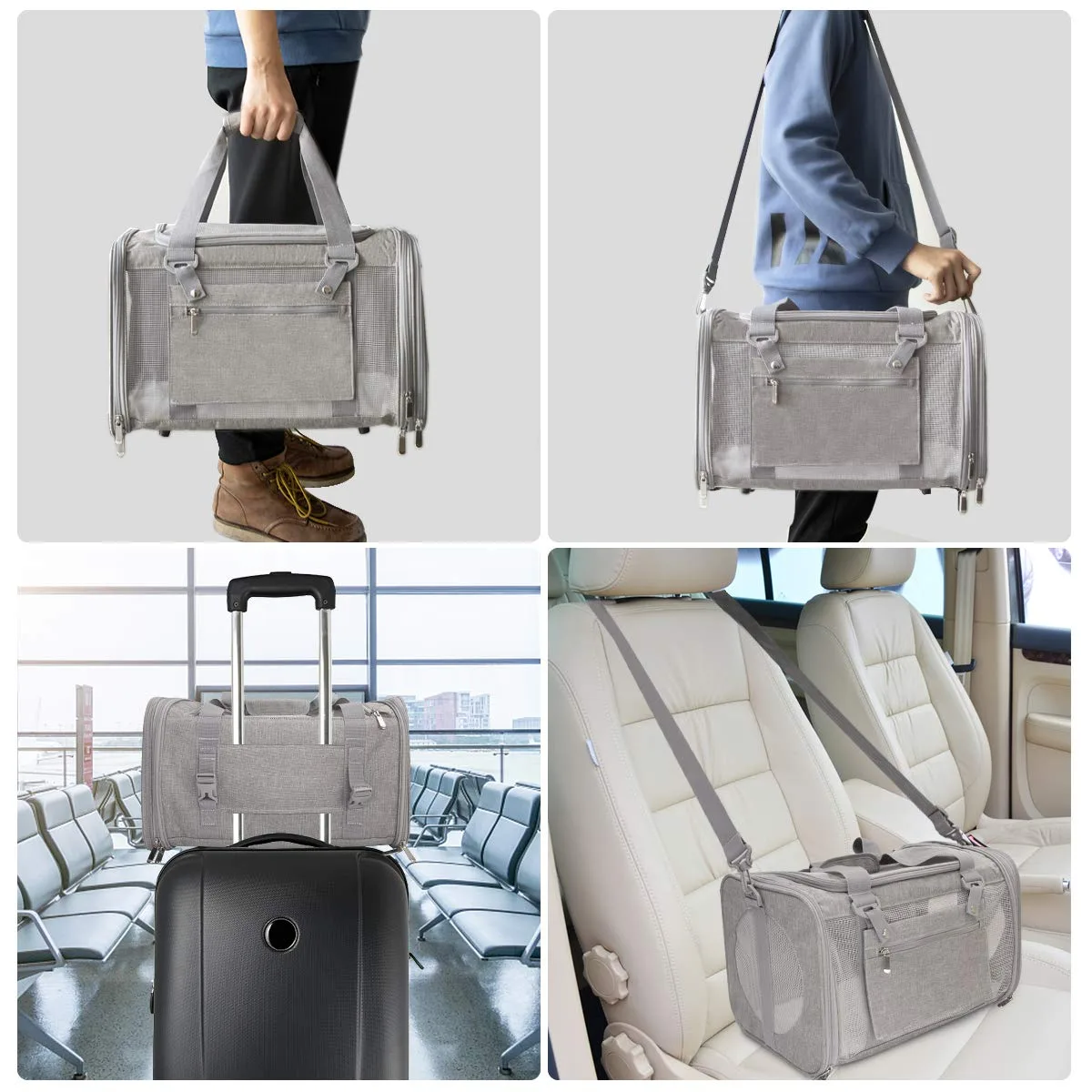
Which format to launch with
For a first season, a waist unit plus a convertible unit covers most of the addressable demand at a manageable development cost. Chest units are better added in the second season once the fit block from the waist program is validated, because the two share pattern data and the second development round is therefore much faster.
Suspension, Bounce Control and Building a Size Run
Suspension is the single most important specification in a running pet bag, and it is worth describing in detail in the tech pack. The three components that matter are the load panel, the compression system and the stabilising geometry. A load panel is the stiffened area that spreads the pet's weight across the body rather than letting it concentrate at a point. A compression system is what stops the load moving within the bag. Stabilising geometry is the strap angle that prevents the unit rotating away from the body.
Compression is usually delivered through webbing and cam buckles or through elastic panels. Webbing gives precise adjustment and holds its setting under load; elastic is more comfortable but loses tension over time and is less effective after repeated washing. For a product sold with a durability expectation, our production team generally recommends webbing compression on the main load path with elastic only in secondary shaping positions.
Size runs should be planned as a garment program rather than as an accessory program. A three-size run covering small, medium and large body types will fit the large majority of the market and keeps the MOQ commitment at 1,500 pieces if each size is ordered at the 500-piece minimum. Buyers who want to lower the commitment can run two sizes at 500 each and add the third on reorder, which is the approach most first-season programs take.
Grading between sizes needs to be specified rather than scaled. A bag scaled uniformly from a medium pattern produces a small size that is proportionally too deep and a large size whose strap geometry no longer sits correctly. Graded patterns cost more to develop but produce a size run that fits, and they reduce the return rate that otherwise erodes the margin gained from a lower unit price.
Fabrics, Moisture Management and Reflective Requirements
Close-to-body products have a different material brief from conventional pet bags. The fabric sits against skin or against a base layer for 30 to 90 minutes at a time, in wet conditions, which makes moisture management, abrasion softness and odor control more important than raw strength.
The shell is usually a lightweight ripstop or a stretch woven in the 150D to 420D range, chosen for low weight and reasonable tear resistance. The body-contact side needs a brushed or spacer construction rather than a flat coated face, because a coated face against skin becomes uncomfortable within minutes. Spacer mesh on the contact panel is the standard solution and adds roughly USD 0.60-1.10 per unit.
Moisture and odor management deserve explicit specification. Sweat and pet dander accumulate in the contact panel, and a unit that cannot be washed will generate complaints regardless of how well it performs structurally. A removable, washable contact panel is the most effective answer and is now expected in the premium half of the market. Antimicrobial finishes are available but should be requested with documentation, since claims made without supporting test data create compliance exposure in several markets.
Reflectivity is both a safety feature and, in some markets, a regulatory expectation for products marketed for use near traffic. Retroreflective piping and printed reflective logos are the two common routes; piping is more durable through washing and costs slightly more. Buyers selling into the EU should be aware that reflective elements on personal equipment are often assessed against visibility standards, and general textile standards are published by bodies such as ISO. Chemical compliance for dyes and finishes is normally handled through OEKO-TEX certification, with substance requirements set out by the European Chemicals Agency.
Cost Drivers and Realistic Price Bands
A running pet bag at USD 8.20 FOB typically breaks down as follows: shell and lining fabric USD 1.85, spacer mesh and padding USD 1.10, webbing and buckles USD 0.95, zips and hardware USD 0.70, elastic and bindings USD 0.45, cutting and sewing labor USD 2.05, QA and packing USD 0.35, and factory overhead and margin USD 0.75.
The striking feature of this build-up is the labor share. Because running units involve more panels, more binding operations and more precise assembly than a simple tote, labor accounts for roughly a quarter of the unit cost, compared with around 15 percent for a basic pet tote. That has a practical consequence for negotiation: volume discounts compress materials and overhead, but labor is comparatively fixed, so the price movement available between 500 and 5,000 pieces is narrower than buyers expect, typically 7-12 percent.
| Format | Typical capacity | FOB band | Development complexity | Primary channel |
|---|---|---|---|---|
| Waist pack | Up to 5 kg | USD 5.40-8.60 | Low | Online, pet chain |
| Chest front-carry | Up to 6 kg | USD 7.80-11.90 | Medium | Premium online |
| Hydration-integrated | Up to 7 kg | USD 9.40-14.20 | High | Outdoor specialty |
| Convertible waist-shoulder | Up to 6 kg | USD 6.90-10.40 | Medium | Online, catalog |
| Lightweight sling | Up to 4 kg | USD 4.60-7.20 | Low | Promotional, value retail |
Given that structure, the most effective cost levers are specification choices rather than price negotiation. Reducing the number of panel colours, using a stock webbing colour instead of a dyed one, and limiting reflective elements to two positions typically saves USD 0.80-1.50 combined without any measurable performance loss. Reducing padding thickness saves money immediately and costs money later in returns, so it is the wrong lever.
Buyers should also model the cost of a size run correctly. Three sizes at 500 pieces each is a 1,500-piece commitment, but the per-size tooling and pattern cost is shared, so the unit price at 500 per size is usually better than a buyer expects from a 500-piece single-SKU order.
MOQ, Sampling and Planning Around the Seasonal Calendar
Standard commercial terms apply: MOQ 500 pieces per colorway, samples in 6-10 working days, bulk production in 35-50 days after sample approval, AQL 2.5 inspection, T/T 30/70 and FOB Xiamen. Because running products are seasonal, the calendar matters more here than in most categories, and buyer-side approvals are usually what determines whether a season is met.
Sampling for a running unit should be treated as a fit exercise. The first sample confirms construction; the second confirms fit on a real body under load. Our production team recommends that buyers evaluate running samples while wearing them with an actual load, because a fit problem that is invisible on a table becomes obvious within two minutes of movement. Building that evaluation into the 6-10 working day sample window costs nothing and prevents the most common cause of a delayed approval.
Seasonality means the production slot is the scarce resource. Running and outdoor categories share the same spring shipping window, and production capacity in the months preceding it fills early. A buyer targeting a March shelf date should be sampling in the preceding autumn, not in January, because a 35-50 day production window plus transit leaves very little slack once artwork and packaging approvals are included.
Capacity itself is rarely the constraint. The production network runs 7 lines with 149 sets of equipment and around 200,000 pieces of monthly output, so a 1,500-3,000 piece running program fits comfortably alongside other categories. What buyers should plan for is the approval chain: sample sign-off, size-set confirmation, artwork approval and packaging approval are four gates, and each one can consume a week if it is not scheduled deliberately.
Testing, Inspection and AQL 2.5 on Close-to-Body Products
Inspection priorities for running pet bags differ from those for a structured bag. Because the product fails through discomfort rather than breakage, the inspection plan should weight dimensional consistency and assembly symmetry more heavily than it would for a simple tote.
The recommended checklist covers: body-contact panel placement and symmetry, strap length tolerance across the size run, buckle release force and retention under vibration, webbing anchorage strength at every load point, spacer mesh attachment integrity, binding coverage without skipped stitches, zip operation under load, reflective element position and width, wash-care label legibility, and odor assessment on finished goods. Dimensional checks should be taken against the approved size set rather than against a single sample, because drift between sizes is the defect most likely to reach a customer.
Where a buyer has published a weight capacity, a static load test and a dynamic bounce test should be documented. Test methods for textiles and soft goods are published by organizations including ASTM International, and independent verification is commonly arranged through SGS. Pet-specific safety considerations are covered in guidance from the American Veterinary Medical Association, which many retailers reference when setting their own acceptance criteria.
AQL 2.5 defines the sample size and acceptance numbers for a given shipment quantity, and it is the agreed basis for release. For this category, buyers should additionally classify any defect affecting fit or body contact as critical, because those are the defects that generate returns even though they may look minor on an inspection table.
Reading First-Season Results: Returns Data as a Specification Input
The most underused asset in a running pet bag program is the returns data from its first season. Most buyers treat returns as a cost to be absorbed and move on. In a fit-sensitive category, returns are in fact the most accurate specification feedback available, and a buyer who structures them properly can enter the second season with a materially better product at the same unit cost.
Start by separating returns into three buckets: fit-related, comfort-related and failure-related. Fit-related returns are those where the customer cites size, strap length or body placement; they indicate a grading or size-chart problem rather than a construction problem. Comfort-related returns cite chafing, bounce or heat; they indicate a specification problem in the contact panel or suspension. Failure-related returns cite broken hardware, split seams or failed zips; they indicate a component specification problem. Each bucket points at a different fix, and mixing them obscures all three.
The second step is to attach the return reason to a size and a production batch. If fit-related returns cluster in one size, the grading is wrong for that size and the pattern can be corrected for the next run at minimal cost. If failure-related returns cluster in one batch, the issue is component or process rather than design, and the fix is an inspection criterion rather than a redevelopment. Our production team can review batch-level returns data against production records when a buyer shares it, which usually narrows the cause quickly.
The third step is to convert the finding into a written specification change before the reorder is quoted. This is the point at which most programs lose the benefit, because the reorder is often placed on the original specification simply because it is faster. A one-week delay to incorporate a corrected size chart is almost always worth more than the week saved, and the correction costs nothing in unit price.
Buyers who follow this loop typically see returns fall by a third or more between the first and second season, which in a category where returns can run at 6-12 percent of units is a larger margin improvement than any achievable price negotiation.
Merchandising, Packaging and Reorder Planning
Running pet bags sell on demonstration. A customer who cannot see how the unit sits on a body will not buy it, and a customer who buys without understanding the fit will return it. Packaging and content therefore carry more commercial weight in this category than in most pet bag lines, and they should be specified alongside the product rather than after it.
At minimum, the packaging needs a fit diagram showing body placement, a size chart with body measurements rather than pet weight alone, and a stated capacity. Pet weight alone is a poor fit indicator because body shape matters more, and buyers who publish only a weight figure see higher return rates than those who publish a measurement chart.
Retail display considerations differ by channel. Online sellers need photography that shows the unit in motion on a body; specialty retailers need a packaging format that allows the product to be handled, since fit is a tactile decision. Both requirements argue against fully sealed packaging and in favour of a format that can be opened without destroying the retail presentation.
Reorder planning should be built around size mix rather than total units. In practice, medium is consistently the fastest-moving size and small is the most likely to be underestimated, so a reorder placed only against total sell-through will produce the wrong size mix. Tracking size-level sell-through from week one is the single most useful thing a buyer can do to make the second order profitable. It is also worth agreeing, before the first order ships, how a size-mix correction will be handled if the mix comes out wrong: whether the next run can be placed at 500 pieces in the fast size only, and whether the slow size can be held as finished stock for a later consolidated shipment. Settling that question in advance turns a forecasting error into a scheduling decision rather than into dead inventory, and it costs nothing to agree at quotation stage. Adjacent categories such as daily walk pet bags and hiking pet bags share fabric and hardware, so a consolidated reorder improves both price and scheduling.
Why brands source here
- Pet bag programmes run since 2014; founding team in sewn goods since 2004
- SGS-verified production floor of 4,950 m² with 137 workers across 7 lines
- Monthly capacity of 200,000 units, audited to BSCI and ISO 9001
People Also Ask
How much does a wholesale pet running bag cost?
Most hands-free running pet bags price between USD 5.40 and USD 11.90 FOB Xiamen, with hydration-integrated units reaching USD 14.20. Labor is a larger share of cost here than in simpler pet bag styles.
What size pet can you run with?
Waist and chest formats realistically suit pets up to about 5-6 kg. Above that, the load becomes uncomfortable for the runner regardless of how well the unit is built.
Do running pet bags bounce?
All of them bounce to some degree. Units with a stiffened load panel, webbing compression and a stabilising strap angle control it effectively; unstructured units do not.
Are hands-free pet bags better than a backpack for jogging?
For pets under about 5 kg, yes, because the load sits closer to the body's centre of mass. For larger animals, a structured backpack with a proper suspension system is the better choice.
What should I look for in a jogging pet bag supplier?
Look for graded size patterns, documented strap and buckle retention testing, washable contact panels, and a stated AQL inspection basis rather than a general quality claim.
Can pet running bags be washed?
They should be. A removable washable contact panel is the standard solution and is expected in the premium half of the market, because sweat and dander accumulate quickly.
Frequently Asked Questions
What is the MOQ for wholesale pet running bags?
MOQ is 500 pieces per colorway. Because most programs run a size set, a three-size launch is typically a 1,500-piece total commitment at 500 pieces per size, with pattern and tooling cost shared across the run.
How long do samples take for a jogging pet bag?
Samples are completed in 6-10 working days from specification sign-off. Buyers should plan to evaluate the sample under load while wearing it, since fit issues are the most common reason for a second sample round.
What is the bulk production lead time for running pet bags?
Bulk runs 35-50 days after sample approval. Buyers targeting a spring shelf date should be sampling in the preceding autumn, because the seasonal production slot fills early.
Can sizes be graded rather than simply scaled?
Yes, and graded patterns are strongly recommended. A uniformly scaled pattern produces a small size that is too deep and a large size with incorrect strap geometry, which increases returns.
Which fabrics are used on the body-contact panel?
Spacer mesh or a brushed construction is standard on the body-contact side. A flat coated face against skin becomes uncomfortable within minutes of running and should be avoided in this category.
What inspection standard applies before shipment?
Pre-shipment inspection is conducted at AQL 2.5, with dimensional checks taken against the approved size set. Defects affecting fit or body contact are classified as critical.
Are reflective elements required?
Reflective elements are not universally mandatory, but they are expected on products marketed for use near traffic and are often assessed against visibility requirements in EU markets. Retroreflective piping is the most durable option through washing.
What payment and shipping terms are standard?
Standard terms are T/T 30/70 with quotation FOB Xiamen. Alternative Incoterms can be quoted for buyers consolidating through their own forwarder.
Can a running pet bag include hydration storage?
Yes. Hydration-integrated units are available and typically price at USD 9.40-14.20 FOB. They are the most complex format to develop because two load systems share one chassis.
Is own-brand branding available on running units?
Own-brand support covering logos, labels, packaging and colorways is available on standard formats. It is handled as a development track alongside the wholesale range rather than as the headline offer.
How should warranty and spare parts be handled?
Buckles and webbing are the most frequently replaced parts. Agreeing a spare-parts allowance before production starts is the cheapest way to resolve field complaints without full product returns.
Can running bags share a container with other pet bag styles?
Yes. Running units are light and pack efficiently, so they are well suited to mixed containers and are often combined with walking and hiking styles that share fabric and hardware.
What compliance documents are available?
OEKO-TEX documentation can be arranged on fabrics, with REACH substance coverage for EU buyers and third-party testing through recognized laboratories. Certificates should be requested at quotation stage.
Talk to QUANZHOU JUNYUAN BAGS about a wholesale pet bag order: MOQ 500 pieces per colourway, samples in 6-10 working days, bulk production in 35-50 days under AQL 2.5 inspection.
Get a free quote Request a sample