Pet Special Needs Bag: Wholesale Sourcing and Specs
A special needs pet bag is best sourced as a modular platform: one bag body plus interchangeable support inserts, quoted at MOQ 500 pieces per colour on the body and separate minimums on each insert, with FOB Xiamen banding of USD 8.60-16.40 per configured unit. The controlling commercial decision is how many insert variants the range carries, because that sets both inventory and tooling. Samples take 6-10 working days; bulk takes 35-50 days.
Executive summary for adaptive product buyers. Special needs pet products serve a fragmented market: animals with mobility loss, limb difference, paralysis, or sensory impairment each need something slightly different, and no single configuration serves them all. The temptation is to build a bespoke product per condition, and that is commercially fatal, because each variant consumes a fabric minimum and a tooling setup while selling in small volumes. The workable answer is a modular platform with a common body and a small number of interchangeable inserts.
Commercial baseline: MOQ 500 units per colour on the bag body, separate minimums on each insert, samples in 6-10 working days, bulk production 35-50 days after sample approval and deposit, inspection to AQL 2.5 plus a load-path gate on every support attachment, payment T/T 30/70 against FOB Xiamen. Our production team develops these platforms through an SGS-verified production base operating to BSCI and ISO 9001 and records load-test data per run, which matters because a support failure in this category injures an animal rather than merely disappointing a customer. Buyers who commit to a platform rather than to a product line recover their development cost within two seasons; buyers who commission bespoke variants per condition rarely recover it at all.
Pet bag tiered pricing usually breaks at three quantity points, and Pet Bag Types & Styles determines which point is realistic for a first order. Cheap pet carriers wholesale quotes that ignore carton cubage tend to lose their advantage once freight is added, so pet bag unit cost wholesale is the only number worth comparing.
Defining the category in a specification sheet
Special needs is a market description, not a product description, and the first job of a buyer is to convert it into something a factory can build. The population includes animals with hind limb paralysis using a wheelchair, animals with a limb difference, animals recovering from surgery, animals with neurological conditions affecting balance, and animals with sensory impairments. Each group has a different requirement, and the overlap between them is smaller than most first-time buyers assume.
The common requirement is support. Every one of these animals needs help maintaining a position that a healthy animal maintains for itself, and that is what separates a special needs bag from a general carry bag. Support is provided either by the base, by a sling, or by a harness interface, and the specification should state which of the three the product uses and to what load.
The second common requirement is access. An animal that cannot position itself needs the owner to place it, which means a large, unobstructed opening and an interior without obstacles. A bag designed for an animal to walk into is the wrong starting point for this category, and adapting one produces a product that is awkward to load exactly when loading is difficult.
The third common requirement is fit. Conditions vary by individual, so an adjustable product outsells a precisely sized one in this category, even though the adjustable version is less elegant. Buyers should design the adjustment range before choosing the size.
- State which support mechanism the product uses: base, sling or harness interface.
- Design for owner loading, with an unobstructed opening.
- Prioritise adjustment range over precise sizing.
- Assume the interior will contain an animal that cannot reposition itself.
- Assume the product will be used daily for years, not occasionally.
That last point affects everything downstream. A special needs product is not an occasional-use item; it is part of a daily care routine, and it is washed, adjusted and loaded every single day. Durability and cleanability therefore matter more here than in any other pet bag category, and a specification tuned to occasional use will fail within a season.
Buyers should also resist over-claiming. Products in this category are frequently marketed with therapeutic language, and that creates both regulatory exposure and channel resistance from veterinary partners. A bag can support, position and carry; describing it as treatment invites scrutiny the product cannot survive.
Modular versus bespoke: SKU strategy and MOQ economics
The central commercial decision in this category is how to serve variety without multiplying minimums. Two strategies exist. The bespoke approach builds a distinct product per condition, which fits each user well and is commercially unworkable. The modular approach builds one body and a set of inserts, which fits each user adequately and is commercially viable.
| Parameter | Bespoke per condition | Modular platform | Adjustable single SKU |
|---|---|---|---|
| Product variants | 4-6 complete bags | 1 body plus 3 inserts | 1 bag, internal adjustment |
| MOQ exposure | 4-6 x 500 units | 500 bodies plus insert MOQ | 500 units |
| Tooling and setup | Full set per variant | One body tool, insert tools | One tool |
| Inventory risk | High, spread thin | Concentrated in bodies | Lowest |
| Fit quality | Best | Good | Adequate |
| Development cost | Highest | Moderate | Lowest |
| Unit cost at 1,000 | USD 13.20-16.40 | USD 10.40-13.80 | USD 8.60-11.20 |
| Channel fit | Specialist clinics | Rehab distributors, DTC | General retail |
| Sample lead time | 8-10 working days each | 6-10 working days | 6-8 working days |
| Bulk lead time | 45-50 days | 38-50 days | 35-45 days |
| Re-order flexibility | Poor | Good | Best |
| Inspection gate | AQL 2.5 plus load test | AQL 2.5 plus load and interface test | AQL 2.5 |
The modular row is the right answer for most buyers. It concentrates inventory in one body that sells across conditions, and it lets a distributor configure at the point of sale rather than at the point of import. The insert minimums are lower than a bag minimum, which is what makes three variants affordable rather than aspirational.
The adjustable single SKU row is the right starting point for a buyer entering the category. It carries the least risk, it reveals which conditions the market actually asks for, and the sales data from it tells the buyer which inserts to develop next. Launching with three inserts before knowing the demand mix is the most common and most expensive mistake in this segment.
The bespoke row has a narrow legitimate use: a specialist clinic or a rehabilitation provider with a defined patient population and a funding source that supports development. Even there, the buyer should confirm that the volume justifies four fabric minimums before commissioning the work.
Wheelchair and mobility-aid compatibility
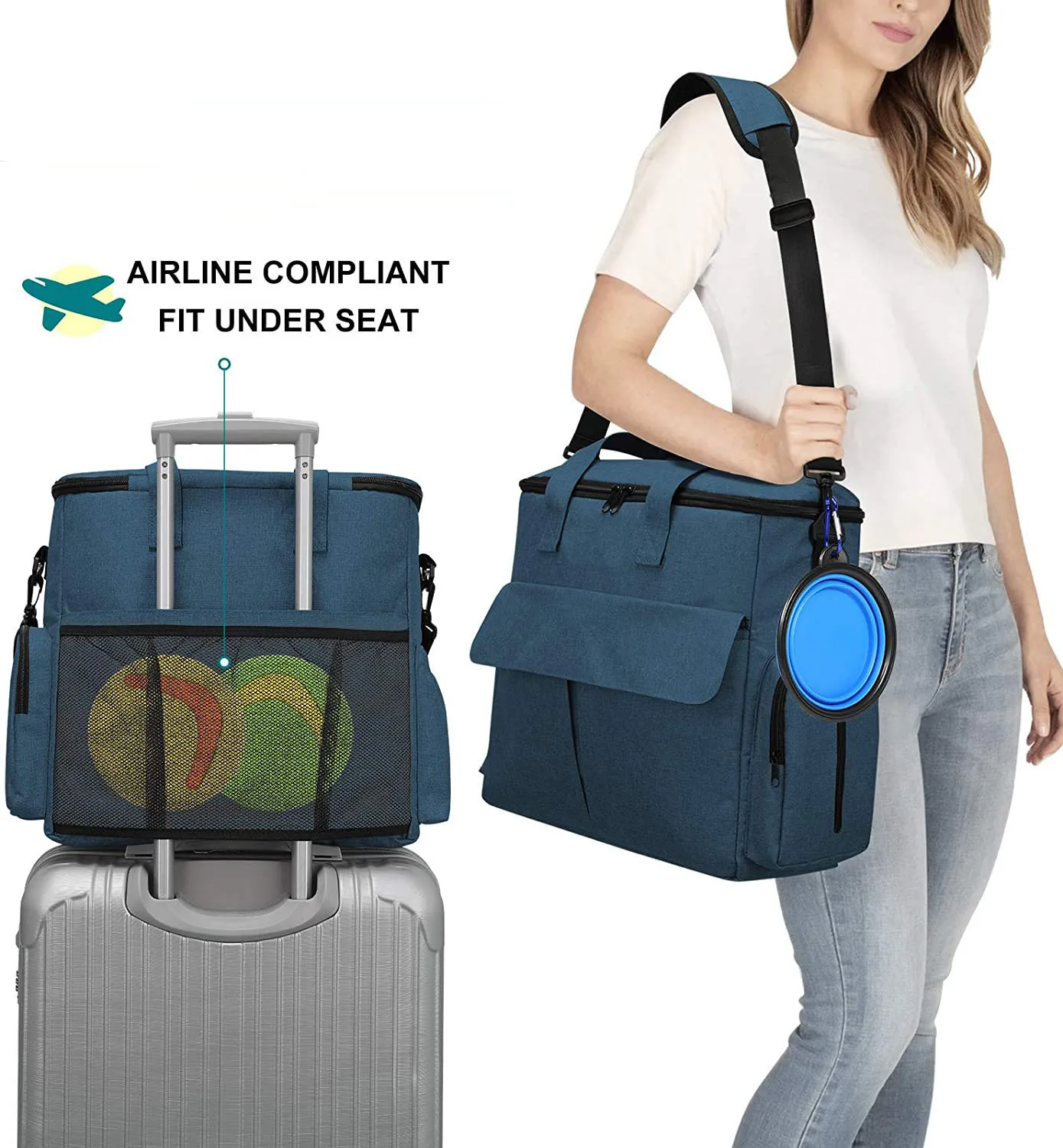
A meaningful share of the market involves animals using a wheelchair or a cart, and the bag has to coexist with that equipment rather than fight it. The practical requirements are a low profile that does not foul the frame, attachment points that reach the cart rather than the animal, and a shape that does not shift the animal's weight in a way the cart is not designed to carry.
Attachment is the specification that matters most. A bag clipped to a cart frame is carrying load through a different path than a bag carried by an owner, and the attachment hardware has to be rated for vibration and movement as well as for static weight. Buyers should specify the attachment interface precisely, test it on the actual cart models their customers use, and require a load test with a safety factor rather than a single rated figure.
Interior clearance is the second consideration. An animal in a cart has its hindquarters supported by the equipment, and a bag interior designed for a fully recumbent animal may not suit one that is partly supported. Buyers should state which configuration the product is designed for, and should offer an insert for the other rather than pretending one interior suits both.
Removability matters for the daily routine. An owner will attach and detach the bag several times a day, and a system requiring tools or two hands will be abandoned. Quick-release hardware with a positive lock, operable one-handed, is the correct specification and is worth the additional unit cost.
Buyers should also consider the reverse case: animals whose equipment changes over time. A cart fitted after surgery may be adjusted or replaced within months, and a bag interfaced to a single frame geometry becomes obsolete with it. Specifying an adjustable interface bracket, rather than one cut to a specific frame, keeps the product usable across the equipment changes that are normal in this market.
- Low profile that does not foul the wheelchair frame.
- Attachment rated for vibration and movement, not static weight alone.
- Quick-release, positive-locking hardware operable one-handed.
- Insert options for partly supported and fully recumbent configurations.
- Compatibility tested against the actual cart models in the market.
Support systems: slings, harness interfaces and load paths
Where the product provides support directly, the load path is the product. A sling or support insert carries an animal's weight through fabric, through seam, through attachment hardware and into the bag body, and every link in that chain has to be specified with a number. Buyers who accept a heavy duty description without a figure are buying an unknown into the one part of the product where failure causes harm.
The specification should state the rated load for each support element, the safety factor applied, and the test method. A support element rated to the top of the weight band with no safety factor will fail eventually, and the usual trigger is a shift in the animal's weight rather than a gradual wear process. A safety factor of three or more against the stated band is the norm in responsible products in this category.
Seam construction behind the support element is as important as the element itself. A bar-tacked anchor on a webbing strap is only as strong as the panel it is sewn into, and a lightweight shell will tear out long before the webbing fails. Buyers should specify reinforcement panels at every support anchor, and should test the anchor into the assembled bag rather than into a fabric swatch.
Harness interfaces should be specified as a system. If the product connects to a harness the owner already owns, the interface has to match the common harness geometries in the market, and the buyer should state which ones. A proprietary interface that fits only the buyer's own harness limits the market severely, and this is a decision with real commercial consequences rather than a technical detail.
Buyers should also consider how the interface behaves when it is not perfectly matched. Owners will adapt, and an interface that fails catastrophically under a makeshift connection is worse than one that degrades visibly. Designing the connection so that wear and incompatibility are obvious before they become dangerous is a reasonable design goal in a category where the customer cannot be relied upon to follow instructions precisely.
Finally, every support element should be inspectable. An owner should be able to see wear at the anchor and at the seam, which argues against concealing load-bearing stitching inside a lining. Visible, inspectable load paths are safer and generate fewer disputes.
Adjustment range and fit across conditions
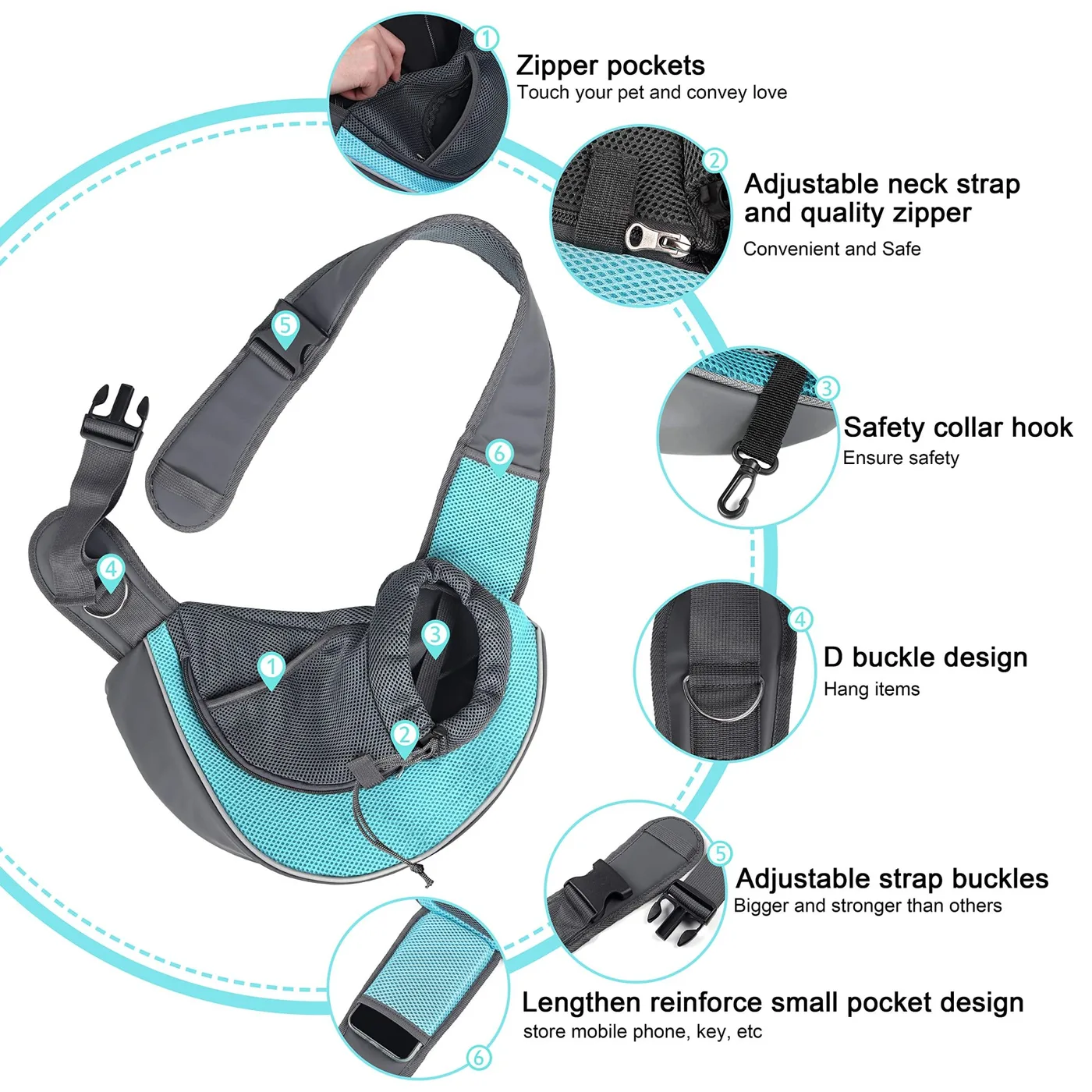
Adjustment is what makes one product serve a fragmented market, and the specification should treat it as a primary feature. The useful adjustments are interior length, support height, opening configuration and strap geometry. Each has a cost, and buyers should fund the two that matter to their actual market rather than all four.
Interior length adjustment is usually the most valuable, because the population varies most in body length. A removable or repositionable divider, or an extendable panel, covers a wide range at modest cost. Support height adjustment matters most for recumbent animals, where the position of a sling determines comfort.
Adjustment mechanisms have their own failure modes. Hook-and-loop loses grip with lint and washing, buckles slip under vibration, and elastic loses tension. Buyers should specify the mechanism by type and cycle life, and should test it over the expected service interval rather than at delivery only.
Fit should be communicated to the customer as a measurement, not as a size name. A buyer selling into this market should publish the interior dimensions, the adjustment range and the weight band, because the customer cannot try the product and will otherwise guess.
Adjustment should also be achievable by one person working alone, which is the reality of the daily routine. A mechanism that needs two hands and a second pair of hands to hold the animal will not be used, and the product will be set once at delivery and never adjusted again. Buyers should test every adjustment with one hand while the other is occupied, because that is the condition under which the product actually operates.
Where a customer's animal falls outside the range, the honest answer is a different product rather than an adjustment pushed to its limit. Buyers should define the limits clearly in their own documentation, because a support product used beyond its design range is a liability.
Fit guidance is also the strongest differentiator available to a brand in this category. Most competitors publish a size chart and nothing more, and customers are left to guess whether a product will suit an animal with a specific condition. Publishing a short guidance note per condition, with the measurements that matter and the configurations that suit them, converts better than any amount of lifestyle photography and costs almost nothing to produce.
Materials, cleanability and long-term daily use
Daily use for years sets the material requirement. A special needs bag is washed frequently, adjusted constantly, and loaded and unloaded several times a day, which means abrasion at the opening, wear at every adjustment point and repeated wet cycles. Materials should be chosen for that duty cycle rather than for appearance.
The shell should be a tightly woven, coated fabric that wipes clean and resists abrasion at the opening where an animal is slid in rather than stepped in. A heavier denier at the opening and along the base is the usual specification, and reinforcement panels at the support anchors are standard.
The interior should be smooth, wipeable and free of anything an animal cannot reposition itself away from. Loops, elastic and decorative trim are hazards here rather than features. A removable, washable liner is the correct baseline and should be specified as a stocked spare, because owners in this category need more than one.
Hardware should be specified for a long service life under daily adjustment. Metal hardware at load points, corrosion-resistant finish because of frequent washing, and quick-release mechanisms with a stated cycle life. Plastic hardware is acceptable away from load paths and dries faster.
- Coated, tightly woven shell with a heavier denier at the opening and base.
- Smooth wipeable interior with a removable washable liner available as a spare.
- Corrosion-resistant metal hardware at every load point.
- Adjustment mechanisms specified by type and cycle life.
- Reinforcement panels behind every support anchor.
Testing, documentation and claims discipline
Testing in this category is about load paths and about claims. Every support element should carry a rated load, a safety factor and a test record against the production lot. Buyers should hold those records in the product file and should require a re-test whenever a material or hardware source changes.
Test methods should be named rather than described. A recognised standard gives a supplier and a buyer a shared reference and removes the ambiguity that lets a marginal result pass. Where a product-specific standard does not exist, buyers can adapt a relevant general method from bodies such as ASTM International, whose published test methods cover textiles, hardware and mechanical loading, and state the adaptation explicitly in the specification.
Product compliance follows the standard set: CPSIA lead and phthalate reports for United States distribution, a Prop 65 assessment for California, REACH SVHC declarations for Europe. An OEKO-TEX certificate on fabrics is efficient and widely accepted, and it is particularly relevant here because the product has prolonged contact with an animal that may have compromised skin.
Claims discipline is the final element. Veterinary partners evaluate these products carefully, and resources from organisations such as the American Veterinary Medical Association are frequently cited in that evaluation. A product described as supportive, positioning and carrying will pass review; one described as therapeutic or rehabilitative will not, and the distributor will carry the reputational cost.
The retained sample and the test file complete the documentation. In a category where a failure harms an animal, the ability to show what was specified, what was tested and what was shipped is the buyer's primary protection.
Building the range: order planning and channel
Start narrow. A single adjustable product launched into the market will reveal which conditions generate demand, and the answer is rarely the one the buyer expects. Developing inserts against real sales data rather than against assumptions is the difference between a range that works and a warehouse of slow-moving variants.
MOQ 500 per colour on the body is the anchor, and insert minimums are lower. Buyers should plan the first order as a majority of bodies plus a modest quantity of each insert, then rebalance on the second order once the configuration mix is known. Ordering inserts evenly across three variants is the common error and almost always produces the wrong mix.
Sampling takes 6-10 working days and should include a load test on the assembled product and a fit check against the actual animal sizes or cart models in the market. Bulk production takes 35-50 days after sample approval and deposit, and inspection to AQL 2.5 should be supplemented with a load-path gate on every support attachment.
Channel choice shapes the range more than in most categories. Veterinary rehabilitation distributors want documentation and will carry fewer variants. Direct-to-consumer brands want fit guidance and will need photography across configurations. General retail wants a simple story and will only take the adjustable single SKU. Deciding the channel first prevents developing inserts nobody will list.
Our production team keeps the platform tech pack, the load-test data and the compliance file on record, which is what allows a second-season insert to be developed against an existing body without restarting the whole programme. That continuity is where the economics of modular design actually pay off.
Pricing the platform correctly matters as much as designing it. The body should be priced to sell at volume because it is the common component, while inserts carry the margin, since a customer who has already bought the body returns for a second insert with no further acquisition cost. Buyers who price the body at a high margin suppress the install base and lose the accessory revenue that makes the category profitable.
Order and quality terms
- MOQ 500 pieces per colourway; samples in 6-10 working days
- Bulk production 35-50 days after approval; AQL 2.5 inspection standard
- T/T 30/70 terms, FOB Xiamen, full document set per shipment
People Also Ask
What is a special needs pet bag?
A carry product designed for animals that cannot fully support or position themselves, using a supportive base, a sling insert or a harness interface rather than a conventional carry compartment.
Is a modular system better than a bespoke design?
For most buyers yes. One body plus interchangeable inserts concentrates inventory, lowers development cost and lets a distributor configure at the point of sale.
How much weight should a support sling carry?
The stated weight band plus a safety factor of at least three, tested on the assembled bag with a named method and recorded against the production lot.
Can these bags attach to a pet wheelchair?
Yes, with attachment hardware rated for vibration and movement and a low profile that clears the frame. Test against the actual cart models customers use.
How do we publish sizing for a fragmented market?
Publish interior dimensions, the adjustment range and the weight band. Customers in this category cannot try the product and will otherwise guess.
Frequently Asked Questions
What is the MOQ for a special needs pet bag?
MOQ is 500 pieces per colour on the bag body, with separate and lower minimums on each support insert. Plan the first order as mostly bodies plus a modest quantity of each insert.
Should we build a product per condition?
Rarely. A modular platform with one body and a small set of inserts concentrates inventory and spreads development cost, while bespoke variants consume a full fabric minimum each.
How should support elements be rated?
With a rated load, a stated safety factor and a named test method, tested on the assembled product rather than on a fabric swatch. A safety factor of three or more is the norm.
What makes a bag compatible with a pet wheelchair?
A low profile that does not foul the frame, attachment hardware rated for vibration as well as weight, and one-handed quick-release with a positive lock.
Which adjustments matter most?
Interior length first, because the population varies most there, then support height for recumbent animals. Fund the two that matter to your market rather than all four.
Should the harness interface be proprietary?
Generally no. A proprietary interface limits the market to customers who also buy your harness. Match the common harness geometries instead.
What liner specification suits daily use?
A removable washable liner, stocked as a spare part from the first order. Owners in this category wash frequently and effectively need more than one.
How long do sampling and bulk production take?
Samples take 6-10 working days and should include a load test on the assembled product. Bulk production is 35-50 days after sample approval and deposit.
What inspection gates apply beyond AQL 2.5?
A load-path gate on every support attachment and an interface check on modular inserts. These are the failure modes that cause harm rather than complaints.
Can the product be described as therapeutic?
No. Supportive, positioning and carrying are defensible descriptions. Therapeutic and rehabilitative claims invite scrutiny the product cannot survive and cost the distributor reputation.
Which compliance documents are needed?
CPSIA lead and phthalate reports for the US, a Prop 65 assessment for California, REACH SVHC declarations for Europe, plus load-test records for every support element.
How should we plan the first range?
Launch one adjustable product, learn the demand mix, then develop inserts against real sales data. Ordering three inserts evenly is the common and expensive mistake.
Talk to QUANZHOU JUNYUAN BAGS about a wholesale pet bag order: MOQ 500 pieces per colourway, samples in 6-10 working days, bulk production in 35-50 days under AQL 2.5 inspection.
Get a free quote Request a sample