Pet Open Top: Open Design
An open-top pet bag is a carry bag whose upper mouth stays unzipped or only partly closed, so containment comes from rim geometry, a short tether and the handler's attention rather than from a sealed panel. The practical wholesale envelope is a 2-8 kg pet, a 36 x 24 x 24 cm to 44 x 30 x 28 cm body, and an FOB Xiamen band of roughly USD 5.20-10.40 per unit with 500 pieces per colorway as the opening minimum.
Open-top work is won or lost on the drawings rather than on the photo. Before any price conversation starts, our production team asks for three things: the mouth geometry, the call-out for the rim stiffener and the anchor detail on the tether. Those three items decide whether the finished bag reads as a fashion tote or as a containment product. Face fabric, lining shade and hardware finish can all be traded afterwards without moving the risk profile one bit.
Programme economics for this family: MOQ 500 pieces per colorway, samples in 6-10 working days once the tech pack is frozen, bulk production 35-50 days after final sample sign-off, pre-shipment acceptance at AQL 2.5, payment T/T 30/70 against FOB Xiamen. No injection tooling is normally needed, so first-order cash exposure stays modest and a reorder can be driven by sell-through numbers rather than by an annual commitment.
Volume runs are coordinated through an SGS-verified production base and partner facilities audited to BSCI and ISO 9001. What a buyer should actually hold is not a headcount claim but a dated capacity slot, an inspection report filed under the purchase-order number, and a compliance folder matched to the destination market.
Wholesale pet bags uk and wholesale pet bags australia share most of the same test file, but Pet Bag Types & Styles still has to be matched to the retailer's own checklist. Pet bags wholesale china terms are usually quoted FOB, so pet bags import export cost is a separate line the buyer has to model.
What an Open-Top Pet Bag Actually Promises the Buyer
An open-top pet bag sells instant access. The handler reaches in, lifts the animal out, puts it back, and never fights a zipper around a moving head and four legs. That single convenience is the entire commercial reason the style exists, and it is the reason a boutique can place it next to a handbag at a price a closed carrier would never command. Everything else in the specification exists to keep that convenience from turning into a liability.
The category is frequently confused with two neighbours. A head-out bag has a structured opening sized around the animal's neck, so the body stays enclosed. A tote used for pets is a fashion bag with a pet liner and no engineered rim at all. The open-top pet bag sits deliberately between them: a real rim, a real tether anchor, and an upper mouth that stays open during normal use. Write that distinction into the tech pack, because a supplier reading only the words "open top" may quote either of the other two.
Buyers who succeed with this style are usually lifestyle retailers, garden-centre chains with a pet aisle, and marketplace sellers whose reviews mention strollers, cafes and short car hops. Buyers who fail are those who try to sell the same bag as a travel carrier. An unsealed mouth will not survive a check-in counter, and the negative reviews that follow are expensive to unwind. Segment the range honestly at the briefing stage instead of letting the channel discover the limit for you.
There is a second promise that is rarely written down but drives repeat orders: the pet is visible. Owners buy open-top bags because they want to see the animal and be seen with it. That means the visual field, the head clearance above the rim and the way the bag photographs on a shelf all belong in the specification, not in the marketing deck. A rim that photographs as a dark tunnel will underperform a slightly taller opening that shows the animal's face.
Two commercial consequences follow from that definition, and both should be settled before a supplier is approached. First, the size grading has to be driven by interior floor area rather than by exterior height, because an animal standing on a narrow base will not settle regardless of how generous the opening looks. Second, the payload band should be printed on the product, since the 2-8 kg range is the figure a retail buyer uses to decide whether the style belongs in the pet aisle or in the accessories department at all.
Buyer takeaway: An open-top pet bag is a short-trip, high-visibility carry product, and the specification must protect access and visibility while acknowledging that containment is partial.
Closure Architecture: Roll-Top, Drawcord and Magnetic Tab
Engineers describe an open top by the way its mouth is narrowed, not by whether it is open. A roll-top uses two or three turns of the upper panel closed with a side-release buckle or a pair of G-hooks. Each turn removes roughly 6-8 cm of mouth height, so a three-turn roll converts a 30 cm opening into a 12 cm slot. This is the strongest option in the family because the fabric itself carries the load, and it degrades gracefully: even one turn left in place keeps a pet of 5 kg from stepping out.
A drawcord runs a 4-5 mm shock cord through a channel at the rim, gathered by a spring toggle. It is the fastest closure to operate one-handed, which matters when the other hand is holding a lead. Its weakness is creep under sustained pull: a cord stretched repeatedly by an active cat will slowly open unless the toggle has a genuine spring rating and the channel is bar-tacked at both ends. Specify the toggle by pull-off force, not by part number alone.
Magnetic tabs and turn-locks are the fashion-forward option. A pair of N-grade magnets set into a folded tab closes the mouth with a satisfying snap and photographs beautifully. They resist gravity well and resist a pushing paw badly. If the assortment targets cats or small terriers, a magnet should never be the only thing standing between the animal and the pavement. Use it as a secondary closure over a drawcord, and say so on the hangtag.
Hook-and-loop strips are quiet, cheap and easy to operate, and they collect fur within a fortnight. Once the loop side is matted, the closure loses most of its shear strength and the customer assumes the bag is broken. If a buyer insists on this option for price reasons, specify a woven loop tape rated for a defined cycle life and add a small elastic keeper so the mouth stays nominally closed even when the tape gives up.
Buyer takeaway: Choose the closure by the animal's escape behaviour and the handler's free hand, then specify it by measurable force and cycle numbers rather than by a supplier's part description.
Escape and Theft Exposure at the Unsealed Mouth
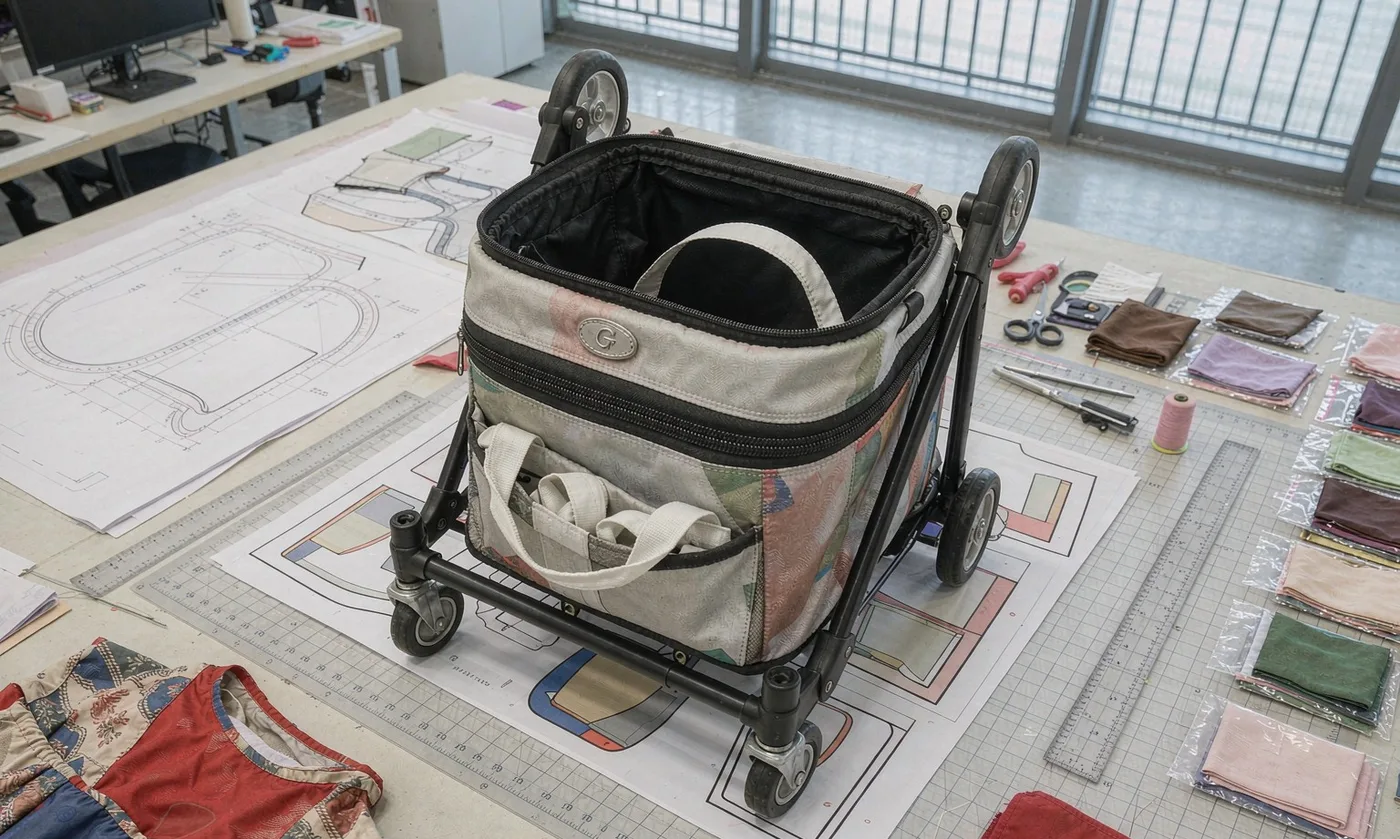
Two unrelated risks share the same opening. Escape risk is a product-engineering question: how much force, how much paw leverage and how much vertical drop does the closure tolerate before an animal is out. Theft risk is a retail-environment question: how easily can a hand reach into the bag, or a blade open it, while the shopper is distracted. Both are highest at the mouth, and both are routinely underestimated by buyers comparing photographs.
Our production team evaluates escape exposure with a 5 kg and a 7 kg weighted dummy that mimics a pushing motion rather than a static load. A cat does not sit still and press; it hooks a front paw over the rim and pulls while pushing with the hind legs. That motion loads the rim in peel, not in shear, which is exactly where magnetic tabs and hook-and-loop fail. The tether is the last line of defence, and its anchor should be tested to at least 150 N with the stitch pattern recorded on the drawing.
| Mouth closure | One-hand operation | Push-out resistance | Theft deterrence | Added unit cost (USD) | Channel fit |
|---|---|---|---|---|---|
| Three-turn roll with side-release buckle | Adequate | High | High (fabric folds obscure the interior) | 0.35-0.60 | Boutique, department store |
| Drawcord with sprung toggle | Excellent | Moderate | Moderate | 0.18-0.32 | Lifestyle e-commerce |
| Magnetic tab pair | Excellent | Low against a pushing paw | Low | 0.45-0.90 | Fashion accessories only |
| Hook-and-loop strip plus keeper | Good | Low after fur contamination | Low | 0.10-0.20 | Promotional, entry price point |
| Tether only, no mouth narrowing | Not applicable | Very low | Very low | 0.00 | Not recommended for wholesale |
| Full zip over the mouth (reference) | Poor | Very high | High | 0.60-1.10 | Travel-adjacent listings |
Read the table as a risk chart, not as a price list. A 0.20 saving per unit on a closure that produces a 3 percent return rate will cost far more in marketplace refunds, replacement freight and review damage than it saves in landed cost. Ask the supplier to quote the same body with two closure options and compare the delta against the return rate you already tolerate on comparable soft carry items.
Theft exposure is harder to test and is best handled through design. A rolled mouth hides the interior, which is why it scores high. A wide open mouth with a visible phone pocket is an invitation. If the assortment must include an open-mouth model, move valuables storage to a rear panel zip and keep the mouth area visually shallow so nothing valuable is obviously visible from above.
Buyer takeaway: Escape and theft both peak at the mouth, so the closure choice should be justified with a push-out test and a reach-in review before the price is negotiated.
Visibility, Soothing and Why an Exposed Head Changes Returns
Owners report that pets settle faster when they can see out, and that observation is the emotional engine of this category. It also cuts the other way: an animal with a full visual field reacts to dogs, traffic and crowds, and a startled jump is precisely the failure the open mouth allows. The specification therefore has to manage stimulation as well as access, which is why an open-top bag is not simply a tote with a tether added.
Welfare guidance is worth reading before writing the hangtag copy. The American Veterinary Medical Association publishes transport and handling guidance that frames containment, ventilation and supervision as jointly necessary. An open mouth satisfies ventilation easily and containment only partially, so the honest listing says the bag is for supervised short trips and carries the handler. That single sentence prevents a large share of the "my pet escaped" reviews.
Visual field can be quantified cheaply. Measure the vertical angle from the animal's eye position to the near rim and to the far rim, and require both angles in the tech pack. A deep bucket with a high front panel gives a narrow field and a calm animal; a shallow tote gives a wide field and a reactive one. Neither is wrong, but they belong in different listings, and a buyer running both should expect different review language and different return reasons.
Rim padding is the third variable. A soft rolled edge lets an animal rest its chin and settle. A hard bound edge is cheaper and looks sharper on a shelf, but animals slide off it and stay alert. Where the assortment sits at a mid price point, a 6-8 mm foam core in the rim with a brushed tricot cover usually pays for itself in review sentiment without moving the unit cost more than about USD 0.20.
Buyer takeaway: Visibility soothes and stimulates at the same time, so specify the visual angle, the rim padding and the supervision wording as a single package rather than as isolated features.
Merchandising the Opened Bag on the Retail Floor
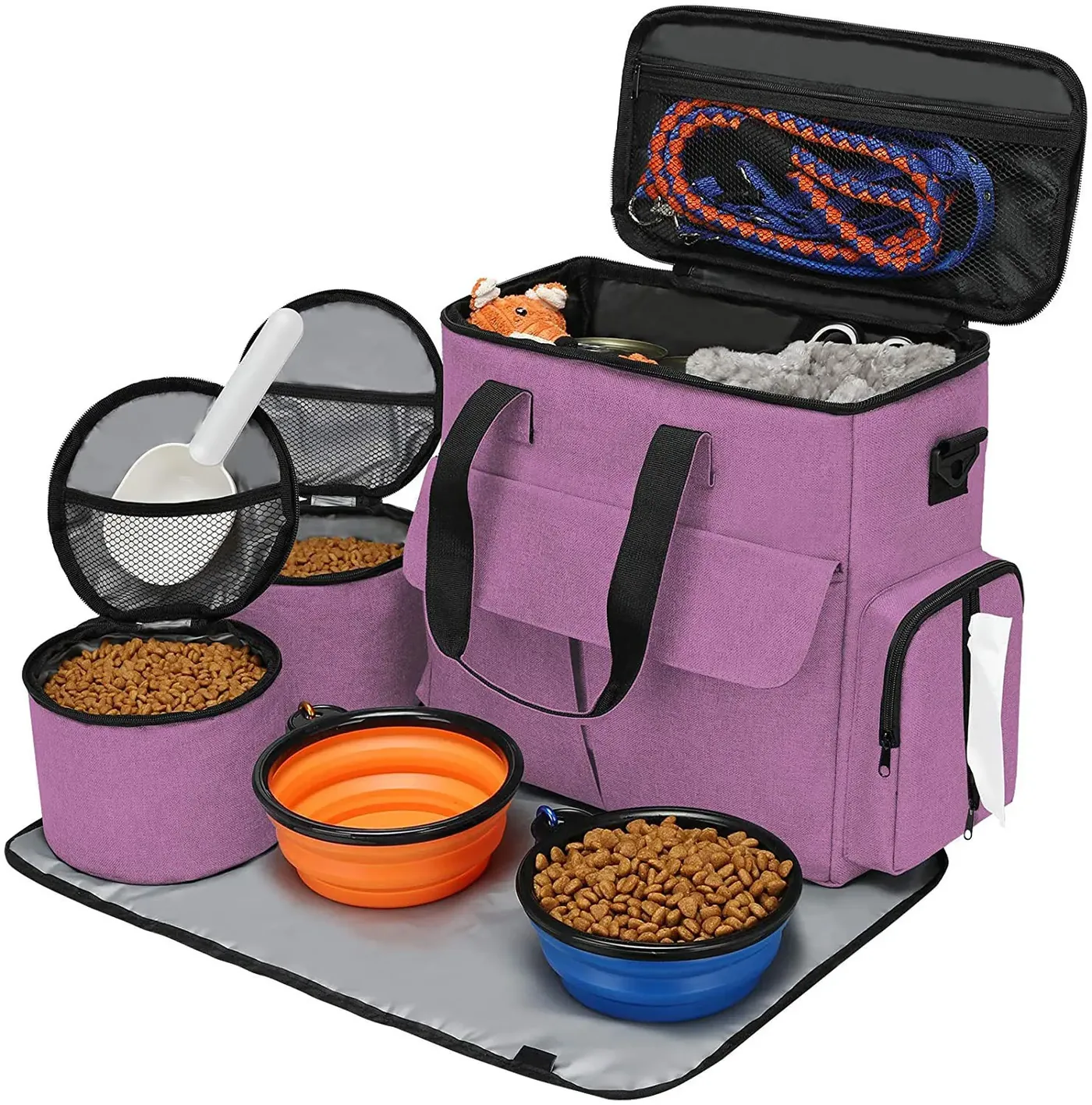
A closed bag merchandises itself; an open one collapses. This is the single most common surprise in the category. A rim stiffener that holds shape in a sample room will still sag after eight weeks in a carton, and by the time the bag reaches a shelf it photographs as a deflated sack. Buyers who plan the display insert at the same time as the bag avoid the problem; buyers who discover it at the planogram stage end up paying for air-freighted inserts.
Specify the retail presentation as a line item. Options are a moulded pulp insert, a formed EVA ring that ships flat and folds into the mouth, or simply a defined stuffing weight of tissue or recycled paper. Each has a cost and a labour implication at the distribution centre. A moulded pulp insert costs roughly USD 0.15-0.30 and is installed at the packing line; loose tissue costs pennies but requires store labour and rarely looks consistent across a chain.
Shelf footprint matters too. Because open-top bodies are photographed from above, retailers typically grant three facings rather than the two a closed carrier receives. That is an argument for keeping the mouth diameter consistent across sizes within a family, so a small, medium and large display as a deliberate nest rather than as three unrelated shapes. Inconsistent mouth geometry across sizes is a quiet killer of planogram approval.
Colour planning should follow the display logic. Neutrals in the largest size, seasonal shades in the smallest, because the small size is the impulse purchase and the neutral is the one that sells through in every quarter. With an opening minimum of 500 pieces per colorway, a three-colour first order is the practical ceiling for most buyers; anything wider fragments the forecast before there is any sell-through data to justify it.
Buyer takeaway: An open-top bag on a shelf needs a shaped insert and a consistent mouth diameter across sizes, and both must be costed before the order is placed.
Costing the Mouth: Where Money Goes in an Open-Top Build
The indicative FOB Xiamen band for this family is USD 5.20-10.40 per unit at commercially realistic volumes. Within that band the mouth is rarely the largest cost line, but it is the most volatile one, because closure hardware and rim stiffening are quoted against wildly different assumptions from one supplier to the next. Pinning those two items down is the fastest way to make three quotations comparable.
Break the cost down by function rather than by material. Body fabric and lining typically carry 35-45 percent of the unit cost; the base board and rim stiffener 12-18 percent; closure hardware 8-15 percent; the tether and its anchoring 4-7 percent; labour on the mouth assembly 10-14 percent; and printed packaging, labelling and polybag the remainder. A quotation that is dramatically below the band is almost always missing the stiffener, the anchor reinforcement or both.
Landed cost is where the style quietly wins. Because the body folds and the mouth can be rolled inward, an open-top bag packs far more efficiently than a framed soft carrier and vastly better than any rigid shell. Expect roughly 24-40 units per master carton depending on size, and confirm the carton dimensions before comparing freight, because a 3 cm difference in packed height changes container utilisation more than a USD 0.30 unit-price difference ever will.
Price negotiation should name its consequences. Consolidating colorways, accepting a stock hardware finish and simplifying the interior pocket layout all reduce cost without touching containment. Removing the rim stiffener, shortening the tether anchor reinforcement or switching to an unrated toggle all reduce cost by transferring risk to the return rate. Ask for two quotations: one that defends the containment spec and one that shows exactly what was removed.
Fabric choice moves the number more than most buyers expect, and it moves it in two directions at once. A 12 oz cotton canvas reads as premium and takes a printed pattern well, but it is heavy and slow to dry, which raises both freight and after-sale complaints. A 600D recycled polyester with a PU coating is lighter, cheaper to ship and easier to clean, yet it shows creasing after compressed packing. Neither is correct in the abstract; the right answer depends on whether the channel sells on hand-feel or on care instructions.
Buyer takeaway: Compare quotations on stiffener, closure hardware and carton cube, because those three lines explain most of the spread inside the USD 5.20-10.40 band.
Sampling, Testing and the Openings Checklist
Development on this family is quick and the temptation is to rush it. Resist that. Samples take 6-10 working days from a frozen tech pack, and bulk runs 35-50 days after final sample approval. Both windows assume that decisions come back promptly and that no custom-dyed fabric is involved. A special shade or a bespoke moulded toggle sits outside the standard window and should be scheduled as a separate pre-production activity with its own date.
Evaluate the sample in a fixed order. First measure: mouth diameter open and closed, rim height, base footprint and tether length. Then load: put the weighted dummy in and run the push-out motion against the closure. Only then look at colour, stitch density and logo placement. Approving appearance before containment is the most common cause of a second sampling round, because a closure change after artwork approval forces the printed materials to move as well.
The test list should be short, specific and written into the inspection worksheet. Four items cover most of the risk: toggle pull-off force, tether anchor pull, rim recovery after a 24-hour compressed pack, and lining colour fastness to rubbing. Dimensional checks, stitch appearance, hardware finish and carton marking then sit on top of that list as standard AQL 2.5 items. A generic bag checklist borrowed from a handbag programme will miss all four.
Reference methods help both sides argue from the same page. Fabric and component behaviours can be discussed against ASTM published test methods, and consumer-product safety expectations for the destination market against CPSC guidance for general-use products. Naming the method in the tech pack converts a subjective argument into a pass or fail.
Buyer takeaway: Freeze the tech pack, test containment before appearance, and give the inspector four named open-top checks alongside the standard AQL 2.5 worksheet.
Channel Requirements and Reorder Signals for Open-Top Listings
Each channel asks for a different piece of paper. A boutique wants a short benefits card and a demonstrable reason to believe, which for this style is the tether and the rim. A department store wants dimensional accuracy and a barcoded carton that matches the purchase order line for line. A marketplace wants searchable attributes, a hero image shot with the mouth open and a visible animal, and explicit exclusion language. One product can serve all three if the content package is built separately for each.
Listing copy should state the payload band, the body dimensions, the closure type and the exclusion. "For supervised short trips, not for airline travel" is not a weakness; it is the sentence that protects the seller from a claim it cannot defend. Buyers who omit it do not win more sales, they win more disputes. Related formats that shoppers cross-shop, such as our pet tote bag range or the head-out bag family, should be linked from the listing so the assortment captures the comparison rather than losing it.
Reorder discipline is where this category either compounds or collapses. With bulk at 35-50 days plus transit, the reorder decision has to be taken while several weeks of cover remain. Track sell-through by size and closure type separately, because a roll-top and a drawcord in the same body do not sell at the same rate even at the same price. Track return reason codes as well; a rise in "pet got out" is a specification signal, not a marketing problem.
Plan the second season from that data. The strongest pattern we see is a neutral core body reordered at full depth, plus one seasonal shade rotated per quarter, with the closure held constant so the supply base does not have to re-qualify hardware every season. That pattern keeps the 500-piece minimum comfortable, keeps the sampling calendar short, and keeps the risk profile identical from one drop to the next.
Buyer takeaway: Build separate content for boutique, department store and marketplace, then reorder on size-level sell-through and closure-level return data rather than on aggregate units.
Production capability
- SGS-verified production space of 4,950 m², 149 machines, 7 assembly lines
- Pet bag output since 2014 from a 137-person team
- 200,000 units shipped monthly under BSCI and ISO 9001 systems
People Also Ask
What is a pet open top bag?
It is a carry bag with an engineered rim and a tether anchor whose upper mouth is designed to remain unzipped or only partly closed during use, giving instant access and pet visibility while accepting partial containment.
Which closure is safest on an open-top pet bag?
A multi-turn roll-top closed with a side-release buckle generally resists a pushing animal best, followed by a sprung-toggle drawcord. Magnetic tabs and hook-and-loop are convenience closures and should not be the only restraint.
Do pets stay calmer when they can see out of the bag?
Many do, because visual contact with the handler reduces distress, but a wide field also increases reactive jumping. Specify the visual angle and pair it with a genuine closure so the calm does not become an escape route.
How much does a wholesale open-top pet bag cost?
Indicative FOB Xiamen is USD 5.20-10.40 per unit, driven mainly by rim stiffening, closure hardware, face fabric and carton cube. Compare quotations on those four lines rather than on the headline price.
Why do open-top pet bags look collapsed in stores?
Because the mouth has nothing to hold it open. Plan a moulded pulp insert, a fold-flat EVA ring or a defined stuffing weight at the same time as the bag, and specify it as a costing line.
Which channels sell open-top pet bags best?
Boutiques, department stores with a pet or travel aisle, and lifestyle marketplaces. Each needs different content: a benefits card, dimensional accuracy, or searchable attributes with explicit exclusion wording.
Can an open-top pet bag be used as an airline carrier?
It should not be marketed that way. The unsealed mouth fails the containment expectation applied to in-cabin carriers and is entirely unsuitable for checked handling.
Frequently Asked Questions
Does an open-top pet bag count as a secure carrier for airline travel?
No. An unsealed or partly sealed mouth does not meet the containment expectation most airlines apply to in-cabin pet carriers, and it is unsuitable for checked handling entirely. List the style for supervised short trips and ground transport, and route travel enquiries to a fully enclosed format.
What closure should a first open-top order use?
A three-turn roll with a side-release buckle, or a drawcord with a sprung toggle rated by pull-off force. Both offer one-handed operation and a measurable containment level. Magnetic tabs should be treated as a secondary closure, not as the primary defence against a pushing animal.
How is escape risk actually evaluated before bulk?
By a push-out test with a weighted dummy that reproduces a paw-hook and hind-leg drive, plus a tether anchor pull to a defined force. Record the stitch pattern and the anchor reinforcement on the drawing so the inspector can verify it on the finished goods.
What is the MOQ and how should a first order be split?
The opening minimum is 500 pieces per colorway. A practical first buy is one proven body across two to three colorways, with the largest size in a neutral shade and the seasonal shade concentrated in the smallest size.
How long do samples and bulk take for this family?
Samples take 6-10 working days from a frozen tech pack. Bulk runs 35-50 days after final sample approval, assuming stock hardware and no custom-dyed fabric. Bespoke toggles or special shades need their own pre-production schedule.
Which inspection standard applies to the shipment?
Pre-shipment acceptance runs at AQL 2.5 with a product-specific worksheet. For this style the worksheet must include toggle pull-off, tether anchor pull, rim recovery after compressed packing and lining rubbing fastness, plus the standard appearance and carton checks.
Can the rim be made softer without losing shape on the shelf?
Yes. A 6-8 mm foam core with a brushed cover gives a comfortable chin rest while a separate display insert holds the retail shape. Splitting comfort and display into two components is cheaper than trying to make one stiffener do both jobs.
What packaging data should be requested with the quotation?
Master carton dimensions, units per carton, gross weight, units per container, insert or stuffing specification, barcode placement and carton marking. Carton cube drives freight more than unit price does in this family.
Are open-top bags acceptable for cats as well as small dogs?
Cats place a different load on the closure because they push and hook rather than simply lean. If cats are in scope, raise the push-out requirement, keep a roll or drawcord as the primary closure and avoid magnetic tabs as the only restraint.
What compliance documents are normally needed?
A bill of materials, the approved tech pack, the inspection report under the purchase-order number, and destination-specific declarations agreed at quotation stage, typically REACH or CPSIA substance statements and, where requested, OEKO-TEX documentation for the face fabric.
How should the listing describe the payload limit?
State the 2-8 kg working band, the body dimensions and the measurement method, and add a supervision sentence. Weight is a screening tool; the controlling measurement is the animal's body length and shoulder height against the interior.
Can an open-top bag ship mixed with other pet bag categories?
Yes, when production timing and carton cube align. Confirm the loading plan early, because folding bodies pack efficiently and a container will usually fill on volume before it reaches any weight limit.
What payment and Incoterm baseline is used?
The standard commercial basis is T/T 30/70 against FOB Xiamen. Keep the Incoterm identical across competing quotations, otherwise freight and origin charges will distort the unit-cost comparison.
When should a second season be planned?
Before the first shipment sells out. With 35-50 days of production plus transit, the reorder decision needs several weeks of remaining cover, and it should be taken on size-level sell-through and closure-level return data.
Talk to QUANZHOU JUNYUAN BAGS about a wholesale pet bag order: MOQ 500 pieces per colourway, samples in 6-10 working days, bulk production in 35-50 days under AQL 2.5 inspection.
Get a free quote Request a sample