Pet Diaper Bag for Baby and Pet: Wholesale Buyer Guide
A wholesale pet diaper bag program starts at MOQ 500 pieces per colorway, with samples in 6-10 working days and bulk in 35-50 days. Baby and pet dual-use bags price from USD 9.60 to USD 24.80 FOB Xiamen, driven by compartment count, hardware quality and the compliance file.
A bag designed to carry both baby supplies and pet supplies is not one product serving two markets; it is a product that has to satisfy the stricter of the two sets of expectations. In practice that means baby-adjacent requirements govern material safety, labelling and documentation, while pet requirements govern cleanability, containment and durability.
Commercial terms follow the standard framework: MOQ 500 pieces per colorway, samples in 6-10 working days, bulk production in 35-50 days after sample approval, pre-shipment inspection at AQL 2.5, T/T 30/70 payment and FOB Xiamen quotation. Production runs through an SGS-verified production base with BSCI and ISO 9001 coverage, 7 lines, 149 sets of equipment and around 200,000 pieces of monthly capacity.
That dual obligation is what makes the category valuable as well as demanding. The compliance work is higher than for a general pet bag, but the achievable retail price is correspondingly higher and the category is less price-contested, because fewer suppliers can produce the documentation that baby and nursery channels require. Buyers entering the category should plan for a longer development cycle and a larger documentation file than a general pet bag program needs, and should treat compliance as a product cost rather than as an overhead.
Bulk pet bag orders consolidate best when carton dimensions are fixed early, and Pet Bag Types & Styles decisions are what fix them. Bulk pet carrier orders that mix sizes inside one carton save freight but complicate the packing line, so the trade-off should be priced rather than assumed.
Why a Dual-Purpose Baby and Pet Bag Is a Different Sourcing Problem
The commercial appeal of a baby and pet bag is straightforward: a household with both a child and a pet needs one bag that serves both, and it will pay more for a product that genuinely does. The sourcing difficulty is that the product has to clear two different sets of buyer expectations, and the two are not equally strict.
Baby-adjacent expectations are stricter. Retailers in nursery and department channels ask about chemical safety, small parts, labelling and traceability before they ask about capacity or colour. A supplier that cannot produce that file will not be listed, regardless of how good the bag is. Pet expectations are more practical: can it contain a mess, can it be cleaned, and does it survive daily use. A product that satisfies the first set usually satisfies the second, provided the cleanability specification is written deliberately.
The practical consequence for a buyer is that the specification should be built from the baby side downwards. Start with the chemical and labelling requirements, confirm what the destination market demands, then design the compartment architecture and the materials within those constraints. Working the other way round produces a product that has to be re-specified after the first retailer questionnaire arrives.
There is also a positioning decision to make early. Some buyers sell the product as a diaper bag with pet-friendly features; others sell it as a pet bag with nursery-grade materials. The two positions require different packaging claims, different photography and, in some markets, different compliance documentation. Deciding which one the brand is selling determines the artwork brief and should be settled before sampling rather than during it.
Finally, buyers should be realistic about development time. A dual-purpose bag has more compartments, more hardware and more compliance content than a general pet bag, which means more specification decisions and a longer approval chain. That is not a reason to avoid the category, but it is a reason to start earlier than a comparable single-purpose program.
Where the Category Sells and What Each Channel Requires
Dual-use baby and pet bags sell through four channels with materially different requirements, and a specification that suits one will often be rejected by another. Mapping channel to specification before development prevents the most common and most expensive mistake in the category.
Nursery and baby specialty chains are the most demanding channel and the most rewarding. They require a full compliance file, they expect CPSIA awareness for the US market, and they audit packaging claims carefully. Their orders are moderate in size but their repeat business is stable, and they support a retail price well above a general pet bag.
Department stores and online marketplaces sit in the middle. They require documentation but are usually satisfied with a standard chemical compliance package plus correct labelling. They care most about review-generating detail: pocket count, wipe-clean surfaces, and a changing mat or insert. This is the volume channel for the category.
Pet specialty retailers treat the product as a premium pet bag and are less concerned with nursery documentation. They are the easiest channel to enter but they support the lowest retail price of the three, which makes them a poor fit for a heavily specified compliance-led product.
Gift and registry channels are the fourth route and are frequently overlooked. A dual-use bag is a natural registry item, and registry placement produces steady, low-promotion volume. The requirement here is presentation: packaging that reads as a gift, a neutral colour palette, and a clear statement of what the product does.
Buyers should choose one primary channel for a first program rather than trying to serve all four. The compliance and packaging work is expensive, and spreading it across incompatible channel requirements is the fastest way to produce a product that satisfies none of them fully.
Compartment Architecture: Designing for Two Sets of Contents
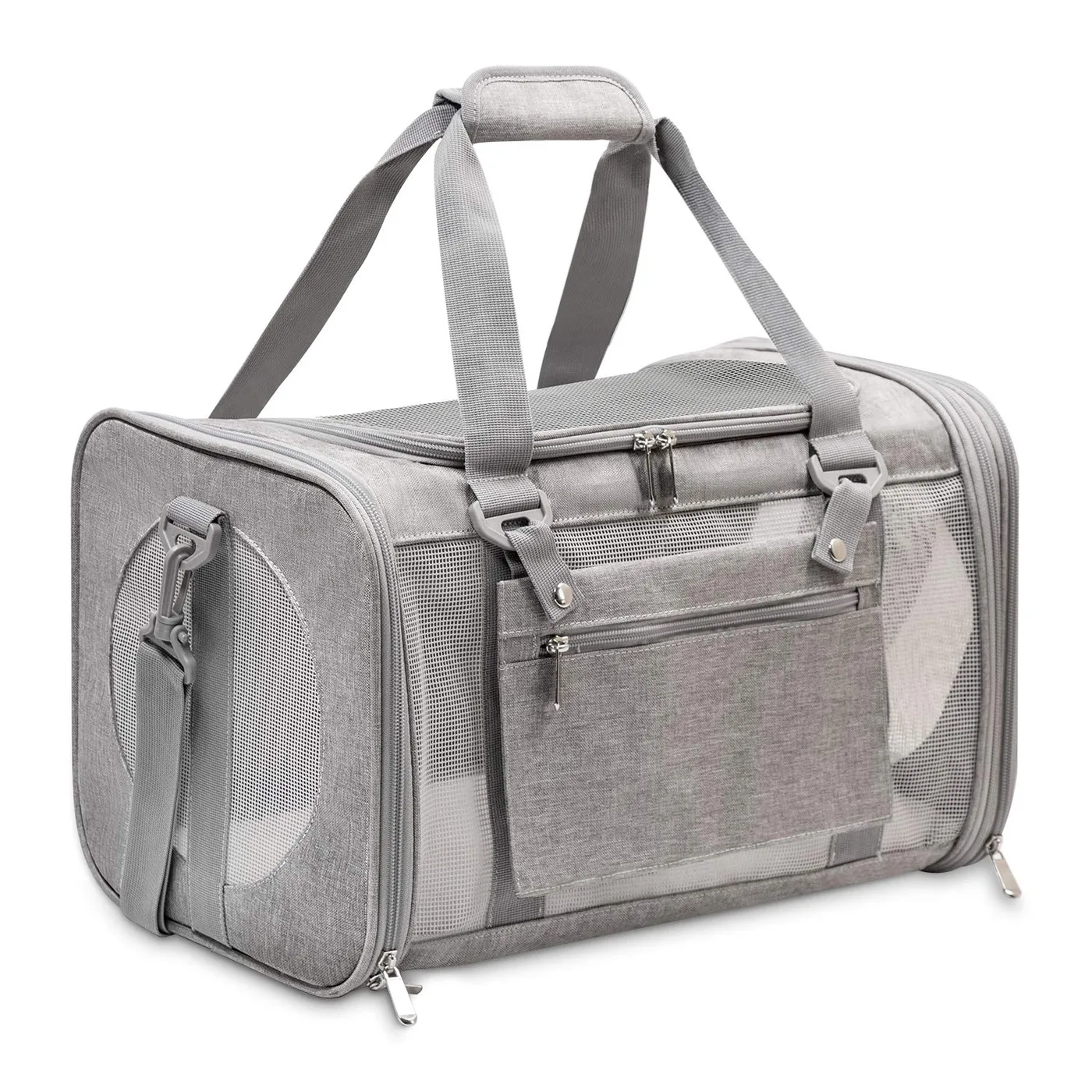
Compartment design is where a dual-use bag either works or fails in use, and it is the part of the specification most often left vague. Baby supplies and pet supplies have different requirements: baby items are small, numerous and must stay dry and clean; pet items are bulkier, smellier and may be damp. A single open compartment serves neither well.
The standard architecture separates three zones. A clean, dry zone holds baby items and should be lined with a wipe-clean material and closed with a full zip. A utility zone holds pet items, treats and waste bags, and should be lined with a material that can be wiped and, ideally, removed and washed. A shared accessory zone holds phones, keys and wallets and should be positioned for access without opening either of the other two.
Separation matters for reasons beyond convenience. Pet treats and food should not share a compartment with baby items, and buyers selling into nursery channels should expect that question directly. A physical divider rather than a simple pocket is the answer, and it should be specified as a structural element rather than as a loose insert.
Access design is the second priority. A parent or pet owner using this product has one hand occupied most of the time. That argues for a wide-mouth main opening, magnetic or one-handed closures on external pockets, and a wipe-dispenser pocket positioned on the exterior. These are the features that appear in reviews, and they cost relatively little to specify.
Insulated bottle pockets are close to expected in this category and should be included in any specification above the entry tier. They add material and labour but they are the single feature most cited in positive reviews, and their absence is cited just as often when they are missing.
Inserts and removable components
A removable wet bag, a foldable changing mat and a washable liner are the three inserts buyers most often add. Each is a separate component with its own material and its own cost, and each should be quoted separately rather than assumed. Bundling them into one price makes later cost comparison impossible and hides the fact that inserts are frequently the first things a buyer can remove to hit a price target without damaging the core product.
Material and Chemical Safety Expectations for Baby-Adjacent Products
Material selection for a baby-adjacent bag should start from the compliance requirement rather than from the aesthetic one. That is not the usual order of decision in pet bag sourcing, and it is the adjustment buyers most often need to make when entering this category.
Chemical compliance is the governing constraint. OEKO-TEX certification on all fabrics, linings and printed areas is the practical baseline, and it should cover the finished construction rather than the base cloth. In the United States, children's product requirements administered by the US Consumer Product Safety Commission set expectations for lead content and phthalates in accessible components, and buyers selling into nursery channels should confirm which parts of the product fall inside that scope before specifying hardware and coatings.
EU buyers work within the REACH framework, and the substance list is maintained by the European Chemicals Agency. California adds its own layer through Prop 65, with the list maintained by the California OEHHA. Buyers should decide at quotation stage whether they need a warning label, because that decision affects artwork and therefore the production calendar.
Beyond chemicals, nursery channels ask about small parts and choking hazards. Magnetic closures, decorative rivets and detachable charms are the components that attract that question, and each should be specified with a pull-test requirement or removed from the design. This is a design constraint rather than a testing burden, and it is much cheaper to resolve on paper than after tooling.
Cleanability remains a functional requirement underneath all of this. A wipe-clean lining that is free of the substances a nursery channel screens for is the specification target, and it should be named explicitly so that a supplier quotes a compliant material rather than a convenient one.
Hardware, Zips and Closure Standards for a Higher-Price Product
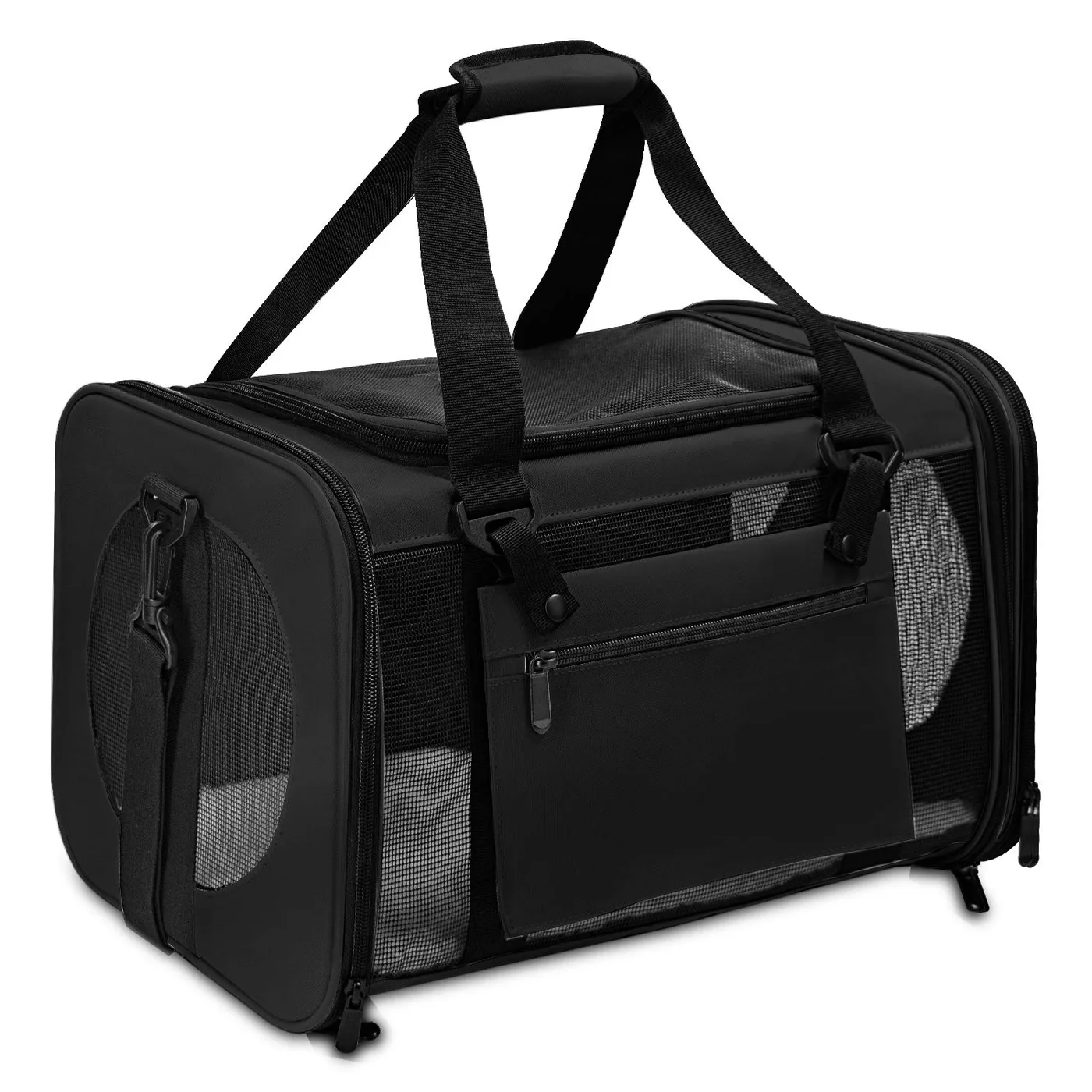
Because this category supports a higher retail price, buyers can specify better hardware than in most pet bag lines, and they should. A dual-use bag is opened and closed constantly, it is heavy when loaded, and it is used in situations where a failure is genuinely inconvenient. Hardware quality is the difference between a product that earns repeat purchase and one that does not.
Zips should be specified by brand or by tested equivalent, with a stated cycle life. A two-way slider on the main opening is standard expectation in this category because it allows partial access without full opening. Zip garages and covered ends prevent the slider catching on linings, which is a common and visible wear complaint.
Buckles and clasps should be specified with a retention figure and a cycle-test expectation. Magnetic closures are popular because they are quiet and one-handed, but they should be assessed against small-parts expectations if the product sells into nursery channels, and their holding force should be tested when the bag is fully loaded rather than empty.
Stroller attachment is a defining feature of the category and a common failure point. Straps or clips that attach the bag to a stroller handle take a real load, and the anchorage is more important than the strap itself. Bar-tack reinforcement at the anchorage, plus a rated buckle, should be specified explicitly rather than assumed.
Feet and base construction should not be overlooked. A loaded dual-use bag is heavy and will be set down frequently, so a reinforced base with metal or moulded feet protects both the bag and the surface it is placed on. It is a small cost that reads as quality in use.
Cost Structure and Price Bands
A mid-spec dual-use baby and pet bag at USD 15.40 FOB typically breaks down as follows: shell fabric USD 3.10, linings including a wipe-clean and an insulated pocket USD 2.40, hardware and zips USD 2.60, webbing and stroller straps USD 1.10, inserts and dividers USD 1.30, padding and structure USD 0.90, cutting and sewing labor USD 2.60, QA and packing USD 0.60, and factory overhead and margin USD 0.80.
Two features of that build-up matter commercially. Labour is high because the product has many compartments and more assembly steps, which means volume negotiation has limited room. Materials are also high because there are more of them, which means material substitution is a real lever but a risky one if it touches compliance.
| Specification | Compartments | Key features | FOB band | Channel |
|---|---|---|---|---|
| Entry dual-use | 3-4 | Wipe-clean lining, basic straps | USD 9.60-13.20 | Online, pet chain |
| Mid dual-use | 5-7 | Insulated pockets, stroller straps | USD 13.40-18.60 | Marketplace, department |
| Premium dual-use | 7-9 | Removable wet bag, mat, tested hardware | USD 18.20-24.80 | Nursery specialty |
| Registry gift edition | 5-7 | Gift packaging, neutral palette | USD 15.80-21.40 | Registry, gift |
| Travel-oriented | 6-8 | Trolley sleeve, larger capacity | USD 17.60-26.90 | Travel, premium online |
Given that structure, the most effective cost levers are compartment count and insert count rather than fabric quality. Removing two pockets typically saves USD 1.20-2.00; removing an insert saves USD 1.00-2.50. Cutting the compliance specification saves money immediately and creates channel risk later, which makes it the wrong lever for this category specifically.
Buyers should also account for compliance cost correctly. Testing and certification are fixed costs per specification, so they fall proportionally harder on a 500-piece order than on a 3,000-piece one. Fewer specifications at higher volume is the more economical structure, and it is worth planning the season that way from the start.
MOQ, Sampling and the Development Calendar
Standard terms apply: MOQ 500 pieces per colorway, samples in 6-10 working days, bulk production in 35-50 days after sample approval, AQL 2.5 inspection, T/T 30/70 and FOB Xiamen. For dual-use bags the sample window deserves more planning than usual, because the specification has more decisions in it.
The first sample should be evaluated on architecture rather than finish. Does the compartment layout work with real contents, is the main opening wide enough, do the stroller straps reach, and is the bag stable when loaded? These are functional questions that are cheap to fix on paper and expensive to fix after bulk begins.
The second round should address materials and compliance. Once the architecture is agreed, the compliant fabrics and hardware can be substituted and the physical sample re-approved. Running the two rounds in that order keeps the 6-10 working day window realistic and avoids re-testing a layout that is about to change.
Compliance documentation should be requested in parallel with sampling rather than after it. Test reports and certificates take time, and a buyer who waits until bulk is finished to request them will hold goods at the factory waiting for paper. Our production team can arrange testing through recognised laboratories during the sampling window when it is requested at quotation stage.
The binding constraint for most programs is the buyer's internal approval chain, which for this category typically includes a compliance reviewer as well as a product and packaging approver. Scheduling those three reviews in sequence rather than in parallel is the single largest avoidable delay in a dual-use program.
Compliance, Testing and Labelling for Baby-Adjacent Pet Bags
The documentation file for this category is larger than for a general pet bag, and it should be assembled deliberately. Retailers in nursery and department channels will ask for it during onboarding, and the questions are predictable enough to prepare for in advance.
The file normally covers chemical compliance on all materials, small-parts assessment, hardware pull and cycle testing, physical performance testing on seams and handles, country-of-origin and care labelling, and factory social compliance. OEKO-TEX certification covers the first item efficiently; test reports from a recognised laboratory cover the second and third; and BSCI plus ISO 9001 coverage addresses the last.
Independent testing is worth budgeting for. Third-party verification through SGS produces a report that a retailer compliance team accepts without further question, and textile test methods are published by AATCC. Where a buyer is selling into a channel that screens for children's product requirements, testing should be arranged against the destination market rather than generically.
Labelling requires specific attention because it is a frequent cause of distribution-centre rejection. Barcode placement, country-of-origin marking, fibre content, care symbols and any required warning statement should all be confirmed with the channel before artwork is approved. A missing care symbol is a trivial production issue and a serious receiving issue.
Claims on packaging should be conservative. Statements about safety, hypoallergenic properties or antimicrobial performance need supporting evidence, and an unsupported claim on a baby-adjacent product carries more exposure than the same claim on a general pet bag.
Inspection Priorities and AQL 2.5 on Multi-Compartment Bags
Multi-compartment products have more defect surface than simple bags, so the inspection plan needs to be correspondingly broader. AQL 2.5 sets the sampling basis; the checklist is what determines whether it catches what matters.
The plan should cover: compartment count and layout against the approved sample, divider and insert fit, zip operation on every closure including two-way sliders, magnetic closure holding force when loaded, stroller strap anchorage strength, hardware retention and cycle behaviour, lining seam integrity and wipe-clean surface coverage, insulated pocket seal integrity, handle and strap root reinforcement, dimensional consistency, and packaging accuracy including barcode and labelling.
Functional defects should be classified above cosmetic ones. A pocket that is missing, a divider that does not fit or a zip that jams are critical; minor thread variation is not. That classification prevents the common situation in which a shipment is held for cosmetic issues while functional ones pass unnoticed.
Compliance documentation should be verified at inspection rather than assumed. Certificates should be checked against the actual materials used in the shipment, because a certificate issued for a different fabric is a frequent and easily missed problem.
Buyers should also confirm the remedy for a failed inspection at quotation stage. Multi-compartment bags are labour-intensive to re-work, so the commercial consequence of a failure is materially higher here than in simpler categories and is worth settling in advance.
Building the Range Around a Dual-Use Hero Product
A dual-use bag works best as the hero of a small range rather than as one SKU among many. It carries a higher price, it requires more explanation at point of sale, and it benefits from surrounding products that share its materials and its compliance file.
The most effective surrounding range uses the same compliant fabric and hardware set in simpler products, so that the compliance cost is amortised across several SKUs. A matching wet bag, a smaller crossbody version and a coordinating accessory pouch are all natural extensions that share the material specification and therefore the documentation.
Pricing should be set to protect the hero. A smaller version at roughly 60 percent of the hero price reads as a deliberate choice rather than as a discount, and it captures buyers who like the concept but not the size. Going below that ratio tends to cannibalise the hero rather than expand the market.
Marketing content should be planned with the product. A dual-use bag needs to be shown in use with both sets of contents, because the concept is not self-explanatory from a photograph of an empty bag. Buyers who budget for that content at sampling stage launch faster than those who arrange it after goods arrive.
Adjacent categories extend the range naturally: multi-function pet mom bags share the compartment architecture, and pet gift set bundles use the same packaging approach and can absorb the same inserts, which makes a consolidated reorder both cheaper and simpler to schedule.
Production capability
- SGS-verified production space of 4,950 m², 149 machines, 7 assembly lines
- Pet bag output since 2014 from a 137-person team
- 200,000 units shipped monthly under BSCI and ISO 9001 systems
People Also Ask
How much does a wholesale pet diaper bag cost?
Dual-use baby and pet bags generally price from USD 9.60 to USD 24.80 FOB Xiamen, depending on compartment count, hardware and inserts. Compliance testing is a fixed cost and falls harder on small orders.
What is a pet diaper bag?
It is a multi-compartment bag designed to carry both baby supplies and pet supplies, with separate clean and utility zones, wipe-clean linings and usually stroller attachment straps.
Are dual-use baby and pet bags safe?
They are when materials carry appropriate certification and small parts are assessed. OEKO-TEX certification and hardware pull testing are the two documents buyers most often rely on.
How many compartments should a diaper bag have?
Five to seven is the practical range for a mid-spec product. More compartments add cost and assembly time without improving usability beyond that point.
What is the difference between a diaper bag and a regular tote?
A diaper bag has separated clean and utility zones, insulated bottle pockets, wipe-clean linings and stroller attachment hardware. A tote has none of those by default.
Do pet diaper bags need special labelling?
Yes. Country-of-origin marking, care symbols and any market-specific warning statement should be confirmed with the channel before artwork approval.
Can a pet diaper bag be used as a carry-on?
Many mid and premium specifications fit under-seat dimensions, but buyers should verify against the airline rather than assume. Travel-oriented versions add a trolley sleeve.
Frequently Asked Questions
What is the MOQ for a wholesale pet diaper bag?
MOQ is 500 pieces per colorway. Because compliance testing is a fixed cost per specification, fewer specifications at higher volume is the more economical structure for this category.
How long does sampling take for a dual-use bag?
Samples are completed in 6-10 working days from specification sign-off. Two rounds are recommended: one on compartment architecture, one on compliant materials and hardware.
What is the bulk production lead time?
Bulk production runs 35-50 days after sample approval. Compliance documentation should be requested during the sampling window so that it is ready when goods are.
Which compliance documents are needed for baby-adjacent pet bags?
The usual file covers OEKO-TEX certification on materials, small-parts assessment, hardware pull and cycle testing, physical performance testing, labelling, and BSCI plus ISO 9001 factory coverage.
Does CPSIA apply to a pet diaper bag?
Requirements administered by the US Consumer Product Safety Commission apply to children's products, and nursery channels commonly apply that expectation to baby-adjacent accessories. Buyers should confirm scope with the channel before specifying hardware and coatings.
How should compartments be arranged?
The standard architecture separates a clean dry zone for baby items, a utility zone for pet items, and a shared accessory zone. A physical divider is preferable to a simple pocket.
Are stroller straps included?
Stroller attachment straps are available and should be specified with bar-tack reinforcement at the anchorage plus a rated buckle, because the anchorage carries the load rather than the strap.
What inspection basis is used?
Pre-shipment inspection is at AQL 2.5, with functional defects such as missing pockets or jammed zips classified above cosmetic issues. Certificates should be verified against the materials actually used.
Can magnetic closures be used?
They can, but they should be assessed against small-parts expectations in nursery channels and their holding force tested when the bag is fully loaded rather than empty.
What inserts are available?
A removable wet bag, a foldable changing mat and a washable liner are the three most common. Each should be quoted separately so the buyer can remove one to hit a price target if needed.
What are the payment and trade terms?
Standard terms are T/T with a 30 percent deposit and 70 percent balance before shipment, quoted FOB Xiamen. Other Incoterms can be quoted on request.
Can the same fabric be used across a wider range?
Yes, and it is recommended. Sharing one compliant fabric and hardware set across several SKUs amortises the compliance and testing cost across the whole range.
How should a smaller version be priced?
At roughly 60 percent of the hero price. Below that ratio the smaller version tends to cannibalise the hero rather than expand the market.
What causes delays most often in this category?
The buyer's internal approval chain. This category typically needs product, packaging and compliance reviewers, and scheduling those reviews in sequence rather than in parallel is the largest avoidable delay.
Talk to QUANZHOU JUNYUAN BAGS about a wholesale pet bag order: MOQ 500 pieces per colourway, samples in 6-10 working days, bulk production in 35-50 days under AQL 2.5 inspection.
Get a free quote Request a sample