Pet Family Bag: All-in-One Wholesale Specs and Costs
A wholesale pet family bag program starts at MOQ 500 pieces per colorway, with samples in 6-10 working days and bulk in 35-50 days. All-in-one pet family bags price from USD 12.40 to USD 29.80 FOB Xiamen, and freight per unit is the cost line buyers most often underestimate.
An all-in-one pet family bag is the largest and most logistically demanding product in the wholesale range. It is bought by multi-pet households and by families who want one bag that serves everyone, which means capacity and shared usability drive the specification, while bulk drives the landed cost.
Commercial terms follow the standard framework: MOQ 500 pieces per colorway, samples in 6-10 working days, bulk production in 35-50 days after sample approval, pre-shipment inspection at AQL 2.5, T/T 30/70 payment and FOB Xiamen quotation. Production runs through an SGS-verified production base with BSCI and ISO 9001 coverage, 7 lines, 149 sets of equipment and around 200,000 pieces of monthly capacity.
The commercial discipline specific to this category is that product cost is only part of the equation. A larger bag occupies disproportionate container space, so a specification change that saves a dollar of material can cost two dollars of freight. Buyers should model landed cost per unit before finalising the dimensions rather than after, and should decide the packed configuration at quotation stage rather than at the point of booking.
Pet bag sample cost is normally credited against the first production order, which makes Pet Bag Types & Styles review the expensive step rather than the sampling itself. Pet carrier sample cost rises with hardware changes, so lock the hardware before the second sample round.
What an All-in-One Pet Family Bag Has to Do
An all-in-one family bag is bought to replace several smaller bags. A household with two pets, or a family where different members handle different outings, wants a single product that carries everything for everyone and can be found, loaded and grabbed without ceremony. That is a different job from carrying one pet's supplies, and the specification should reflect it, particularly in the way zones are arranged and in the way the bag behaves when it is only partly full.
Capacity is the headline requirement, but usable capacity rather than nominal volume. A large bag with one open compartment is harder to use than a slightly smaller one with defined zones, because contents migrate and the bag becomes a search exercise. The specification priority is therefore organisation at scale: defined zones that stay defined when the bag is loaded and moved.
Durability requirements scale with size. A larger bag carries more weight, is lifted more awkwardly, and is more likely to be dragged or set down hard. Handle anchorage, base structure and seam strength at the corners all need to be specified for a heavier load case than a mid-size bag, and that is a genuine engineering difference rather than a marketing one.
Shared usability is the third requirement and the one most often missed. If three people use the same bag, the adjustment system has to reset quickly, the strap length range has to cover different body sizes, and the layout has to be intuitive to someone who did not pack it. Those are specification decisions, and they are what distinguish a family bag from a large individual bag.
Finally, the category has a storage constraint that buyers should not ignore. An all-in-one bag is large, and the customer has to store it somewhere. A collapsible or semi-collapsible structure is a genuine selling point in this category and is worth specifying even though it adds development complexity, because the customer who cannot store the bag conveniently will not use it regularly no matter how well it performs in every other respect.
Capacity Tiers and Sizing for Multi-Pet Households
Capacity should be specified in litres and verified by an agreed measurement method, because a litre figure is the primary way customers compare products in this category and an inaccurate one is a direct cause of returns. Three tiers cover the market.
A compact family bag in the 25 to 35 litre range suits a household with one small pet or two very small ones. It is the size most likely to be used daily, it fits in a hallway or a car footwell, and it is the easiest tier to merchandise because it does not look intimidating on a shelf. Freight per unit is manageable at this size.
A standard family bag in the 40 to 55 litre range is the volume tier. It suits two pets or a pet and children's supplies, it is the size most customers picture when they think of a family bag, and it supports a mid-to-high retail price. The freight penalty starts to become material at this tier and should be modelled carefully.
A large family bag above 60 litres is a specialist product. It suits multi-pet households, long trips and customers who explicitly want maximum capacity, but it is difficult to merchandise, it is heavy to ship, and a significant proportion of customers who buy it find it too large in practice. Buyers should treat it as an optional third SKU rather than a core one.
Sizing should also account for the fact that customers systematically underestimate how much they need. A buyer offering two sizes should position them clearly by use case rather than by pet count, because a customer deciding between two large bags needs to know whether a specific item fits, and the internal dimensions are what answer that question while the litre figure does not. The size guide should therefore describe what fits rather than how many pets the bag suits, which also reduces the number of customers who buy the largest tier and then find it impractical to store.
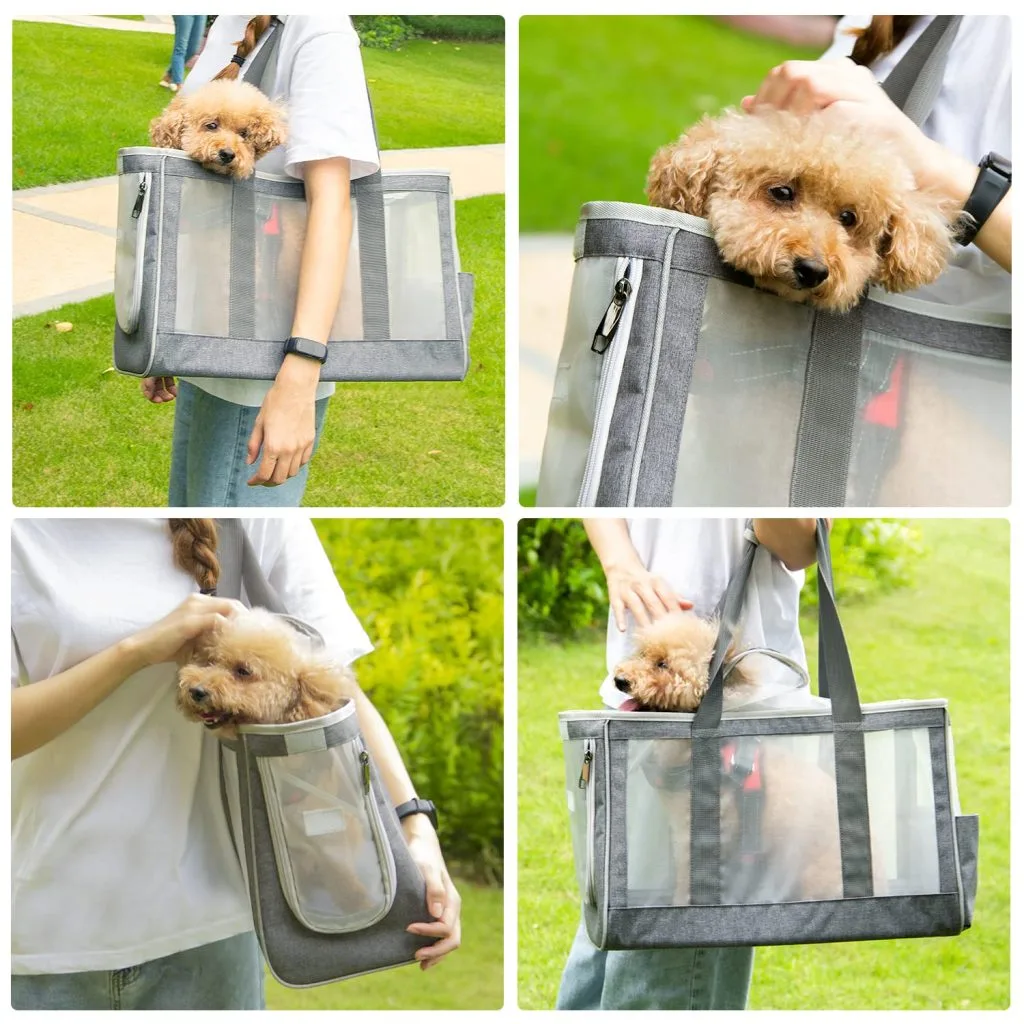
Setting the size mix
For a first season, the compact and standard tiers in a 40:60 ratio is a reasonable opening structure. The large tier should be added only after a season of data, because it carries the highest freight cost per unit and the highest risk of customer regret.
Structure, Base and Load Distribution at Larger Sizes
Structure is what makes a large bag usable, and it is the specification area where underspending is most visible in use. A large soft bag that slumps when loaded is difficult to carry, difficult to pack and looks cheap, regardless of how good the fabric is.
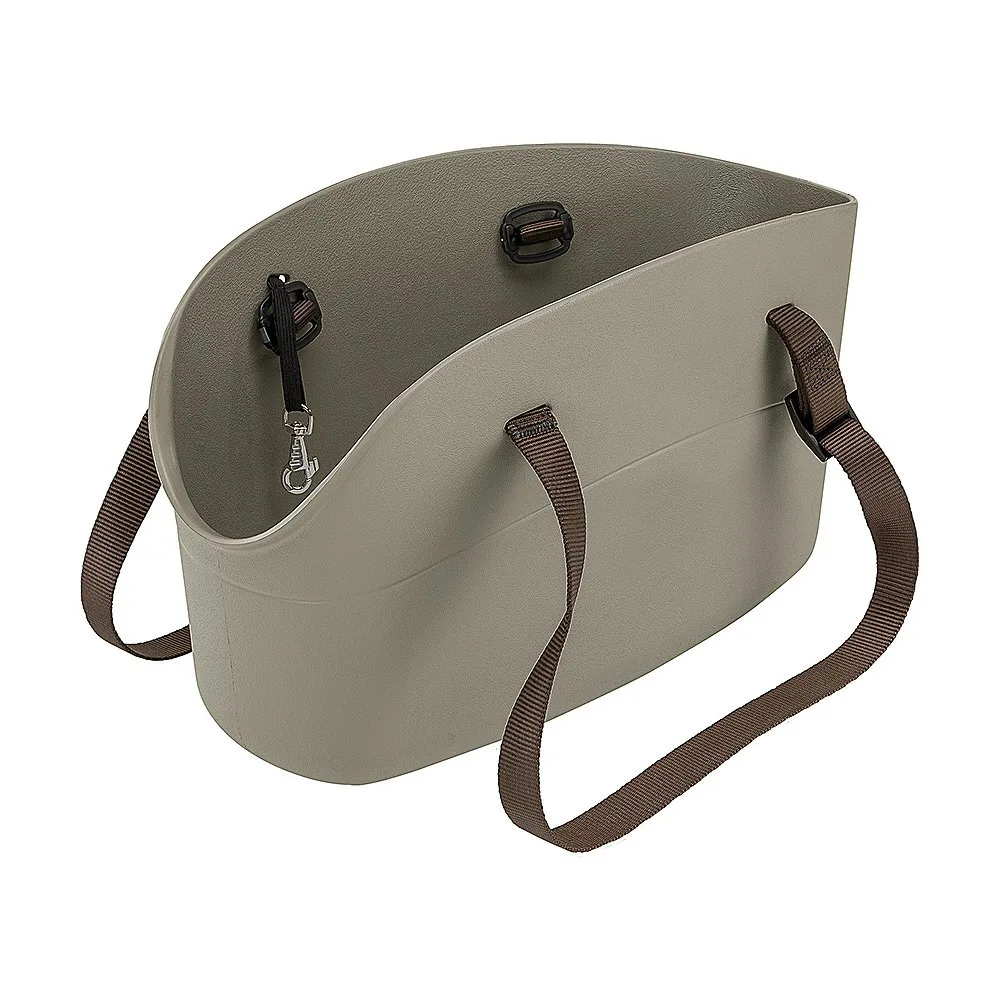
The base is the primary structural element. A moulded or reinforced base with feet keeps the bag upright while loading, protects the contents from wet ground and prevents the base fabric abrading through. At family-bag sizes a moulded base is standard rather than optional, and the cost is justified by a visible improvement in how the product behaves.
Load distribution matters because a heavy bag pulls on its anchorages. Straps should be attached to a reinforced panel rather than to the shell fabric, and the load path should run into the frame rather than through a seam. Bar-tack coverage at every anchorage, plus a box-stitch pattern at handle bases, is the standard specification at this size.
Internal structure is the second element. A semi-rigid panel in the back and base, plus a divider that holds its shape, keeps the bag's form when it is partly loaded. Without it, a half-full family bag collapses and its contents shift, which is the complaint customers describe when they say a bag is awkward rather than when they say it is badly made.
Collapsibility should be specified as a deliberate feature rather than as an accident. A bag that folds flat for storage but stands up when loaded is the ideal, and it is achievable with a removable base board or a folding frame. It adds development work and roughly USD 1.20-2.80 per unit, and it is one of the few additions in this category that customers actively notice and value.
Shared Use: Designing for More Than One User
A family bag is used by more than one person, and that single fact produces a set of specification requirements that do not appear in single-user products. Buyers who ignore them produce a bag that works well for the person who packed it and poorly for everyone else.
Adjustment is the first requirement. Straps should have a wide adjustment range and a system that resets quickly, because a bag shared between people of different heights is adjusted constantly. Cam buckles reset faster than ladder locks and hold better under load, and they are the right choice at this size.
Layout should be legible. Zones should be distinguishable without unpacking: a contrast lining colour in one zone, an external pocket for the items everyone needs, and clear separation between pet supplies and personal items. A customer who did not pack the bag should be able to find what they need in a few seconds.
Identification matters more than it sounds. A label panel or a writable tag reduces the friction of a shared bag, and it is a very low-cost addition that customers notice. Where a family has more than one bag, an external identification window prevents mix-ups.
Cleaning responsibility is the last shared-use consideration. If several people use a bag, none of them owns its maintenance, which means surfaces should be wipe-clean and any removable liner should be removable without tools or difficulty. A liner that is hard to remove will not be removed, and the bag will fail on odour rather than on structure, which is a particularly damaging failure in a shared product because the person who notices it is usually not the person who caused it.
Freight and Packaging Economics of a Bulky Product
Freight is the defining commercial constraint in this category and the one most often discovered too late. A family bag cubes out a container far faster than it reaches a weight limit, which means the effective constraint is volume, and the landed cost per unit can be two to three times that of a mid-size bag of similar invoice value.
The practical implication is that dimension changes dominate cost changes, and that a buyer comparing two quotes should compare carton dimensions as carefully as unit prices, because the cheaper unit in a larger carton is frequently the more expensive product by the time it is delivered. Reducing packed height by three centimetres can reduce freight per unit more than removing a dollar of material content. Buyers should evaluate specification changes in terms of packed volume as well as unit cost, and should ask the production side for packed carton dimensions before the specification is frozen rather than after, because the freight quote is the only place where a dimension decision becomes visible as money.
Collapsibility is the most effective freight lever available. A bag that ships flat rather than assembled can improve container utilisation substantially, and the saving frequently exceeds the cost of the folding mechanism. Buyers shipping long distances or air-freighting part of an order should consider this seriously.
| Tier | Capacity | Approx. packed volume | FOB band | Freight impact |
|---|---|---|---|---|
| Compact family | 25-35 L | Low-medium | USD 12.40-17.80 | Manageable |
| Standard family | 40-55 L | Medium-high | USD 17.20-23.60 | Material |
| Large family | 60 L and above | High | USD 22.40-29.80 | Severe |
| Collapsible standard | 40-50 L | Low when folded | USD 19.60-26.40 | Reduced |
| Family bag with organiser set | 40-55 L plus pouches | Medium-high | USD 21.80-28.90 | Material |
Packaging should be designed with the same constraint in mind. A retail carton sized for shelf presence can double the shipped volume of an already bulky product, and parcels networks price on dimensional weight. A compressed flat pack or a banded format usually costs less to ship and can be assembled at the point of display, and it also reduces the damage rate, because a carton sized tightly around a bulky soft product absorbs knocks better than one with air space around it.
Duty and classification should also be confirmed early, because bulky soft goods can attract different treatment depending on construction and market. Confirming with a broker before the first shipment is cheaper than correcting at customs.
Cost Bands and Price Positioning
A standard-tier family bag at USD 19.80 FOB typically breaks down as follows: shell fabric USD 3.80, lining and zonal materials USD 2.20, structure and base USD 3.10, webbing and hardware USD 2.40, padding and panels USD 1.30, cutting and sewing labor USD 4.20, QA and packing USD 0.90, and factory overhead and margin USD 0.90.
Two features dominate: structure and labour. Structure is the largest discretionary material cost, and labour is high because a large bag with defined zones involves many assembly operations. That combination means the category is relatively insensitive to volume negotiation, with a move from 500 to 3,000 pieces typically improving unit price by 6-10 percent.
The effective levers are therefore structural. Reducing zone count, simplifying the base from moulded to reinforced, and removing padding from low-value panels are the three changes that move cost without visibly changing the product. Reducing fabric quality is the wrong lever here, because a large bag made of light fabric fails quickly and visibly.
Price positioning should account for the fact that customers compare family bags against luggage as well as against pet bags. That comparison supports a higher retail price than the pet category alone would, and buyers who price against pet bags rather than against luggage usually underprice the product.
Bundling is a strong option in this category. A family bag sold with two or three organiser pouches uses the same materials, adds modest labour, and supports a materially higher retail price than the bag alone. It also solves the merchandising problem of a bulky product by filling the visual space the bag occupies, and it gives the retailer a reason to allocate floor space that a single large bag would not justify on its own.
MOQ, Sampling and Development Considerations
Standard terms apply: MOQ 500 pieces per colorway, samples in 6-10 working days, bulk production in 35-50 days after sample approval, AQL 2.5 inspection, T/T 30/70 and FOB Xiamen. Larger products add two development considerations worth planning for.
The first is that a sample should be evaluated loaded and carried, not inspected on a table. A family bag's behaviour under a full load is the entire product proposition, and problems with base stability, strap comfort and balance appear only when it is loaded. Buyers should plan to load a sample with realistic weight during the 6-10 working day window.
The second is that structural components may need tooling. A moulded base or a folding frame at this size is usually a custom component, which adds tooling cost and 15-25 days before the 35-50 day production window. Buyers who want to avoid that should specify a standard base size and adapt the bag to it rather than the reverse, which usually costs a little in design freedom and saves several weeks in the calendar as well as the tooling charge.
Colourway planning should be conservative. Because the product is large and visible, neutral shades dominate and bright colours are risky. Two shades at 500 pieces each is a 1,000-piece commitment and covers the market adequately, and it is worth agreeing at that point whether a second size tier can be added later at 500 pieces without re-opening the whole approval chain, because first-season data in this category almost always shows the size mix was wrong in one direction.
Buyers should also plan the freight decision at quotation stage rather than at booking. Deciding then whether goods ship assembled or folded, and in what carton configuration, determines the landed cost and should be modelled before the dimensions are frozen.
Compliance, Testing and Claim Discipline
Large bags attract testing questions because buyers publish capacity, weight and durability claims. The documentation should be assembled before those claims are written, because a claim that cannot be supported is a liability rather than a marketing asset.
Chemical compliance is the baseline and should cover shell, lining, coatings, printed areas and hardware. OEKO-TEX certification across the finished construction is the efficient route, and the EU substance framework is maintained by the European Chemicals Agency. Structural components such as moulded bases and foams should be explicitly included, because they are frequently omitted from a certificate that covers only textiles.
Physical testing should cover load capacity, handle and strap anchorage strength, seam strength, base stability and, where the bag is collapsible, a cycle test on the folding mechanism. Independent verification through SGS produces a report a retail or marketplace compliance team will accept, and general product test methods are published by ASTM International.
Claim discipline matters more here than in smaller categories. A published weight capacity on a large bag is a safety-adjacent claim as well as a marketing one, and it should be supported by a test rather than by an estimate. Buyers publishing a figure should be able to produce the report behind it.
Factory compliance documentation completes the file. BSCI and ISO 9001 coverage allows large buyers to approve the production base without commissioning their own audit, and the framework is summarised by ISO. Labelling should be confirmed with the channel before artwork approval.
Inspection priorities for oversized bags
The inspection checklist should weight structure: base seating and flatness, anchorage bar-tack coverage, seam strength at corners, divider and zone placement, handle balance when loaded, strap adjustment range and retention, and packed dimensions against the approved carton specification. Dimensional checks matter more here than in any other category, because a drift in packed size changes freight cost as well as fit.
Merchandising an Oversized Product and Planning the Range
An all-in-one family bag is difficult to merchandise because it occupies space disproportionate to its price. That constraint shapes every downstream decision, from how many SKUs to carry to how the product is photographed and displayed.
Retail display requires floor or pallet space rather than shelving, and packaging should be designed to stand or stack rather than to hang. A bag that slumps on a shelf looks cheap regardless of quality, so the retail packaging should support the structure or the bag should be displayed stuffed.
Online presentation needs scale reference. A photograph of a large bag without a person or a familiar object beside it communicates nothing about size, and it is the most common cause of a customer ordering the wrong tier. Buyers should budget for scale-reference photography at sampling stage, because arranging it after goods arrive delays the launch and the images are the single biggest influence on whether a customer selects the right capacity tier.
Range planning should keep the category narrow. One or two sizes plus an organiser set is sufficient, because each additional size carries a 500-piece minimum and a disproportionate inventory footprint. Buyers who carry three sizes usually find that the middle one accounts for most of the volume and that the extremes tie up disproportionate warehouse space for the units they sell.
Adjacent categories extend the range sensibly: practical-style pet dad bags share the durable construction approach, and pet travel kits use the same organiser components, so a consolidated reorder across all three improves both unit cost and container utilisation.
Production capability
- SGS-verified production space of 4,950 m², 149 machines, 7 assembly lines
- Pet bag output since 2014 from a 137-person team
- 200,000 units shipped monthly under BSCI and ISO 9001 systems
People Also Ask
How much does a wholesale pet family bag cost?
All-in-one pet family bags generally price from USD 12.40 to USD 29.80 FOB Xiamen. Structure and labour dominate the build-up, and freight per unit is usually the largest surprise in the landed cost.
What size pet family bag is most practical?
The 40 to 55 litre standard tier suits most multi-pet households. Sizes above 60 litres are bulky to store and ship, and a significant share of buyers find them too large.
Can a large pet bag collapse for storage?
Yes, with a removable base board or a folding frame. It adds roughly USD 1.20-2.80 per unit and is one of the few features customers actively notice.
How much weight can a pet family bag carry?
It depends entirely on the specified anchorage and structure. Any published capacity should be supported by a test rather than estimated, because the claim affects both safety and returns.
Why do large pet bags cost so much to ship?
They cube out a container before reaching its weight limit, so freight is driven by volume. Shipping folded rather than assembled is the most effective lever available.
Should a family bag have compartments?
Yes. A large open compartment becomes a search exercise once loaded. Defined zones that stay defined under load are what make a large bag usable.
How should an oversized pet bag be displayed in store?
On floor or pallet space, standing or stacked rather than hanging, and preferably stuffed so that it holds its shape. A bag that slumps on a shelf looks cheap.
Frequently Asked Questions
What is the MOQ for wholesale pet family bags?
MOQ is 500 pieces per colorway. Because neutral shades dominate in this category, two shades are usually sufficient, keeping a first commitment at 1,000 pieces.
How long do samples take?
Samples are completed in 6-10 working days from specification sign-off. They should be evaluated loaded and carried, because base stability and balance problems appear only under weight.
What is the bulk production lead time?
Bulk production runs 35-50 days after sample approval. Custom tooling for a moulded base or folding frame adds 15-25 days ahead of that window.
How should capacity be specified?
In litres, measured by an agreed method. Capacity is the primary comparison point for customers in this category, so an inaccurate figure is a direct cause of returns.
Which capacity tier sells best?
The 40 to 55 litre standard tier is the volume tier. The 25 to 35 litre compact tier suits daily use, and sizes above 60 litres are a specialist SKU with higher customer regret.
Does a moulded base add much cost?
Yes, it is the largest discretionary material cost at this size, but it is effectively standard. It keeps the bag upright while loading and prevents base abrasion.
Can the bag ship flat to reduce freight?
Yes. A collapsible structure improves container utilisation substantially and the freight saving frequently exceeds the cost of the folding mechanism.
What inspection basis is used?
Pre-shipment inspection is at AQL 2.5, with structural defects and dimensional drift treated as critical. Packed dimensions matter because they affect freight cost as well as fit.
Are organiser pouches available with the bag?
Yes. A bundle with two or three pouches uses the same materials, adds modest labour and supports a materially higher retail price than the bag alone.
What certifications can be supplied?
OEKO-TEX certification covering textiles and structural components can be arranged, with REACH coverage for EU buyers and BSCI plus ISO 9001 documentation for the production base.
Should a weight capacity be published?
Only if it is supported by a test. A published capacity on a large bag is a safety-adjacent claim as well as a marketing one, and it should be backed by a report.
What are the payment and trade terms?
Standard terms are T/T with a 30 percent deposit and 70 percent balance before shipment, quoted FOB Xiamen. Other Incoterms can be quoted on request.
How many sizes should a first order include?
One or two. Each additional size carries a 500-piece minimum and a disproportionate inventory footprint, and the middle size usually accounts for most of the volume.
Why is freight so significant in this category?
Because a large bag reaches a container's volume limit long before its weight limit. A three-centimetre reduction in packed height can matter more than a dollar of material.
Talk to QUANZHOU JUNYUAN BAGS about a wholesale pet bag order: MOQ 500 pieces per colourway, samples in 6-10 working days, bulk production in 35-50 days under AQL 2.5 inspection.
Get a free quote Request a sample