Pet Bag Sourcing Programme: How It Runs
Short answer: a pet bag sourcing programme runs in nine stages and takes 90 to 130 days end to end. Brief and RFQ take 10 to 15 days, sampling 6-10 working days per round, bulk production 35-50 days, inspection against AQL 2.5 two to four days, then 25 to 40 days on the water. Standard terms are MOQ 500 pieces per colourway, FOB Xiamen, settled T/T 30/70.
Most wholesale pet bags are bought as transactions and then re-bought, from scratch, twelve months later. A programme replaces that cycle. It fixes one brief, one technical pack, one supplier scorecard and one inspection protocol, so that the second order costs a fraction of the first in time and carries a fraction of the risk. The sequence below is the one our production team runs with importers, distributors and brand owners: written brief with target landed cost, screened shortlist scored against weighted evidence, RFQ issued with a complete technical pack, samples in 6-10 working days per round across two or three rounds, confirmation sample retained on both sides, bulk production 35-50 days from approval and deposit, random inspection at AQL 2.5, document pack released with the container, then a reorder loop governed by dye lot records. Commercial terms do not flex by programme: MOQ 500 pieces per colourway, FOB Xiamen, T/T 30/70. QUANZHOU JUNYUAN BAGS has run pet bag programmes since 2014, with a founder in the trade since 2004, working through an SGS-verified production base of 4,950 square metres across 7 production lines, 149 machines and 137 staff at roughly 200,000 pieces a month under BSCI and ISO 9001. What follows is the operational detail of each stage: how long it takes, what it costs, which documents change hands, and where programmes most often break.
What a Pet Bag Sourcing Programme Actually Covers
A purchase order is a transaction. A pet bag sourcing programme is a system that produces purchase orders reliably, and the distinction separates importers who grow a category from those who relive their first order every season. The system has nine stages, and each stage has an owner, a calendar allowance and a gate that has to be passed before the next one starts. Treating pet bag sourcing as a nine-stage process rather than one negotiation is the highest-return change most buying teams can make, because it turns judgement calls into checklists a colleague can execute.
The argument for structure is arithmetic. Between 70 and 80 percent of the landed cost of a pet bag is locked before the first bulk piece is cut: fabric grade and coating, hardware specification, pattern efficiency, carton dimensions and compliance testing are all decided during the brief, the technical pack and the sampling rounds. Once bulk starts, the only levers left are freight mode, payment timing and defect rate.
Ownership matters as much as supplier selection. A workable split gives the category manager the brief, the sourcing lead the screening and RFQ, the quality lead the technical pack and inspection protocol, and the logistics lead the booking, documents and customs entry. When one person holds all four roles, gates get skipped, because nobody is positioned to say no to themselves. The failure mode is consistent: a phone call replaces the confirmation sample, and eleven weeks later the goods arrive in a shade nobody signed off.
Table 1 sets out the nine stages with calendar allowances for a first programme and for a repeat. First programmes run long because briefs are unstable; repeats run short because the specification already exists. The longest single block is bulk production at 35 to 50 days, and it is the least compressible stage.
| Stage | What happens | Owner | First programme (days) | Repeat (days) | Gate artefact |
|---|---|---|---|---|---|
| 1. Brief | SKU count, colourways, target landed price, destination market, compliance scope | Category manager | 5-8 | 1-2 | Signed brief with target landed cost |
| 2. Screening | Longlist to shortlist using weighted evidence | Sourcing lead | 7-10 | 0-1 | Scorecard above 70 points |
| 3. RFQ and tech pack | Technical pack issued, quotes normalised to one comparison sheet | Sourcing lead | 5-7 | 2-3 | Comparable quote set, same Incoterm |
| 4. Sampling | Two to three rounds, each 6-10 working days plus courier | Quality lead | 21-35 | 8-14 | Approved sample, revision number recorded |
| 5. Confirmation sample | Built in production fabric on production tooling, retained both sides | Quality lead | 6-10 | 6-10 | Two physical retention pieces sealed |
| 6. Bulk production | Cutting, sewing, assembly, inline QC, packing | Supplier | 35-50 | 35-50 | Production schedule slot confirmed |
| 7. Inspection | Random sampling at AQL 2.5, defect classification, report | Quality lead | 2-4 | 2-4 | Passed report or documented corrective action |
| 8. Documents and loading | Commercial set, packing list, container plan, booking | Logistics lead | 4-7 | 3-5 | Complete document pack before vessel cut-off |
| 9. Transit, clearance, reorder | Ocean leg, customs entry, duty, warehouse receipt, reorder trigger | Logistics lead | 28-45 | 28-45 | Duty paid, dye lot logged, reorder raised |
Every stage needs a written gate, and a gate is an artefact rather than a meeting: a signed brief carrying a target landed cost, a scorecard above threshold, a normalised quote set, an approved sample with a revision number, two sealed retention pieces, a confirmed production slot, a passed inspection report, a document pack lodged before cut-off, and a cleared customs entry with the dye lot logged. If the artefact does not exist in writing, the stage has not been passed. This applies equally to buyers who source pet bags from China through an intermediary and to those dealing directly with a pet bag manufacturer.
A sourcing programme pays for itself once annual repeat volume passes roughly 12,000 pieces, because below that the fixed cost of specification, tooling, lab dips and compliance testing cannot be recovered across enough units to beat a spot buy. Below that threshold the honest advice is to buy from stock ranges rather than commission a programme. Above it, the economics invert quickly: the second and third orders carry almost no specification cost and a much shorter calendar, which is where wholesale pet bags stop being a purchasing problem and become a margin engine.
Writing the Brief: SKU Count, Colourways, Target Landed Price and Destination
The brief is the cheapest document in the programme and the most expensive one to get wrong. Five numbers decide everything downstream: SKU count, colourways per SKU, target landed cost per unit, destination market and compliance scope. Buyers who open with a photograph and the question "how much" receive a quote built on assumptions that resurface as change orders. Buyers who open with a one-page brief receive a quote they can compare.
SKU architecture and where ranges go wrong
A coherent pet bag range is built from three size bands per format, not from a long tail of near-identical styles. A soft-sided programme runs small, medium and large against published pet weight bands, with one or two hero SKUs carrying 45 to 60 percent of forecast volume. The common error is launching eight styles at once: eight sets of patterns, hardware bills, test scopes and sampling rounds, none reaching the volume needed for a good fabric price.
The cost of breadth is not linear. Each extra style adds a full set of fixed costs — pattern development, sample rounds, tooling for branded hardware, test reports — while fragmenting the fabric buy. A four-style programme at 3,000 pieces per style buys fabric at a better rate than an eight-style programme at 1,500 each, and needs half the sampling calendar. Practical guidance for a first programme: no more than four styles, no more than three colourways, and one hero SKU specified in enough depth to carry the margin.
Colourway discipline interacts directly with minimums: at MOQ 500 pieces per colourway, four styles in three colourways is a 6,000-piece commitment if every combination is ordered, so most first programmes run the hero style in three colourways and the supporting styles in one or two.
Target price has to be landed, not ex-works
Quoting a target of USD 9.00 FOB and discovering later that the landed cost is USD 14.20 is the most avoidable disappointment in pet bag sourcing. A landed target is built backwards: retail price, minus channel margin, minus duty, freight and handling, equals the ceiling on FOB. Worked properly, a bag retailing at USD 49.99 through a distributor taking 45 percent and a duty and freight load of roughly 22 percent of FOB leaves an FOB ceiling near USD 15.50, not the USD 11.00 intuition suggests.
Write the target as a landed number and state the assumptions beneath it: duty rate by HS code, freight per cubic metre, inland haulage, brokerage and currency rate. Then hold those assumptions still. When a quote arrives above the ceiling, the first conversation is about specification levers, not discount.
Destination market decides the compliance file
Destination is not merely a freight question; it determines which documents, tests and label formats the programme must produce. A container of wholesale pet bags destined for the United States faces CPSC consumer product requirements including tracking labels and applicable lead and phthalate limits, plus California's Proposition 65 warning framework administered by OEHHA. The same container destined for the European Union faces REACH substance restrictions under ECHA, plus national packaging and labelling rules.
Programmes shipping airline-approved designs add a further layer. Carriers marketed for in-cabin use must be specified against airline dimensional rules, so read the published guidance from IATA on live animal transport and the FAA traveller guidance on flying with pets before fixing the pattern: a two-centimetre change in height is cheap at sampling stage and impossible at bulk stage. Independent restraint evidence from the Center for Pet Safety is worth reading before any crash-performance claim goes into artwork.
The practical output is a one-page brief: formats with size bands, colourway plan with per-colourway quantities, target landed cost with assumptions, destination market, compliance scope and inspection standard. That page is what a pet bag manufacturer quotes against, and its quality is the strongest predictor of whether the quote is comparable and the sample is right first time. Buyers who source pet bags from China without it spend the next eight weeks discovering what they wanted.
Four numbers decide a programme before any supplier is contacted: SKU count, colourway count, target landed cost and destination market; every downstream delay can be traced to one of them being vague.

Screening and Scoring Pet Bag Wholesale Suppliers
Screening is where pet bag wholesale suppliers are separated from companies that merely look like them on a search results page. The failure mode is familiar: a longlist assembled from search and fair conversations, narrowed by price, confirmed by a round of reassuring emails. Every step optimises for the wrong signal. Price tells you nothing about whether the fabric matches the approved sample, and enthusiasm tells you nothing about whether the production slot is real.
A structured screen replaces impression with evidence. The mechanism is a weighted scorecard in which every candidate answers the same questions on the same day against the same evidence rules, so two suppliers can finally be compared on paper before money moves. Table 2 gives weights that work well for pet bag procurement; the point is not that these numbers are correct in the abstract, but that they are written down before the first candidate is scored.
| Criterion | Weight | Evidence that earns full marks | Common fail |
|---|---|---|---|
| Quality system | 20 | Current ISO 9001 certificate matching the legal entity and site address, plus a written defect classification | Certificate issued to a different entity or expired |
| Compliance evidence | 15 | Test reports dated within 12 months, scope matching the destination market, issued by a named laboratory | Reports from an unnamed lab, or scope for the wrong market |
| Material traceability | 15 | Fabric and hardware mill references, dye lot records, OEKO-TEX or equivalent certificate numbers | Generic mill name with no lot reference |
| Capacity realism | 15 | Line count, machine count, monthly output and allocated share stated in writing | Total capacity quoted as if it were allocated |
| Engineering support | 10 | Pattern-making in-house, written change-control process, technical pack feedback returned | Samples produced but no engineering comments |
| Sampling speed | 10 | Committed 6-10 working days per round with a named owner and courier plan | Open-ended "about two weeks" |
| Cost transparency | 10 | Cost drivers itemised, substitution requires written approval | Single lump price with no drivers |
| Communication | 5 | Median response under one working day measured over two weeks | Fast replies before deposit, slow after |
A 70-point threshold is a workable pass line. Above 85 points, the candidate is worth developing with allocated capacity; between 70 and 85, worth quoting with a documented corrective conversation attached to a named owner and a date; below 70, worth dual-sourcing at best. Write the thresholds before scoring, not during a dispute, because a threshold chosen during a dispute will always be chosen to justify the decision already made.
Two evidence traps deserve explicit mention. First, an ISO 9001 certificate issued to a legal entity that is not the one on your invoice is worth nothing; check that the site address on the certificate matches the address on the commercial documents, and verify the standard at ISO's own overview of ISO 9001 if the scope wording looks unusual. Second, capacity quoted as a total is not capacity offered to you. A base running 7 lines at roughly 200,000 pieces a month has other customers; what matters is the allocated share, and how that share is prioritised in peak season.
The buying entity should score whoever issues the invoice and ships the goods, whether that is a pet bag manufacturer, a sourcing agent or an intermediary. Buyers who source pet bags from China through an intermediary should insist the producing entity is the one scored, because an entity absent from the documents produces evidence you cannot use when something goes wrong. This is also the point at which to ask who holds the compliance file: the party that can produce a test report within 24 hours is the party that has actually been running the programme.
Shortlisting is not a one-off event. Re-score quarterly, because capacity, staffing and certificate status drift, and a supplier scoring 82 in March can be a 68 by September after a peak-season overload. The pet bag wholesale suppliers shortlist method sets out the document request sequence in more detail; buyers running wholesale pet bags across two seasons should re-score before each reorder rather than annually.
Score the legal entity that appears on your commercial invoice and bill of lading, and re-score it every quarter; a supplier relationship that is never re-measured is a relationship being managed by optimism.
RFQ Mechanics and the Technical Pack
In pet bag sourcing, an RFQ is only comparable if every recipient is pricing the same object. That is routinely violated: five suppliers receive a photograph, three quote 600D polyester, one quotes 420D, one quotes recycled polyester, and the spreadsheet compares nothing. The instrument that fixes this is the technical pack, and the discipline is refusing to issue an RFQ without one.
A complete technical pack for pet bag sourcing contains eleven elements: a dimensioned specification with tolerances, a materials bill naming denier and coating, a hardware schedule with finishes, a colour standard with lab dip references, a construction note covering stitch density and reinforcement, branding artwork with placement and method, a packing specification with carton dimensions, a labelling specification with fibre content and origin, a compliance scope naming the destination tests, an inspection standard with AQL and defect definitions, and a commercial frame with Incoterm, currency and payment terms. Anything missing is filled by assumption.
Tolerances are the cheapest insurance available. Stating dimensions as 46 x 28 x 28 cm plus or minus 1 cm converts a future argument into a measurement; without tolerances, every bulk deviation becomes a debate about intent. The same logic applies to colour: a Pantone reference plus an approved lab dip, retained physically, is the only defence against bulk goods that are "close enough" to the supplier and unsaleable to the buyer.
Normalise quotes before comparing: same Incoterm — FOB Xiamen is standard here — same currency, quantity break and packing specification. Then look past unit price at three predictors of total cost: tooling for branded hardware and whether it is amortised, the sample charge and whether it is credited against the bulk order, and the quote validity window. A quote valid 15 days while fabric is moving signals a renegotiation.
Ask for cost drivers, not just the price. A supplier willing to state that fabric is 31 percent of FOB, hardware 16 and labour 18 is one you can negotiate with structurally: change a zip specification and watch the effect. A supplier returning a single number removes your ability to engineer the price. This is also where OEKO-TEX certification of textile inputs enters, because certified fabric costs more and can be verified rather than asserted.
Two questions close every RFQ: what is the production slot if we approve today, and what happens to it if we approve in three weeks. Those answers reveal more about capacity realism than any certificate. A pet bag manufacturer that names a date and explains the slippage rule is describing a real schedule; one that says "about 40 days after deposit" is describing a hope.
Issue the RFQ only with a complete technical pack, and normalise every quote to one Incoterm, one currency, one quantity break and one packing specification before comparing a single number.
What to Send, and in What Order
Everything above collapses into one sequence: send four things in this order and nothing else until asked. First, the brief — formats with size bands, colourway plan, target landed cost with duty and freight assumptions, destination market and compliance scope. Second, the technical pack. Third, your commercial frame — Incoterm and named port, currency, quantity breaks, payment terms, and a shipment window rather than a single date. Fourth, your evidence expectations: which test reports you require, in whose name, and the consequence if they cannot be produced within 48 hours.
With those four artefacts on file the rest is predictable: a quote you can compare, sampling at 6-10 working days per round across two or three rounds, confirmation that freezes the specification and books the slot, bulk production 35-50 days, inspection at AQL 2.5 against a classification you wrote, and documents reconciled before cut-off. QUANZHOU JUNYUAN BAGS runs that sequence on terms that do not change by programme: MOQ 500 pieces per colourway, FOB Xiamen, T/T 30/70.
Two closing points, both cheap. Start smaller than your ambition: one format, three size bands, one hero colourway, then extend once the programme is proven. And write everything down, because the dispute that costs most in pet bag sourcing is never about a zip or a seam — it is about who said what, and whether anyone can produce it.

Sampling: Rounds, Revisions and What Each Change Costs
Sampling is where a pet bag sourcing programme either converges or bleeds. Each round costs calendar time at 6-10 working days plus three to five days of courier in each direction, and each round costs money. The discipline is not to minimise rounds by approving quickly; it is to make every round answer a specific question, so that three rounds produce a production-ready specification rather than three approximations of one. Wholesale pet bags bought on a photograph are the usual reason a fourth round becomes necessary.
Round one answers "is the concept buildable and does the silhouette work". Round two answers "do the materials, hardware and construction meet the specification". Round three, typically the pre-production or confirmation sample, answers "can this be built at volume in the production fabric on the production line". Asking all three questions in round one is why programmes take five rounds.
| Round | Question it answers | Working days | Typical cost per style (USD) | Must be frozen afterwards |
|---|---|---|---|---|
| 1. Concept sample | Silhouette, proportions, basic construction | 6-10 | 80-150 plus courier | Dimensions, format, panel layout |
| 2. Revised sample | Fabric hand, hardware function, reinforcement, branding placement | 6-10 | 60-120 plus courier | Material bill, hardware schedule, artwork position |
| 3. Confirmation sample | Repeatability in production fabric on production tooling | 6-10 | 40-80, often credited to the bulk order | Everything; this becomes the reference standard |
| 4. Salesman set (optional) | Photography, buyer presentation, listing imagery | 5-8 | Set cost quoted separately | Nothing; built from frozen specification |
The cost table understates the real cost of a late change, because the true figure is not the sample charge but the calendar. A change requested after the confirmation sample does not cost 6-10 working days; it costs the production slot. That is why pet bag wholesale suppliers ask for written approval before cutting, and why pet bag procurement teams that skip the confirmation step end up expediting bulk pet bag orders by air. Fabric has been booked, cutting has been scheduled and, in a base running 7 lines at roughly 200,000 pieces a month, your place in that queue has been sold to someone else while you decide. The realistic penalty for a post-confirmation change is two to four weeks, not one of the sampling allowances above.
This is why the confirmation sample must be treated as a contract object rather than a formality. Two identical pieces are produced, one retained by the supplier and one by the buying entity, both sealed and labelled with the revision number, and both referenced in the purchase order. When a dispute arises about shade, stitch density or hardware finish, the sealed pieces resolve it in minutes. Without them, the dispute consumes the relationship.
Revision control is the companion discipline. Every sample carries a revision number and a dated change log; verbal instructions are written down and confirmed the same day. Teams that source pet bags from China at scale usually appoint one owner for that log, because bulk pet bag orders have been lost over an instruction that was given, understood and never recorded. Where a sourcing agent or an intermediary is handling communication on behalf of the brand owner, insist that the change log is copied to all three parties, because the most expensive misunderstanding in this category is the one in which an instruction was given, understood and never recorded.
Evaluate samples functionally, not aesthetically. Load the bag to its stated weight limit and carry it. Cycle the zip fifty times. Check the mesh for snagging at the seam allowance. Flex the handle attachment at the reinforcement point. Measure the interior against the published size band. Then photograph the sample under the same lighting you will use for listing imagery, because a photographed sample is evidence and a remembered sample is not. For a detailed breakdown of revision economics, see our separate analysis of what each sample revision costs to change.
Three sample rounds at 6-10 working days each is the efficient path for any pet bag sourcing programme; a fourth round usually means the brief was vague, and every change after the confirmation sample costs a production slot rather than a sampling fee.
Cost Structure: The Levers That Actually Move the Number
Buyers negotiate price; programmes engineer it. The difference matters because a pet bag manufacturer cannot discount below its own cost structure for long, but it can absolutely re-specify a product to meet a target. The same logic drives pet bag procurement in every durable consumer category, and it is why engineering conversations beat discount conversations on wholesale pet bags. Understanding where the money sits turns a confrontational conversation into a design conversation, and design conversations produce durable savings.
| Cost block | Share of FOB | Main lever | Realistic saving | Risk of pulling it |
|---|---|---|---|---|
| Main fabric with coating | 28-34% | Denier, coating type, fabric width and pattern efficiency | 2-5% of FOB | Abrasion and hydrostatic performance drop |
| Hardware: zips, buckles, mesh, webbing | 14-18% | Brand of zip, finish, mesh specification | 1-3% of FOB | Zip failure is the top field complaint in this category |
| Trims and branding | 5-8% | Woven label vs printed, puller style, hangtag count | 1-2% of FOB | Perceived value falls faster than cost |
| Direct labour | 16-20% | Stitch count, operation count, automation on repeat styles | 1-2% of FOB | Fewer reinforcing operations means weaker joins |
| Factory overheads | 8-11% | Line setup amortised across volume, pattern efficiency | Up to 2% on repeats | Limited; largely fixed |
| Packaging | 4-6% | Carton specification, polybag gauge, insert count | 0.5-1.5% of FOB | Damage rate in transit rises |
| Testing and compliance, amortised | 2-4% | Test once per material family rather than per SKU | 1-2% of FOB | Under-testing creates recall exposure |
| Supplier margin | 8-12% | Volume commitment and continuity across seasons | 1-2% of FOB | Squeezing it moves you down the priority list |
Three levers outperform the rest. The first is fabric: moving from 600D to 420D, or reducing a coating specification that was over-specified for the use case, is the largest single line in the bill and the one with the most headroom. The second is pattern efficiency, because a layout that yields four percent more panels per metre reduces fabric cost without changing the fabric. The third is volume continuity: a supplier will price a two-season commitment differently from a one-off, because it can book fabric at a better rate and plan the line.
Quantity breaks behave predictably in this category. Stepping from 500 to 1,000 pieces per colourway typically moves the unit price by 4 to 8 percent, driven mostly by fabric lot size and line setup amortisation; the arithmetic behind that floor is set out in our guide to how MOQ is actually calculated. Stepping from 1,000 to 3,000 moves it a further 3 to 6 percent. Beyond roughly 5,000 per colourway the curve flattens, because the cost structure is then dominated by material and labour, neither of which improves much with scale. Buyers who chase 20,000-piece orders hoping for another 15 percent usually find 3 percent and an inventory problem.
Currency and payment terms are a cost lever that is frequently ignored. T/T 30/70 against an FOB Xiamen base is standard, and the 30 percent deposit is what books fabric and the production slot. A pet bag manufacturer pricing in USD will treat a 60-day credit request as a cost and add it to the unit price. A buyer offering a larger deposit or earlier balance payment is buying a better price and a firmer slot; a buyer asking for 60 days after shipment is paying for it in the unit price, whether or not it appears as a line item. Model both options in landed terms before choosing.
Finally, beware any saving in pet bag sourcing that moves cost off your invoice and onto your risk register. Removing a reinforcement bar saves cents and returns as warranty claims. Downgrading a zip saves more and returns as returns. A good test before accepting any specification change: ask what the field failure rate is expected to do, and who carries the cost when it rises. If the answer is "you do", the saving is not a saving. For a fuller treatment of how quotes are assembled, read our guide to what moves the wholesale pet bag price.
Fabric specification, pattern efficiency and multi-season volume commitment are the three cost levers worth negotiating; hardware downgrades are the one saving that reliably costs more than it returns.
Confirmation Sample, Production Slot and Bulk Scheduling
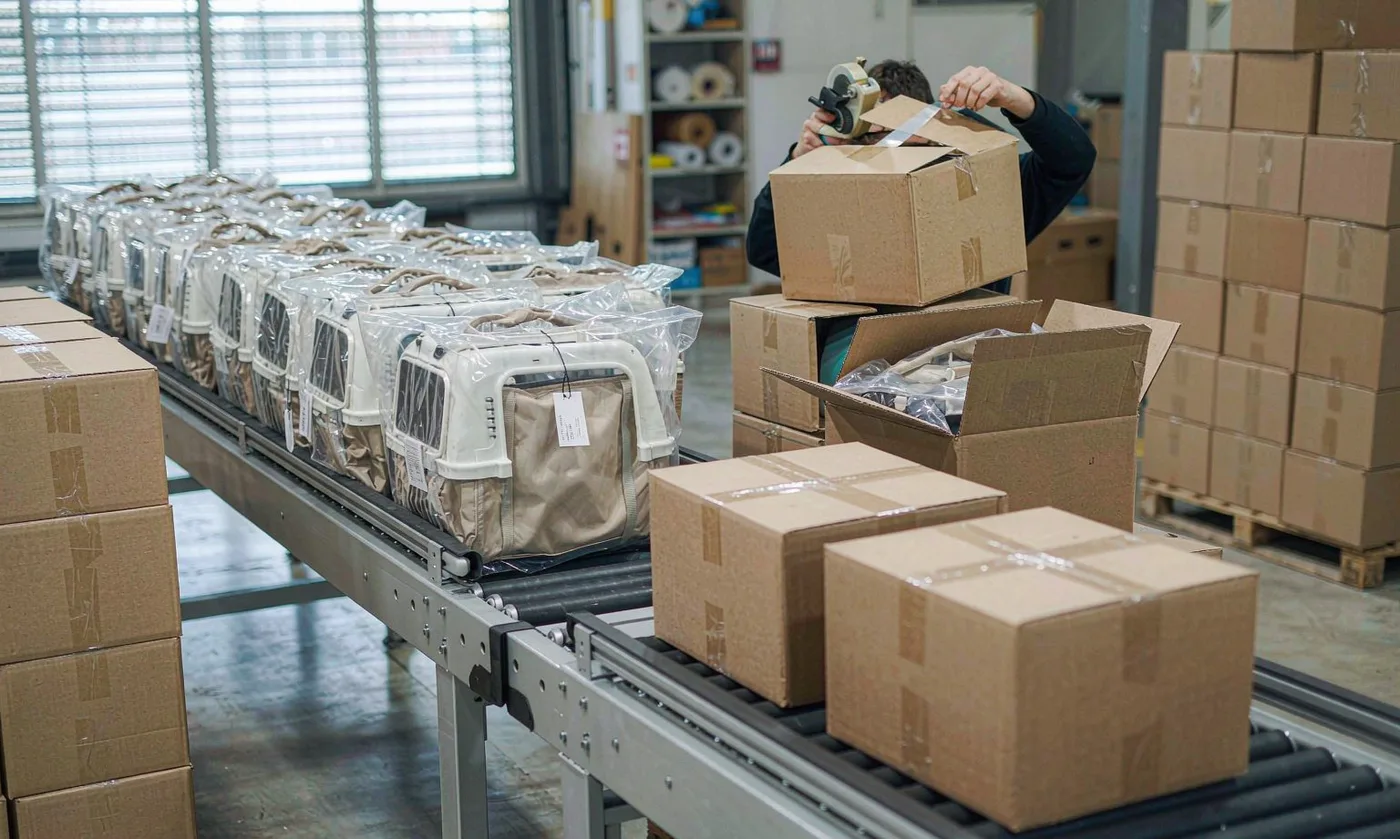
The handover from sampling to bulk is the point where most pet bag sourcing programmes lose time, and they lose it for a reason that has nothing to do with manufacturing. The delay sits with the buying entity: artwork is not final, the colour approval is verbal, the quantity is still under discussion, or the deposit has not been released. Every pet bag manufacturer sees this pattern, and bulk pet bag orders that start late finish late however good the line is. Bulk production 35-50 days is a stable and well-understood allowance; the two to four weeks that appear around it are almost always self-inflicted.
Three artefacts must exist before a production slot is booked. First, a written confirmation sample approval naming the revision number and the date. Second, a purchase order stating quantity per colourway, unit price, Incoterm, payment terms, inspection standard and a shipment window rather than a single date. Third, the deposit, released against the proforma invoice. Our separate note on bulk lead time planning breaks the 35-50 day allowance into component operations for buyers who need to model it week by week. A supplier asked to hold a slot without all three is holding capacity on a promise, and pet bag wholesale suppliers rationally decline or quietly reallocate. Buyers who source pet bags from China on a rolling basis should pre-book slots a season ahead.
Scheduling inside the base is worth understanding, because it explains why promised dates slip in ways that look arbitrary from outside. Cutting, sewing, assembly and packing are sequenced across 7 production lines and 149 machines, and material arrival gates the sequence. A pet bag manufacturer running several programmes at once will re-sequence rather than idle a line, so your slot is only as firm as your materials are early. If a branded zip arrives four days late, the sewing line is re-sequenced and your slot moves, not because anyone decided it should but because a line cannot sew around a missing component. This is why material-leading items — custom hardware, printed webbing, dyed fabric — should be ordered at confirmation rather than at bulk start.
Peak season changes the arithmetic. In this category the predictable crush runs from roughly August to November as northern-hemisphere buyers stock wholesale pet bags for the holiday and winter gifting period, and again from February to April ahead of spring travel demand. A programme approved in September competes for allocated capacity; the same programme approved in June does not. The countermeasure for wholesale pet bags is calendar rather than negotiation: approve earlier than feels necessary, or accept a slot at the long end of the 35-50 day range and plan the on-shelf date from there.
Mid-production visibility is the buyer's remaining control. Reliable pet bag wholesale suppliers will send a weekly written status covering cut quantity, sewn quantity, packed quantity and inline defect rate, with photographs of packed cartons from week two onward. A supplier that can produce those four numbers weekly is running a schedule; one that answers with reassurance is not. Where the numbers diverge from plan — packed quantity tracking below sewn quantity, for example — the cause is almost always a material shortage or an inline quality hold, and both are fixable if surfaced early. Treat that weekly report as the core discipline of pet bag sourcing rather than an optional courtesy.
Change control closes the loop in a pet bag sourcing programme. After confirmation, any change to material, colour, hardware or construction requires written approval from both parties with a stated effect on price and date. That clause protects the buyer against silent substitution and protects the pet bag manufacturer against unrecorded instructions. It also has a useful side effect: the existence of a change-control process discourages casual requests, and casual requests are what break schedules.
Bulk production 35-50 days is rarely the source of a missed season in a pet bag sourcing programme; the delay accumulates in the two to four weeks before the slot is booked, while artwork, colour approval or the deposit remains open.
Inspection, AQL and the Document Pack
Inspection is the last point at which a problem in bulk pet bag orders can be fixed cheaply. After the container is loaded, every defect becomes a write-off or a dispute; before it, most defects are reworkable. The instrument is a random pre-shipment inspection against AQL 2.5, and the discipline is a written defect classification agreed before production starts rather than negotiated at the warehouse.
AQL 2.5 with a general inspection level II sample plan is the default for this category and means, in plain terms, that a shipment is accepted if the number of defects found in a statistically drawn sample falls below a defined threshold. Critical defects — anything that could injure an animal or a person, such as a failed handle attachment or a sharp internal edge — are treated separately and are normally unacceptable at any count. Major defects, such as a non-functioning zip or a visible seam gap, are counted against the 2.5 threshold. Minor defects, such as a loose thread or a light mark, are counted but tolerated at a higher limit.
The classification matters more than the number. Two parties can agree on AQL 2.5 and still disagree about everything, if one counts a misaligned panel as major and the other as minor. Write the classification into the purchase order with photographic examples. Then require the inspector to report against it by category, not as a single pass or fail.
Three inspection moments are worth building into a programme rather than one. A first-piece check at the start of cutting catches pattern and material errors before a thousand units are cut. An inline check at roughly 30 percent completion catches construction drift while it is still correctable. A final random pre-shipment inspection against AQL 2.5 confirms the packed cartons and the packing specification. Programmes that skip to the final check pay for the first two in rework.
| Document | Issued by | Needed for | Timing | Frequent error |
|---|---|---|---|---|
| Commercial invoice | Supplier | Customs valuation, payment | Before vessel cut-off | Quantity or Incoterm inconsistent with the PO |
| Packing list | Supplier | Customs, warehouse receipt | Before vessel cut-off | Carton count and piece count disagree |
| Bill of lading | Carrier or forwarder | Title, release of goods | Within days of sailing | Consignee details incomplete |
| Certificate of origin | Chamber of commerce | Duty treatment, preference claims | Before sailing | HS code not matching the invoice |
| Test reports | Named laboratory | Market compliance file | Held on file, produced on request | Scope does not cover the destination market |
| ISO 9001 certificate | Certification body | Buyer quality file | Annual refresh | Entity name differs from the invoice |
| BSCI audit report | Audit body | Retailer social compliance | Annual refresh | Expired, or site address mismatch |
| Fumigation or wood declaration | Supplier or forwarder | Customs where pallets are wooden | With booking | Wood packaging used without declaration |
| Insurance certificate | Insurer | Cargo claim | At or before shipment | Taken out after the loss event |
| Inspection report | Inspection body | Release decision, claim defence | Before loading | Report issued after the container is sealed |
Documents fail for boring reasons, and boring reasons cost real money. The three that recur: an HS code on the certificate of origin that differs from the one on the invoice, a commercial invoice quantity that disagrees with the packing list, and a consignee field left incomplete on the bill of lading. Each one can hold a container at port for days at a demurrage rate that exceeds the margin on the goods. Assign one person to reconcile the full set against the purchase order before cut-off, and require a single consolidated PDF rather than ten attachments.
The compliance file is a separate artefact from the shipment set and belongs to the brand owner rather than to any single order. It holds the test reports, material certificates, supplier audit reports and the declaration of conformity for each market, and it is what a marketplace or a regulator asks for. Build it once per material family and update it annually, rather than re-testing per SKU; that single decision is the difference between a compliance cost of 2 percent of FOB and 6 percent.
Agree the defect classification in writing before production begins; AQL 2.5 tells you how many defects are acceptable, but only the classification tells you what counts as one.
Container Loading, Freight and Port Arrival
Freight is where a well-run pet bag sourcing programme either protects its margin or quietly surrenders it. The mechanism is cube: pet bags are bulky relative to their weight, so most shipments of wholesale pet bags cube out long before they weigh out, and the unit that matters is cost per piece delivered rather than cost per container. Freight is also the stage where bulk pet bag orders most often surrender margin silently, because nobody rechecks the carton specification once the first container ships.
| Format | Carton configuration | Carton volume (m3) | Pieces per 20GP | Pieces per 40HQ | Notes |
|---|---|---|---|---|---|
| Small cat carrier | 12 per carton | 0.10 | 2,900-3,100 | 6,700-7,200 | Nests well; best cube in the range |
| Medium soft carrier | 10 per carton | 0.12 | 2,000-2,200 | 4,700-5,000 | Typical hero SKU for wholesale pet bags |
| Large dog carrier | 6 per carton | 0.14 | 1,000-1,150 | 2,400-2,600 | Frame panels reduce nesting |
| Backpack-style carrier | 15 per carton | 0.11 | 3,200-3,500 | 7,400-7,900 | Compresses flat; check strap bulk |
| Accessory and add-on items | 20 per carton | 0.08 | 3,900-4,200 | 9,000-9,600 | Used to fill residual cube |
Figures assume roughly 28 cubic metres of usable space in a 20GP and 65 in a 40HQ, at a realistic 88 percent loading efficiency once carton dimensions and stowage losses are accounted for. Actual results depend on the carton specification, which is why the packing specification belongs in the technical pack rather than being left to the packer. A two-centimetre reduction in carton height across a 40HQ is worth several hundred additional pieces, at zero additional freight cost.
Mixed containers are the default for most importers, because a single-SKU order rarely fills a 40HQ at a rational inventory level. Plan the mix by cube rather than by value: allocate space to the hero SKU first at its forecast rate of sale, then fill residual cube with slow movers and accessories. Load heavy cartons low and distribute weight across the container floor; a badly distributed load is a safety issue and, in some markets, a road-leg compliance one. Our note on mixed-size container loading covers the planning sequence in more detail.
Mode selection is a simple trade between cash and time. Sea freight at 25 to 40 days transit is the default for planned replenishment; air freight at 5 to 8 days is a rescue mechanism for a missed launch, and at three to six times the freight cost per piece it should be a decision with a named owner rather than a reflex. A useful rule: if the air freight premium per piece is below the margin lost by a missed listing window, fly it; otherwise, ship it and move the on-shelf date.
Incoterm clarity prevents the most common freight dispute. Buyers who source pet bags from China usually settle on FOB Xiamen, which means the supplier's responsibility ends when the goods are loaded on board at the named port and the buyer carries the ocean leg, insurance, destination charges and customs. Pet bag procurement teams should name the port and the rule version in every contract. Buyers who ask for CIF without specifying the destination port, insurance level and excluded charges discover at arrival that their "delivered" price was not. Whatever term is chosen, name the port, name the version of the rule and state which destination charges are excluded.
At arrival, three things determine whether the goods reach the warehouse on schedule: a complete document set lodged before vessel arrival, an accurate HS classification with duty paid or deferred correctly, and a customs broker who has the file before the vessel berths rather than after. Duty rates on this category vary by destination and by classification, and the applicable schedule should be confirmed against published tariff sources such as WTO tariff and trade information before the landed cost model is finalised. Under-declaring to save duty is not a strategy a pet bag manufacturer will support; it is a deferred liability with interest.
Pet bags cube out before they weigh out, so the metric a pet bag sourcing programme should manage is cost per piece delivered, and the cheapest incremental capacity available is usually a better carton specification.
Reorders, Dye Lot Control and Range Governance
A programme is not complete at delivery; it completes at the second order, where the first one's documentation discipline pays out. Reorders are cheaper and lower-risk than first orders for one reason: the specification, materials and compliance evidence already exist. The risk they introduce is different — consistency across time — and it is governed by dye lot control.
Dye lot variation is the most common complaint in repeat wholesale pet bags programmes. Fabric is dyed in lots and lots vary slightly in shade, so a reorder in a new lot can differ visibly from the original shipment even when every specification is identical. Two adjacent colourways on a shelf that do not match read as a quality problem to a consumer and generate returns that have nothing to do with construction.
The control is procedural. Require the dye lot reference for every bulk fabric purchase to be recorded on the packing list and purchase order, retain a sealed cutting from each lot, and specify a tolerance against the retained standard as a delta E value or a physical comparison under defined lighting. Where a reorder must match goods already in market, supply the retained cutting from the original lot and require a lab dip before bulk dyeing begins.
Range governance is the other half. Every programme needs a quarterly review with four questions: which SKUs carry volume against forecast, which sit below the reorder threshold, which colourways have turned, and what has changed in the supplier scorecard. Volume concentration is healthy — most ranges show 60 to 70 percent of units in two or three SKUs — and the decision is whether to discontinue the tail rather than rescue it.
| Risk | Trigger signal | Countermeasure | Owner |
|---|---|---|---|
| Colour drift between reorders | New dye lot reference on the packing list | Lab dip against retained cutting before bulk dyeing; lot reference recorded | Quality lead |
| Silent material substitution | Fabric hand or weight differs from the retained sample | Change-control clause requiring written approval; inspection against the confirmation sample | Quality lead |
| Production slot slippage | Weekly status shows packed quantity below plan | Escalate at 20 percent variance; pre-book custom hardware at confirmation | Sourcing lead |
| Peak-season capacity squeeze | Quote lead time quoted at the long end; slot date vague | Approve 8-12 weeks earlier; commit across two seasons for allocated capacity | Category manager |
| Compliance scope gap | Destination added after the test scope was fixed | Re-test before the first shipment to the new market; maintain one compliance file per market | Quality lead |
| Document holds at port | HS code or consignee inconsistency across documents | Single-owner reconciliation of the full set before vessel cut-off | Logistics lead |
| Freight cost drift | Cost per piece delivered rising without a rate change | Review carton specification and loading efficiency quarterly | Logistics lead |
| Inventory imbalance after launch | Tail SKUs below 5 percent of units but holding working capital | Quarterly range review with a written discontinuation rule | Category manager |
| Currency movement against the landed model | Spot rate moves beyond the assumption in the brief | Fix the rate assumption in the brief and review at each reorder | Category manager |
Reorder timing should follow a trigger rather than instinct: reorder point equals forecast weekly sales multiplied by total replenishment lead time in weeks, plus safety stock. With a 35-50 day bulk allowance, 25-40 days transit and roughly 15 days of sampling and documentation, total lead time is 13 to 15 weeks, so a SKU selling 200 units a week triggers near 2,900 units on hand. Buyers who reorder at four weeks of cover are permanently expediting.
Finally, keep the relationship measured. Pet bag procurement improves when the scorecard is revisited rather than filed: re-score quarterly against the same weights used at screening and bring the score into the commercial conversation: a supplier at 88 points with a two-season commitment is a different negotiating position from one at 72 with a history of slot slippage. After two or three cycles most programmes find that the cheapest cost reduction is not a re-negotiation but a smaller tail, an earlier approval and a cleaner brief.
Govern the programme quarterly on four questions — volume against forecast, tail performance, colourway turns and supplier score — because a range that is never pruned accumulates cost faster than it accumulates sales.
SGS-verified production base
- SGS-verified production floor of 4,950 m², 149 machines, 7 assembly lines
- 137-person team running wholesale pet bag programmes since 2014
- 200,000 units monthly, audited to BSCI and ISO 9001
People Also Ask
How long does a pet bag sourcing programme take?
Allow 90 to 130 days end to end for a first programme: 5-8 days for the brief, 7-10 for screening, 5-7 for the RFQ, 21-35 for two to three sample rounds at 6-10 working days each, 6-10 for the confirmation sample, 35-50 for bulk, 2-4 for inspection, 4-7 for documents and loading, and 25-40 on the water.
What is a realistic MOQ for wholesale pet bags?
MOQ 500 pieces per colourway is the standard for own-brand pet bag programmes at this specification level. It reflects fabric lot size and line setup rather than an arbitrary policy, and it is why most first ranges run no more than three colourways across four styles.
How many sample rounds should I budget for?
Budget for three: a concept sample, a revised sample in the intended materials, and a confirmation sample built in production fabric. Each runs 6-10 working days plus courier time, and a fourth round usually indicates an incomplete brief rather than a difficult product.
What does AQL 2.5 mean for a bulk pet bag order?
AQL 2.5 sets the defect threshold in a statistically drawn sample at general inspection level II. Critical defects such as a failed handle attachment are unacceptable at any count; major defects such as a failed zip count against the 2.5 limit; minor issues are tolerated at a higher limit. The written defect classification matters more than the number.
Should I buy FOB or CIF for pet bag imports?
FOB with a named port is the clearer option for most importers, because it separates the supplier's responsibility from the freight and insurance you control. If you take CIF, name the destination port, the insurance level and the excluded destination charges in writing, or the delivered price will not be the price you modelled.
How do I compare quotes from different pet bag suppliers?
Normalise them first: same Incoterm and port, same currency, same quantity break, same packing specification and same material bill. Then compare tooling treatment, sample charges and quote validity alongside the unit price, and ask which cost drivers each supplier is willing to itemise.
What causes most delays in pet bag sourcing?
Delays accumulate before the production slot is booked, not during it: open artwork, verbal colour approval, unsettled quantities or a deposit not yet released. Bulk production 35-50 days is stable; the two to four weeks around it are usually self-inflicted.
How often should I re-score my pet bag supplier?
Quarterly, against the same weighted sheet used at screening. Capacity, staffing and certificate status drift, and a supplier scoring 82 in one quarter can be at 68 after a peak-season overload. Bring the current score into every commercial conversation.
Frequently Asked Questions
What is the difference between a sourcing programme and a one-off purchase order?
A purchase order buys goods once; a pet bag sourcing programme establishes the brief, technical pack, scorecard and inspection protocol that let subsequent orders run faster and with less risk. The economics change at roughly 12,000 pieces of annual repeat volume, above which the fixed costs of specification and testing are recovered and reorder lead times shorten substantially.
Who should own each stage inside the buying organisation?
Split four ways: the category manager owns the brief and range architecture, the sourcing lead owns screening and the RFQ, the quality lead owns the technical pack and inspection protocol, and the logistics lead owns booking, documents and customs. Concentrating all four roles in one person causes gates to be skipped because nobody can veto their own shortcut.
What must appear in a technical pack before a supplier can quote accurately?
Eleven elements that any pet bag manufacturer should be able to read without follow-up questions: dimensioned specification with tolerances, materials bill with denier and coating, hardware schedule with finishes, colour standard with lab dip reference, construction notes including stitch density and reinforcement, branding artwork with placement and method, packing specification, labelling specification, compliance scope, inspection standard with defect definitions, and the commercial frame.
Why is the target price expressed as landed cost rather than FOB?
Working backwards from retail through channel margin, duty, freight and handling produces the FOB ceiling that actually matters. A bag retailing at USD 49.99 through a 45 percent distributor margin and a 22 percent duty and freight load carries an FOB ceiling near USD 15.50, well above the figure intuition suggests, and modelling it only at FOB hides the gap until the goods arrive.
How should size bands be planned for a first pet bag range?
Three size bands per format, aligned to published weight bands for cats and small dogs, with one or two hero SKUs carrying 45 to 60 percent of forecast volume. Launching eight styles at once multiplies pattern, tooling, testing and sampling costs while fragmenting the fabric buy and weakening the price.
What compliance documents differ between US and EU destinations?
US shipments of wholesale pet bags typically require CPSC consumer product documentation including tracking labels and applicable lead and phthalate limits, plus Proposition 65 warnings for California. EU shipments require REACH substance compliance plus national packaging and labelling rules. Airline-approved designs additionally need dimension checks against published carrier and aviation guidance.
How is allocated capacity different from total capacity?
Total capacity is the whole output of a base; allocated capacity is the share you will actually receive given other customers' bookings. Always negotiate against the allocated figure and ask how it is prioritised in peak season. A supplier quoting total capacity as though it were yours is describing a queue you have not joined.
What should a confirmation sample approval contain?
A written approval naming the revision number and date, two identical physical pieces retained and sealed by each party, and a reference to those pieces in the purchase order. Sealed retention pieces resolve disputes about shade, stitch density or hardware finish in minutes rather than through extended correspondence.
What is the real cost of a change requested after confirmation?
Not the sample fee but the production slot. Fabric has been booked and cutting scheduled, so the realistic penalty is two to four weeks rather than one sampling cycle. This is why change control requiring written approval from both parties, with stated price and date effects, belongs in every purchase order.
Which cost blocks offer the most headroom in a pet bag quote?
Fabric specification at 28-34 percent of FOB, pattern efficiency, and multi-season volume commitment. Hardware downgrades look attractive at 14-18 percent of FOB but return as field failures, since zip failure is the leading complaint in this category. Test scope optimisation saves 1-2 percent when done per material family rather than per SKU.
How much does quantity really change the unit price?
Moving from 500 to 1,000 pieces per colourway typically shifts unit price by 4-8 percent; 1,000 to 3,000 by a further 3-6 percent. Beyond roughly 5,000 per colourway the curve flattens because material and labour dominate, so chasing very large orders for another 15 percent usually yields around 3 percent plus an inventory problem.
What payments terms are standard, and what do they buy?
T/T 30/70 against an FOB Xiamen base is standard here; the 30 percent deposit books fabric and the production slot, with the 70 percent balance against documents or before shipment as agreed. A larger deposit or earlier balance buys a firmer slot and often a better price, while extended credit is paid for in the unit price.
When should inspection happen during bulk production?
At three points: a first-piece check at the start of cutting to catch pattern and material errors, an inline check around 30 percent completion to catch construction drift, and a final random pre-shipment inspection against AQL 2.5 on packed cartons. Programmes that run only the final check pay for the first two in rework.
What are the most common document errors that hold containers at port?
Three recur: an HS code on the certificate of origin that differs from the invoice, a commercial invoice quantity that disagrees with the packing list, and an incomplete consignee field on the bill of lading. Each can hold a container for days at demurrage exceeding the margin on the goods, so one owner should reconcile the full set before cut-off.
How many pieces of each format fit in a 20GP or 40HQ container?
For wholesale pet bags at roughly 28 cubic metres usable in a 20GP and 65 in a 40HQ, at about 88 percent loading efficiency: approximately 3,000 small cat carriers in a 20GP and 7,000 in a 40HQ; 2,100 medium carriers and 4,850; 1,100 large carriers and 2,500; and 3,350 backpack-style carriers and 7,650. Carton specification moves these figures materially.
When is air freight justified for pet bag shipments?
When the air premium per piece is below the margin lost by missing a listing window. Otherwise sea freight at 25-40 days remains correct and the on-shelf date should move instead. Air freight should always be a decision with a named owner and a written comparison, never a reflex after a planning failure.
How should dye lot variation be controlled across reorders?
Record the dye lot reference on every packing list and purchase order, retain a sealed cutting from each lot, specify a tolerance against the retained standard, and require a lab dip against the original cutting before bulk dyeing when a reorder must match goods already in market. Pet bag wholesale suppliers that keep lot records rarely argue about shade. Critical campaigns can book two seasons of fabric in one lot.
What reorder point should a pet bag programme use?
Reorder point equals forecast weekly sales multiplied by total replenishment lead time plus safety stock, and it is the discipline that keeps bulk pet bag orders off aircraft. With 35-50 days of bulk, 25-40 days transit and roughly 15 days of sampling and documentation, total lead time is 13-15 weeks, so a SKU selling 200 units a week triggers near 2,900 units on hand. Reordering at four weeks of cover means permanently expediting.
Start a wholesale pet bag programme with QUANZHOU JUNYUAN BAGS: MOQ 500 pieces per colourway, samples in 6-10 working days, bulk production in 35-50 days under AQL 2.5 inspection, FOB Xiamen.
Request a quote Ask for a catalogue