Pet Wheeled Bag: Wheels Included Buyer Guide
A pet wheeled bag is a soft or semi-structured shell with a factory-fitted wheel module - fixed, inline or removable - and the wheel assembly typically carries 18-30 percent of the unit cost. Programs start at MOQ 500 pieces per colourway, sample in 6-10 working days per round, and run 35-50 days in bulk after approval.
"Wheels included" sounds like a single specification and it is not: it covers fixed wheels, a removable module and a full chassis, and the three behave completely differently on cost, cube and return rate. Commercial floor is MOQ 500 pieces per colourway, because the wheel set is a purchased assembly with its own supplier minimum. Sample development runs 6-10 working days per round and wheeled builds need two rounds in most programs - one for the shell and one for rolling behaviour under a loaded test. Bulk production is 35-50 days after sample approval and deposit clearance, released only after an AQL 2.5 inspection with a written report. Terms are T/T 30/70, FOB Xiamen, with fabric and trim matched to a signed Pantone reference and approved in a controlled light box. The decision that matters most is whether the wheel module is fixed or removable, because it determines your return profile and your spare-parts strategy simultaneously. Specify wheels by part reference with diameter, durometer, bearing type and rated load, and require a loaded rolling test at pre-production. A wheel that passes a visual check and fails at three kilometres is the single most expensive defect in this category.
Two quotes that look comparable on unit price rarely are: one pet carrier supplier prices the carrier alone while another bundles the pad, the hang tag and the polybag. Split the bill of materials line by line before comparing, and ask each pet bag supplier to state the carton cubage, because that is where the freight difference hides.
Wheel System Taxonomy for Pet Bags
Four wheel architectures appear in the pet bag category and they are routinely confused in listings. Inline wheels are two wheels on a fixed axle at the base, rolled behind the user; they are cheap, stable in a straight line and poor on soft ground. Spinner or caster systems use four swivelling wheels and allow the bag to be pushed upright beside the user; they cost more, use more components and are more prone to debris ingress. A removable module is a wheel plate that clips or bolts onto the shell; it costs the most per unit and it is the only option that lets one shell serve both rolling and carry use. A full chassis is a framed trolley build and belongs in a different cost band entirely.
Choosing among them is a use-case decision that a buyer can make quickly. Inline wheels suit pavement, stations and airport concourses - hard, flat, predictable surfaces. Spinner systems suit retail floors and indoor environments where the user wants the bag beside them. Removable modules suit customers who will carry the bag part of the time and want the wheel weight gone for the rest. Full chassis suits heavy pets and long distances.
The cost ladder runs in that order as well. Inline is the cheapest wheel solution, spinners add roughly 25-40 percent on the wheel line, a removable module adds tooling and hardware on top, and a full chassis roughly doubles the wheel and frame cost. Buyers should map the wheel architecture to the price band first and then design the shell, not the other way around, because the wheel decision is the one that cannot be changed late in the program.
One caution on claims: "wheels included" says nothing about durability. Two listings can both state wheels included while one carries 50 mm plastic wheels with plain bearings and the other carries 70 mm sealed-bearing wheels rated for four times the load. The specification sheet is where the difference lives, and it should be published in wholesale sell sheets even when it is not on the retail package.
Specifying Wheels: Durometer, Bearing, Housing and Axle
A wheel specification has four independent variables and all four belong on the brief. Diameter sets obstacle clearance and rolling efficiency: 50 mm is an indoor wheel, 65 mm handles pavement cracks, 75 mm and above handles kerbs and gravel. Durometer sets ride and wear: softer compounds in the 70-80A range roll quietly and grip well but wear faster; harder compounds above 85A last longer but transmit vibration and can mark some floor finishes. Most pet bag programs land in the 80-85A band as a compromise.
Bearing type determines service life more than any other single variable, and it is the variable most often silently downgraded. A plain bore wheel works for a season of light use and then develops play and noise. A sealed ball bearing resists hair, sand and moisture and survives several seasons. The cost difference per wheel is small relative to the return cost it prevents, which is why sealed bearings should be the default specification for any program above the entry price band.
Housing and axle are where load actually goes. The housing should be specified by material and by wall section, with a rated load per wheel that accounts for dynamic rather than static loading. A 12 kg pet on a two-wheel inline set with the bag's own weight produces a static load well under the rated figure, but a kerb strike multiplies it briefly. Ask for a dynamic rating and, if the supplier cannot provide one, treat that as a signal about the component.
Axle retention is the last specification and the most commonly omitted. State whether the axle is riveted, bolted or captured in a moulded housing, and how it is retained under lateral load. Wheels that eject from their housing under a sideways load are a safety issue as much as a quality one, and the failure appears in the field rather than in the sample room.
| Option | Typical wheel spec | Best surface | Cost index | Return risk |
|---|---|---|---|---|
| Inline fixed | 2 x 65 mm, 82A, sealed | Pavement, stations | 100 | Low |
| Spinner set | 4 x 50 mm, 85A, swivel | Indoor retail floors | 125-140 | Medium |
| Removable module | 2 x 70 mm, 80A, bolted plate | Mixed carry and roll | 150-175 | Medium |
| Full chassis | 2 x 75 mm, 85A, framed | Long distance, heavy pets | 190-215 | Low with spares |
Removable Versus Fixed Wheel Modules: Cost and Return Trade-off
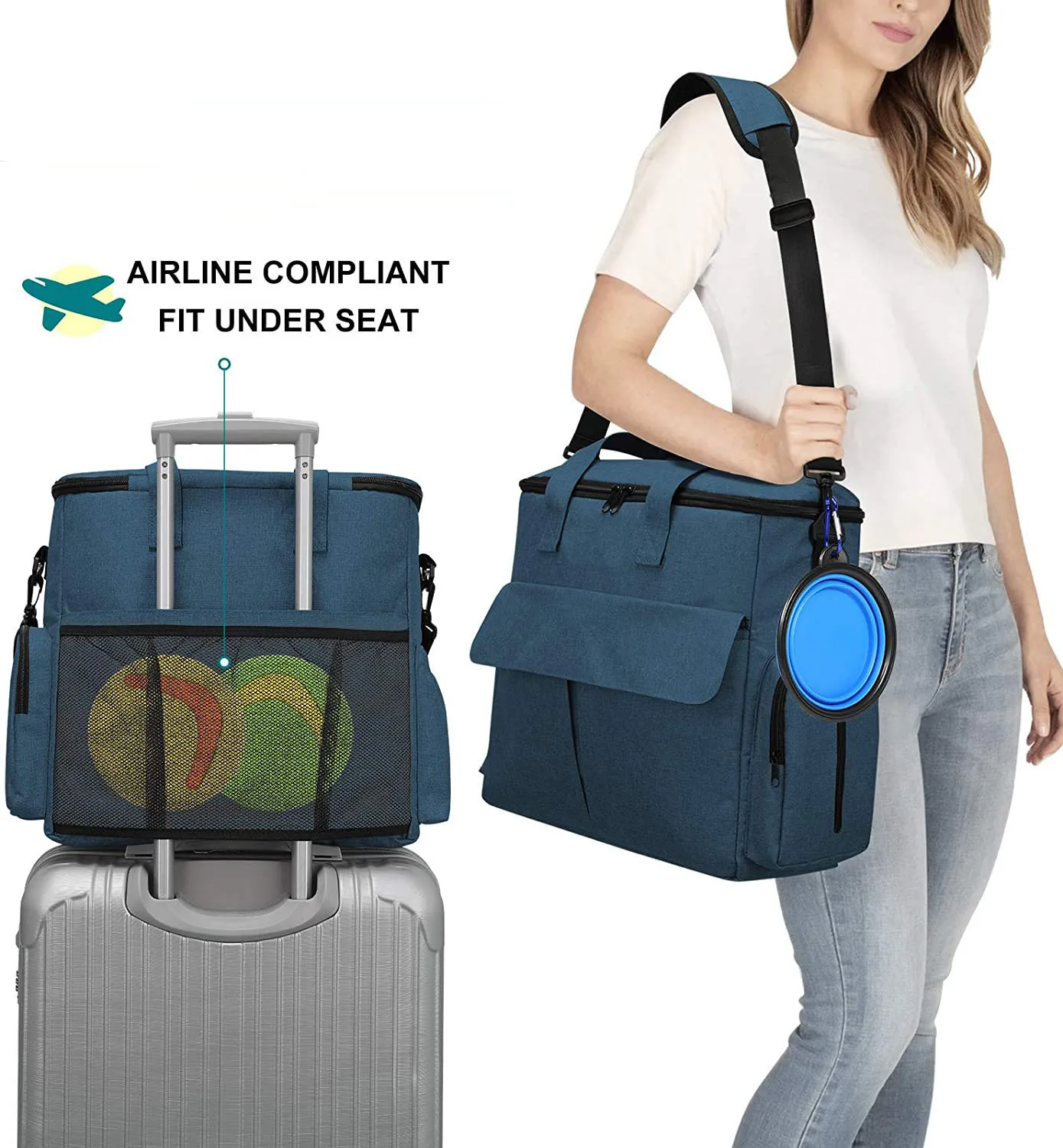
The removable-versus-fixed decision is the most consequential one in a wheeled pet bag program, and it is usually made for the wrong reason. Buyers choose removable modules because the feature is easy to market; they should choose them because the product genuinely needs to be carried part of the time. A module that is fitted once and never removed is pure cost and pure weight with no benefit to the customer.
Fixed wheels are cheaper, lighter and structurally better. Because the load path is permanent, the reinforcement can be engineered once and the failure modes are fewer. They also pack better, since the wheel protrusion is designed into the shell rather than added to it. The cost is that the bag is always a rolling bag - heavier than a soft equivalent and awkward to carry on a shoulder for long periods.
Removable modules add a plate, a retention mechanism, a reinforcement panel and a set of operations, which typically adds 50-75 percent on the wheel line and 200-400 grams to the product. In exchange they give the customer a bag that can be carried cleanly and a product that can be repaired by replacing the module. Programs that plan a spare-module accessory usually find the economics improve, because the module becomes a revenue line rather than a warranty cost.
The retention mechanism is the thing to test, not the wheel. A module that detaches under load is a safety failure and a reputation failure at the same time. Specify the engagement force, the number of engagement points and a retention test under rated load with a stated safety factor, and require a cycle test of the engagement mechanism at pre-production. Photograph the test and attach it to the approval sheet.
Weight Penalty and How to Manage It
A wheeled pet bag carries a weight penalty of roughly 0.6-1.4 kg over its soft equivalent. Publish the empty weight, and offset the penalty where you can - alloy or polymer components instead of steel, a lighter base board, and trim specified by rating rather than by appearance.
Testing Protocol: Rolling Distance, Drop and Debris
Wheel testing should answer three questions and it can be answered on the bench at the production base rather than in a laboratory. How far does the wheel roll before it degrades? What happens when the loaded bag is dropped? And what happens when hair, sand and moisture reach the bearing? Each has a simple protocol and each catches a defect that a visual inspection misses entirely.
Rolling distance testing runs a loaded bag - loaded to the stated maximum pet weight with ballast, not empty - over a stated distance on a stated surface, with inspection at intervals. The inspection looks for flat spotting, housing cracking, noise and bearing play. Several kilometres of equivalent running is a reasonable target for a product expected to last more than one season, and the result should be recorded with photographs rather than as a pass/fail sentence.
Drop testing covers the kerb-strike and mishandling case. A loaded bag dropped from a stated height onto a corner, repeated a stated number of times, reveals whether the housing, the axle retention and the base reinforcement survive real use. This is the test that separates a wheel rated for the load from a wheel that merely looks adequate, and it is the cheapest of the three to run.
Debris testing is the one most programs skip and it is the one that matches real conditions best. Pet hair, sand and moisture are present in every use environment, and a bearing that is not sealed will degrade quickly once they enter. Run a contaminated rolling cycle and inspect, or specify sealed bearings and require the supplier's ingress rating in writing.
Where a claim needs to be defensible to a retailer or a marketplace, anchor it in a recognised method rather than an internal one. ASTM standards cover relevant material and product test methods, and a pre-production report from an independent body such as SGS carries weight in a compliance review that an internal bench note does not.
How to Read a Wheel Specification Sheet
Check four fields before accepting a wheel reference: the rated load per wheel, the durometer, the bearing description and the housing material. A sheet that lists diameter only is not a specification, and the absence of a rated load usually means the component was selected by appearance rather than by duty.
Costing the Wheel Module and Its Effect on Unit Price
In a wheeled pet bag, the wheel module typically carries 18-30 percent of the bill of materials, and it is simultaneously the least negotiable line and the most sensitive to volume. The reason is structural: the module is bought from a component supplier in tiers, and the tiers are steep. A program at 500 pieces per colourway sits at the bottom of the tier structure; moving to 1,500 units typically improves the wheel line more than any other single change to the order.
That reality should shape how a buyer approaches the quote. Rather than negotiating the finished unit price, ask for the wheel line priced at three volumes - 500, 1,000 and 1,500 units - and then decide whether consolidating colourways to reach the next tier is worth more than the colourway variety. In most first-season programs it is, because the colourway can be added in the second season once volume is proven.
Specification changes move the line as well, and some are nearly free. Changing from a plain bore to a sealed bearing adds a small amount per wheel and removes a large expected warranty cost. Changing diameter from 50 mm to 65 mm adds material cost and materially improves rolling behaviour on pavement. Changing from a custom housing to a standard supplier housing removes tooling entirely. Ask for all three priced as options rather than accepting one configuration.
The landed-cost view is what matters. A wheeled bag carries a higher carton cube than a soft bag, so the freight allocation per unit rises alongside the component cost. Model both, and model them per carton rather than per unit, before fixing a retail price - this is where wheeled programs lose margin without any single line looking wrong.
Sampling and Validation Timeline for Wheeled Programs
Wheeled programs need two sample rounds in almost every case, and the rounds must test different things or the second round is wasted. Round one validates the shell: silhouette, capacity, reinforcement placement, strap geometry and whether the wheel protrusion wrecks the packability of the bag. Round two validates rolling: loaded rolling behaviour, handle or pull-strap feel, noise, and whether the bag stays stable when set down and when rolled over a threshold.
Each round runs 6-10 working days plus freight and evaluation, so four to six weeks of development is realistic. The component decision must be made in round one, because wheel and housing procurement overlaps the sampling window and a change in round two restarts the clock on the longest-lead item in the program.
Ballast is the detail that separates a useful round two from a pleasant one. A bag rolled empty feels fine almost regardless of specification; a bag rolled with 12 kg of ballast exposes deflection, noise, wander and bearing weakness immediately. Insist that the factory's internal rolling test uses ballast at the stated maximum pet weight, and ask for video rather than photographs.
Bulk runs 35-50 days after sample approval and deposit clearance, and release is conditional on an AQL 2.5 inspection with a written report. For wheeled builds the plan must add a rolling check, an axle-retention check and a completeness check, because these defects are invisible in a static inspection and inevitable in a batch of 500 units if the process is not controlled.
Compliance and Documentation for Wheeled Categories
A wheeled pet bag attracts more documentation scrutiny than a soft one, mainly because it has more materials and more claimed performance. The file should cover the shell fabric and coating, the trim, the wheel compounds, any metal components and the packaging, each with a test report naming the material and dated within the last twelve months.
For the United States, general consumer product obligations run through the U.S. Consumer Product Safety Commission, and children's-product requirements attach if the item is marketed toward children or styled as a children's article. For Europe, restricted substances fall under REACH with the European Chemicals Agency as the reference; wheel compounds and coatings are the items most likely to need specific evidence, because they are polymer formulations rather than commodity textiles.
Every performance claim needs a matching record. Maximum pet weight needs a load test; wheel diameter needs a dimensional check; sealed bearings need a supplier specification with an ingress rating; a removable module needs an engagement-force and cycle result. Build a one-page claim-to-evidence map at pre-production and keep it with the sample approval form, because marketplace challenges arrive without warning and are answered in hours or not at all.
Where the destination is California, review the Proposition 65 requirements before artwork is finalised, since required warnings cannot be added after printing. Country of origin, fibre content and care instructions follow the destination's labelling format and should be approved in the same review cycle as the warnings.
Assortment Planning for Wheeled Lines
A wheeled line is more expensive to extend than a soft line, because every variant potentially changes the wheel specification, the base reinforcement and the carton. That makes assortment discipline more valuable here than in any other pet bag format: the number of variants a program carries determines how much of its budget goes into engineering and how much goes into inventory.
The practical structure for a first season is one wheel architecture across two sizes or two colourways. Standardising the wheel architecture means one specification, one test plan, one spare-parts stock and one set of component purchasing tiers, and it lets the program concentrate volume where volume matters most. Programs that launch two different wheel architectures in the same season pay for two engineering cycles and dilute the volume that would have improved the component price.
Choosing between a second size and a second colourway should follow the channel. In e-commerce, a second size usually outperforms a second colourway, because search and filtering handle size and customers arrive with a pet of a known weight. In physical retail, a second colourway usually outperforms, because the fixture shows colour and the customer cannot filter by size. Match the extension to the channel's behaviour rather than to a rule of thumb.
Plan the spare-parts stock as a line item in the first order rather than as a response to complaints. A common allowance is two to five percent of unit volume in wheels, bearings, axles and - for modular systems - complete replacement plates. Held at the destination warehouse, that stock turns a warranty replacement into a same-week part shipment and protects the margin on the whole program.
Channel Requirements and Spare-Parts Strategy
Wheeled pet bags sell through channels where the customer has a long walk and a hard surface: transport hubs, travel retail, large-format pet chains and the upper band of e-commerce. They underperform in convenience formats, where the price band cannot absorb the component cost, and in channels where the shopper cannot test the roll before buying - which makes the listing content unusually important.
Because the customer cannot roll the bag online, the listing has to do it for them. Publish the wheel diameter, the maximum pet weight, the empty weight and the exterior dimensions including wheels, and include a short rolling video in the image set. Listings that publish those four numbers have measurably fewer mismatch returns than listings that publish capacity alone.
Spare parts should be planned at the first order, not after the first complaint. Two to five percent of unit volume in wheels, bearings and - for removable modules - complete replacement plates converts a category-typical warranty replacement into a low-cost part shipment. Decide at design stage whether the wheel is field-replaceable with a common tool, because that choice cannot be made later.
Assortment discipline matters here too. Where the line already carries a trolley rolling bag and a suitcase-style pet luggage build, keep the wheeled bag clearly positioned as the lighter, softer alternative and differentiate on published weight rather than on appearance, because at the fixture the three look similar and customers will otherwise trade down to the cheapest.
The same logic applies to the listing. Where three wheeled formats share a category page, publish the wheel diameter, the empty weight and the maximum pet weight for each, because those are the numbers that make the differences real to a customer who cannot roll the product before buying. Without them the page reads as three versions of the same item and price becomes the only differentiator.
Production capability
- SGS-verified production space of 4,950 m², 149 machines, 7 assembly lines
- Pet bag output since 2014 from a 137-person team
- 200,000 units shipped monthly under BSCI and ISO 9001 systems
People Also Ask
How long should a wheel on a pet bag last?
Long enough to survive several kilometres of loaded rolling on the target surface. Specify a tested rolling distance with inspection intervals rather than accepting a visual check.
Are four wheels better than two on a pet bag?
Four swivelling wheels suit indoor floors and push-along use; two inline wheels suit pavement and straight-line travel. Surface decides, not wheel count.
Can wheels be replaced after purchase?
They can if the design allows it. Decide at design stage whether the wheel or module is field-replaceable with a common tool, and stock spares from the first order.
Why do wheeled pet bags develop noise over time?
Usually bearing contamination from hair, sand and moisture, or flat spotting from a durometer that is too soft for the load and surface.
Does a wheeled bag ship at a higher freight cost?
Yes. The wheel protrusion raises carton cube, so freight allocation per unit rises alongside the component cost and should be modelled per carton.
Should I offer a spare wheel module as an accessory?
Yes for removable-module programs. It turns a warranty cost into a revenue line and gives the customer a reason to stay with the brand.
Frequently Asked Questions
What does wheels included actually specify?
Very little by itself. The specification that matters is wheel diameter, durometer, bearing type, housing material, rated load and whether the module is fixed or removable - all of which should appear on the brief.
What is the MOQ for a wheeled pet bag program?
500 pieces per colourway. The wheel set is a purchased assembly with its own supplier minimum, which sets the floor for the whole program.
How long does sampling take?
6-10 working days per round, and wheeled builds need two rounds: one for the shell and one for loaded rolling behaviour.
What is the bulk production lead time?
35-50 days after sample approval and deposit clearance, with freight additional. Component procurement overlaps sampling, so late wheel changes push the whole program.
Which inspection standard applies?
AQL 2.5 with a written report, extended with a rolling check, an axle-retention check and a completeness check for any removable module.
How much does the wheel module add to unit cost?
Typically 18-30 percent of the bill of materials, and it is the line most sensitive to volume - the step from 500 to 1,500 units moves it more than negotiation does.
Should I specify sealed bearings?
Yes for any program above the entry price band. The per-wheel cost is small compared with the warranty cost of bearings degraded by hair, sand and moisture.
What wheel diameter should I choose?
50 mm is an indoor wheel, 65 mm handles pavement, 75 mm and above handles kerbs and gravel. Choose by the surface your customer actually encounters.
Is a removable wheel module worth the extra cost?
Only if the bag is genuinely carried part of the time. A module that is fitted once and never removed is cost and weight with no customer benefit.
What payment and shipping terms are standard?
T/T 30/70 - 30 percent deposit, 70 percent before shipment - on FOB Xiamen. Alternative Incoterms can be quoted but change the landed cost model.
Do wheel compounds need separate compliance evidence?
Usually yes, because they are polymer formulations rather than commodity textiles. Keep a current test report naming the compound for both the US and EU markets.
How do I reduce returns on wheeled pet bags?
Publish wheel diameter, maximum pet weight, empty weight and exterior dimensions including wheels, add a short rolling video to the listing, and stock spare wheels from the first order.
Talk to QUANZHOU JUNYUAN BAGS about a wholesale pet bag order: MOQ 500 pieces per colourway, samples in 6-10 working days, bulk production in 35-50 days under AQL 2.5 inspection.
Get a free quote Request a sample